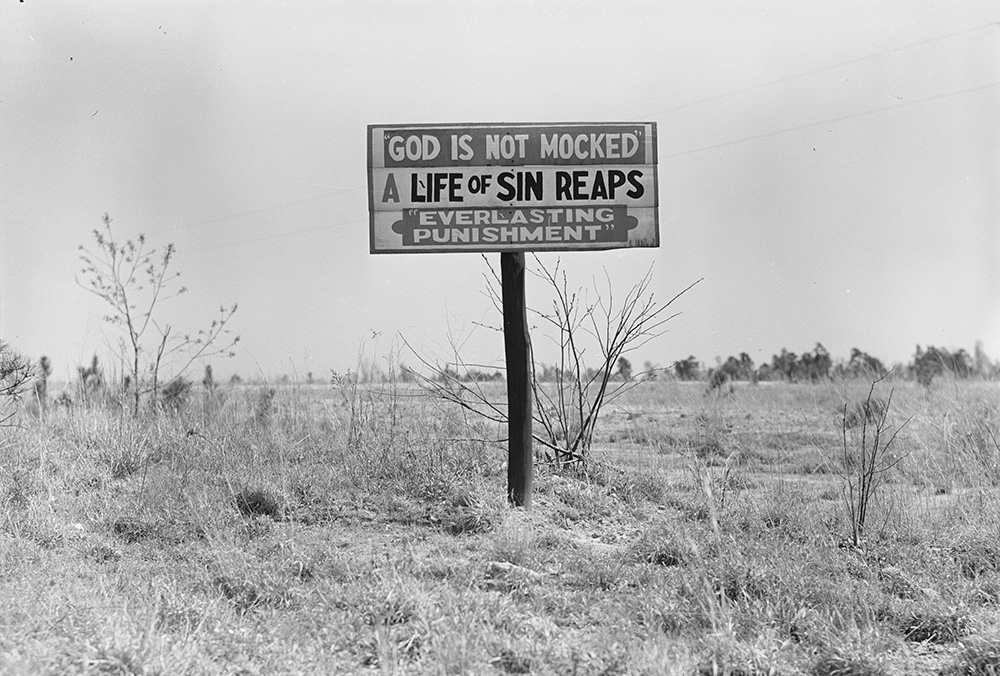
Religious sign along a highway in Georgia, 1939 (Library of Congress/Marion Post Wolcott)

by Sr. Mary M. McGlone
Join the Conversation
Send your thoughts to Letters to the Editor. Learn more
When I drive through Kansas on Interstate 70, I pass numerous signs reminding travelers that Judgment Day is coming and we're all headed directly and eternally to heaven or hell. We'd better get ready for God's terrible judgment! I find it amusing that not too far from these signs one sees advertisements for "adult" entertainment.
We call today's celebration "The Solemnity of Our Lord Jesus Christ, King of the Universe." Our famous selection from Matthew 25 could lead us to believe that our king is first and foremost an exacting judge. Our other readings offer far gentler and attractive images.
How can we combine the vision of the judge of Matthew 25 with Ezekiel's image of the God as shepherd or Paul's depiction of the risen Christ who has conquered death and draws absolutely everyone to God the Father? It seems that the parables that precede today's story might help us interpret it.
Much of what we've heard in these later chapters of Matthew's Gospel depicts the Judgment Day. One of the ideas common to all of them is the characters' freedom to fashion their own lives and destiny. Some snub the invitation to dine in joy with the king and the tired, poor, huddled masses who share his banquet table. Some give their all to be ready for the bridegroom; others hadn't counted on such a significant cost. Some learn to risk everything to follow the master, others think primarily about keeping themselves safe.
Ezekiel presents us with the image of a tender God for whom it's impossible to stand by when leaders fail to care for their people. This is the God of Moses who said, "I have heard my people's cry, I know well what they are suffering, therefore I have come down to rescue them." Ezekiel's Divine Shepherd is wholly dedicated to the well-being of the sheep.
In his First Letter to the Corinthians, Paul tells us that Christ will bring everyone to life. After reminding the community that they truly are the body of Christ, Paul describes the effects of Christ's resurrection: Those who live in Christ live in the risen Christ; they share his life, his love and his relationship with the Father and Spirit.
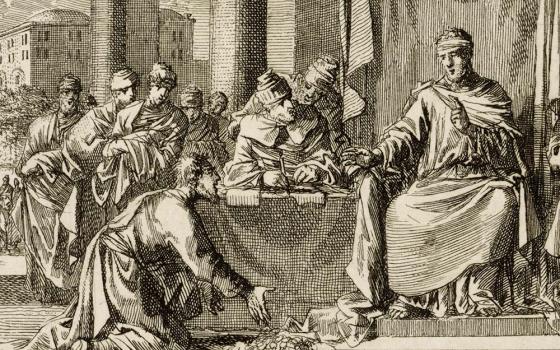
With those readings as our background, we can look again at Matthew's depiction of the day of Christ's appearance in glory. On that day, all nations, the whole world, will be gathered together. Then Christ will surprise them all by dividing them, not by nationality, religion or gender, but as what Matthew depicts as the sheep and goats.
The sheep group is composed of humble people who have lived as members of the body of Christ, people who loved God and saw every part of creation as the beloved of God and parts of their own body. These people, with or without their own knowledge, made Christ's love present by the way they spent their lives.
Advertisement
The people chosen to inherit the kingdom God has prepared may be surprised by Christ's explanation that they served God in every act of serving, reverencing and loving others. Surprised or not, Christ invites them to live forever in a realm they have helped build throughout their lives. The life they will know in the future is one they have already accepted. They already belong to God's realm. They have tasted and loved it. They have given their all in whatever ways they could for the good of others.
Then the judge explains to the ones on the left side how it happened that they were directed there. Without knowing it, they had spent their lives creating their own place of desolation. Every time they neglected to care about the needy, sick, hungry or prisoner, whenever they refused to recognize others as fellow human beings to whom they owed all the respect and love they expected for themselves, they built up the realm in which they would spend their future.
The risen Christ explained that they had chosen their predicament. Through their attitudes and behavior, they had allowed themselves to become people who could never be happy in God's realm, which recognizes no distinction between those who had been poor, beggars or lepers and those who had status, degrees, wealth or power. That realm would be repugnant to them.
I wonder what would happen if, instead of ads for "adult" activities or even images of Judgment Day, there were signs on the highway asking, "Are you becoming the person you truly want to be?" or "Whose world have you made brighter or lighter today?" or "What kind of world are you building these days?" Those signs would make me smile. They would also give me something to think about as I cross the wide prairie.
Maybe we ourselves should be those signs.