(Unsplash/Olivia Snow)

by Annie McAuliffe
Join the Conversation
Send your thoughts to Letters to the Editor. Learn more
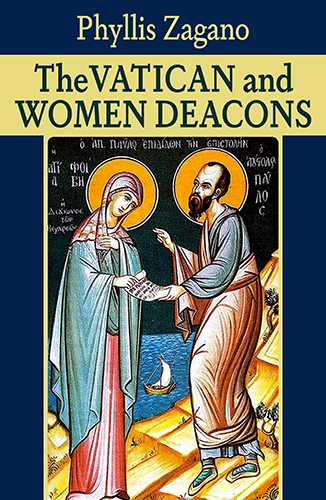
In The Vatican and Women Deacons, Phyllis Zagano provides an account of the Vatican's engagement with the issue since the restoration of the permanent diaconate in 1967 and makes the case that the primary barrier to ordaining women deacons today is not theological, but cultural.
Scholarship confirming the sacramental ordination of women deacons in the early church stretches back to the 17th century and has been consistently developed since that time.
"It is the Church, not Jesus, which has established this ministry of service," therefore the church retains the authority to ordain any qualified minister to it, Zagano writes. The question that matters now is "not whether women can be ordained as deacons, but whether they should be so ordained."
Zagano scrupulously documents the Vatican's 50-year pattern of continuously and without transparency bouncing the matter between internal commissions, some lacking actual experts on the diaconate, despite repeated calls for women's diaconal ministry from globally diverse bodies of the faithful. With such recordkeeping, Zagano lends considerable weight to a point she makes frequently in public appearances: "They can't say no, they just don't want to say yes."
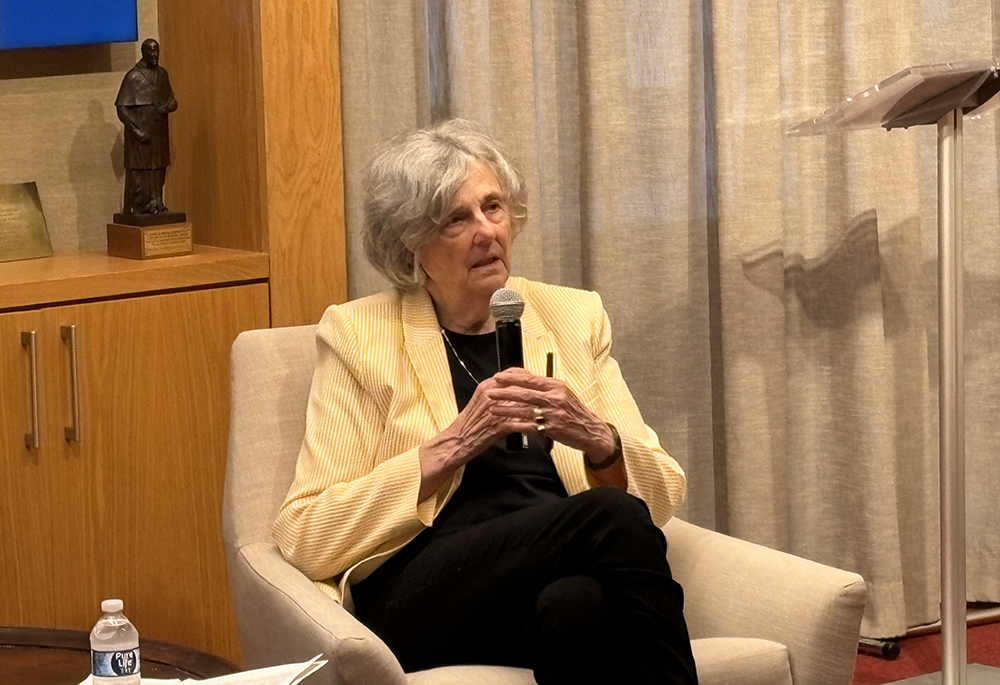
Phyllis Zagano, professor at Hofstra University, author and scholar of religious studies, presents her new book The Vatican and Women Deacons at the America Media headquarters in New York, May 20, 2026. (NCR photo/Camillo Barone)
Zagano does not present the commissioners as a monolith; some, she alleges, attempted to derail the maturation of the question for ideological reasons. A subcommission of the International Theological Commission, or ITC, produced a document that was "printed, numbered, and voted on," which Zagano believes took a favorable position on women deacons. But then-prefect of the International Theological Commission, Cardinal Joseph Ratzinger, "refused to promulgate it."
Other commissioners, she indicates, were simply not ready to say yes.
For Catholics like me who came of age in the Pope Francis era, that distinction may elicit a particular bitterness. I have to wonder: Had I and my all-girls Catholic high school peers seen a woman preaching the Gospel at Mass or presiding at baptisms and marriages, what impact might it have had on the formation of our faith? We will never know. Because, in Zagano's telling, members of Vatican commissions from the 1970s through the early 2000s were just personally not ready for that.
The book's coverage of more recent commissions delivers a sobering reality check to those hopeful that progress might be imminent. In a May 2016 meeting between Pope Francis and the International Union of Superiors General (UISG), one sister asked the question, "What prevents the Church from including women among permanent deacons, as was the case in the primitive Church? Why not constitute an official commission to study the matter?"
Zagano characterizes Pope Francis' answer as "the common recollections of nonspecialists."
He repeated what he had been taught long ago: that women in the early church served as deacons whose ordination status was unclear and whose primary role was to baptize other women, as well as serve as a go-between for women and their bishops. Nevertheless, he agreed with the need to study the matter further and set up a commission: the one Zagano herself served on between 2016 and 2018.
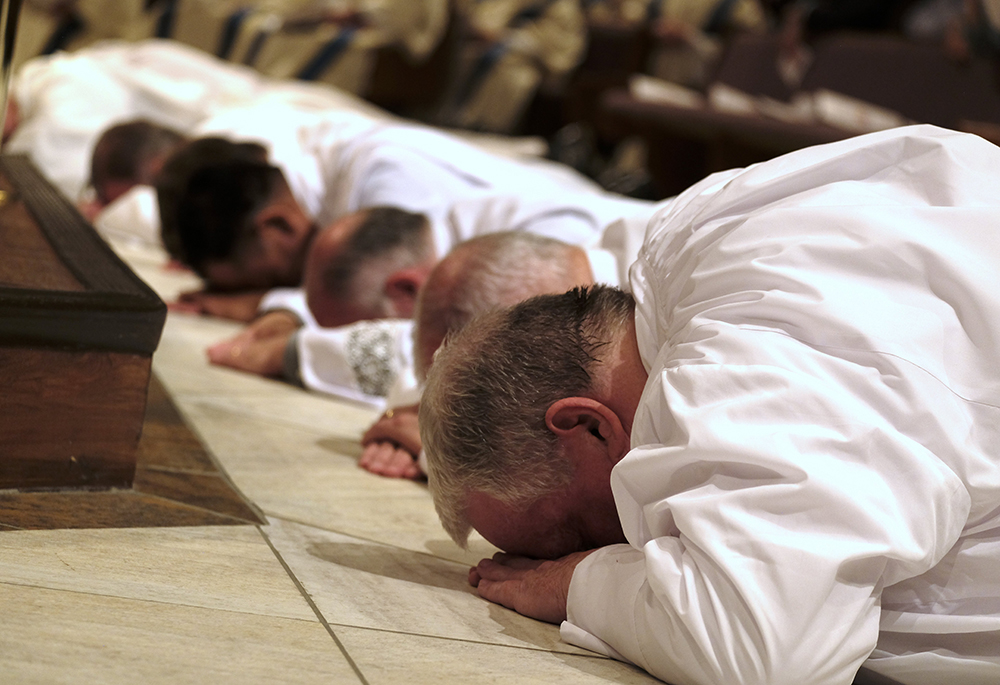
Men lie prostrate during their ordination to the diaconate at the Catholic Pastoral Center in Nashville, Tennessee, April 1, 2023. (OSV News/Tennessee Register/Katie Peterson)
Readers are likely to feel puzzled by Francis' reaction to the findings of his commission.
At the commission's final luncheon in June 2018, "Pope Francis approached the table and informally thanked the commissioners… The pope also asked who the first deaconess would be. The commissioners pointed to Zagano." Yet when meeting again with the International Union of Superiors General little more than a year later, Pope Francis "handed the UISG president 'the little that everyone agreed on' " and used an Italian expression referring to the commissioners as "all different, all toads from different wells," refusing to draw any firm conclusion.
In a webinar hosted by Discerning Deacons in July, Zagano said, "I didn't know what he was talking about, and I still don't."
A second commission was convened in 2020, and its negative findings made headlines in December 2025. In her investigation of the work of this 2020 commission, Zagano found that, once again, some commissioners drew conclusions based on limited understandings of history and the diaconate. The fact that no meetings took place with every original member present, due to a series of illnesses, is also eyebrow-raising.
Advertisement
Opponents of a female diaconate have seized upon the negative report of that second commission to play the same trick they have been playing for decades: Create the false impression that definitive magisterial teaching against ordaining women to the diaconate exists, then use that impression to shut down further discussion.
As far as the objection of the "unicity of orders," Zagano responds with current magisterial teaching affirming the sacramental nature of diaconal ordination and separating diaconal ministry as wholly distinct from that of the priesthood and episcopacy. This separation is likely to be the most disappointing aspect of the text for Catholics whose aspirations for women include the priesthood. Zagano argues that even at the Vatican's highest levels, significant theological confusion has led to the diaconate being yoked to the priesthood in unhelpful ways. In her analysis, this confusion of the two ministries has prevented progress in discussion of women's vocations.
Zagano nevertheless offers a way forward, one grounded in observation about how the church calls forth women's gifts, sound knowledge of church teaching and firm trust in the workings of the Holy Spirit. She offers as a solution the principle of subsidiarity: Entrust local leaders with the power to make the decisions that most directly impact their communities. Subsidiarity could allow bishops in dioceses that need and desire women deacons to proceed with ordaining them; the dioceses which do not would not be required to.
As for the future of women deacons? Zagano concludes, "The most likely scenario is that the current pope, or the next pope, will present a motu proprio … granting permission for bishops to ordain women as deacons" — and reminds us that what comes from the Holy Spirit cannot be stopped.