

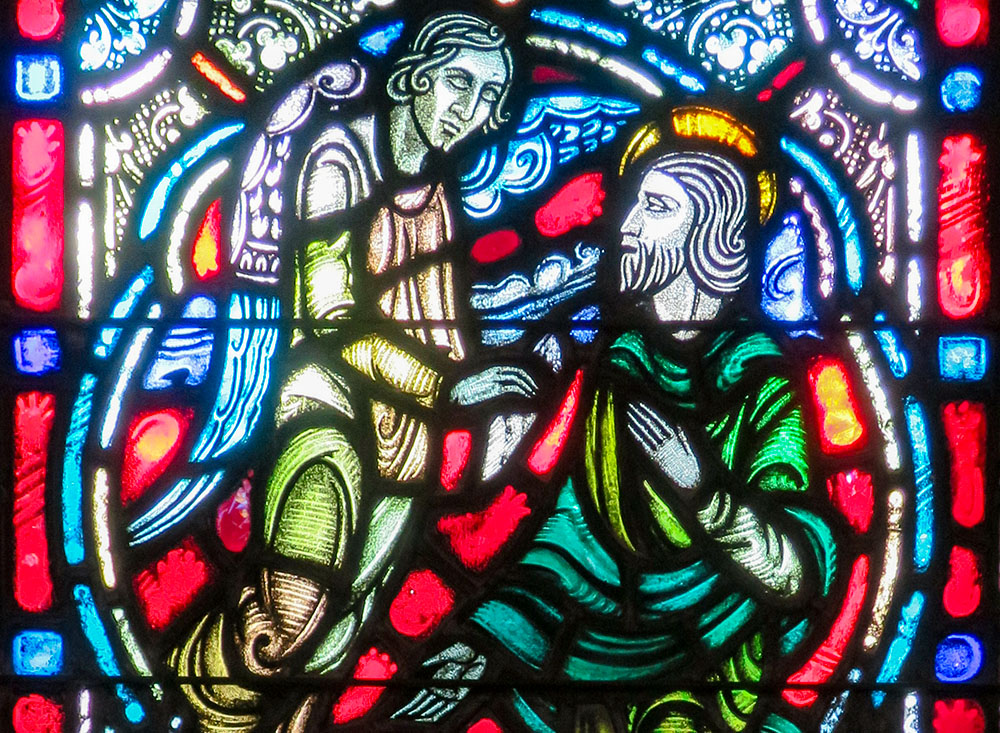
An angel appears to St. Joseph in a dream, depicted in stained glass at St. Mary's Catholic Church in Rome, Georgia. (Wikimedia Commons/Nheyob)

by Sr. Mary M. McGlone
Join the Conversation
Send your thoughts to Letters to the Editor. Learn more
Ahaz was one of the cruelest kings Israel ever knew; he even offered his own son as a burnt offering to the god Moloch (2 Kings 16:3). Isaiah went to King Ahaz with words of warning. As the true king of Israel, God swore to protect the people, and told Ahaz to ask for a sign to prove it. Pretending piety, Ahaz refused to ask for a sign; he preferred to rely on his allies rather than to trust God's providence.
Ignoring the mutinous king, Isaiah told him of the birth of an emmanuel-child who would be the sign that God remained with the people.
What irony! Matthew picked the prophecy to Ahaz, the child killer, to interpret the birth of Jesus, the Son of God who would conquer evil and death. Not only that, but the grand sign for Ahaz was the most unremarkable thing in the world: the birth of a child.
Isaiah's story has God's fingerprints all over it. Responding to a proud and conniving ruler who depended only on political alliances, God worked through a simple young woman whose vulnerable child possessed the power to undermine well-armed, determined bullies. The message? God dwells with people through their very own. God overcomes the haughty through the humble.
Matthew reinterprets Isaiah's prophecy, applying it to the coming of Jesus, the Emmanuel. From there, Matthew's story continues with details that demonstrate God's mysterious ways. While Luke portrays the Nativity through the lens of Mary and Jesus' blood relatives, Matthew chooses to underline Joseph and God's distinctive role in all that happened.
As he weaves his narrative, Matthew states quite simply that Mary was "found with child through the Holy Spirit." Could he have been any more low-key in announcing the Incarnation? Just seven words? Yet, those words coincide with Isaiah's announcement about Emmanuel. They introduce us to Joseph's simple willingness to encounter a new reality and change his life in the light of it.
Matthew's portrayal of Joseph reveals what is often entailed in collaborating with God. Joseph, like Mary, had to be willing to give up everything for the sake of God's mysterious plan. "Everything" included his place of residence, his family and his reputation — all those things by which we tend to identify ourselves.
When Paul wrote the greeting in his Letter to the Romans, like Matthew he described the mystery of the Incarnation in deceptively simple terms. Paul portrayed Jesus as "descended from David according to the flesh, established as Son of God in power according to the Spirit of holiness." These phrases proclaim two profound truths. First, Emmanuel is flesh of our flesh, a participant in God's creation like everything else that has ever been or will be on Earth.
Paul adds that Jesus Christ was established as Son of God through the Holy Spirit and confirmed as such in the Resurrection. While no one had yet developed Trinitarian theology or teaching about Jesus' two natures, Paul laid the groundwork for understanding that God created mortal humanity as capable of sharing in divinity and that Jesus is the effective sign of that.
Paul continues, "We have received the grace of apostleship ... called to belong to Jesus Christ." In other words, through his life, death and resurrection, Christ draws the willing into realizing their true identity in himself.
Advertisement
Teilhard de Chardin once wrote, "By virtue of Creation and, still more, of the Incarnation, nothing here below is profane for those who know how to see." The Gospel, in fact all of Scripture, proclaims the sacredness of creation and God's desire to be one with us. Preaching to the Greeks (Acts 17:24-28), Paul described God's design for us, saying, "In him we live and move and have our being."
Paul taught that our life in Christ is a fact, not an aspiration. Whether we realize it or not, we belong to God just as much as Jesus did. When we choose to embrace this reality, our sense of identity changes.
Paul taught that Christ emptied himself in order to be one of us (Philippians 2:5-8). In response, we, like Joseph, are invited to empty ourselves, choosing to abandon anything that can get in the way of our union with God or our collaboration with God's design for creation.
God holds all of Creation in life. On this Fourth Sunday of Advent, just a few days before Christmas, let us contemplate the Nativity as God's invitation to become more conscious of our share in divine life. We humans are creatures capable of grasping the truth of our lives and of choosing to collaborate with the divine design, helping everything to move toward our shared divine destiny.
In the end, it is we who are called to become the sign through which the world can encounter Emmanuel.