

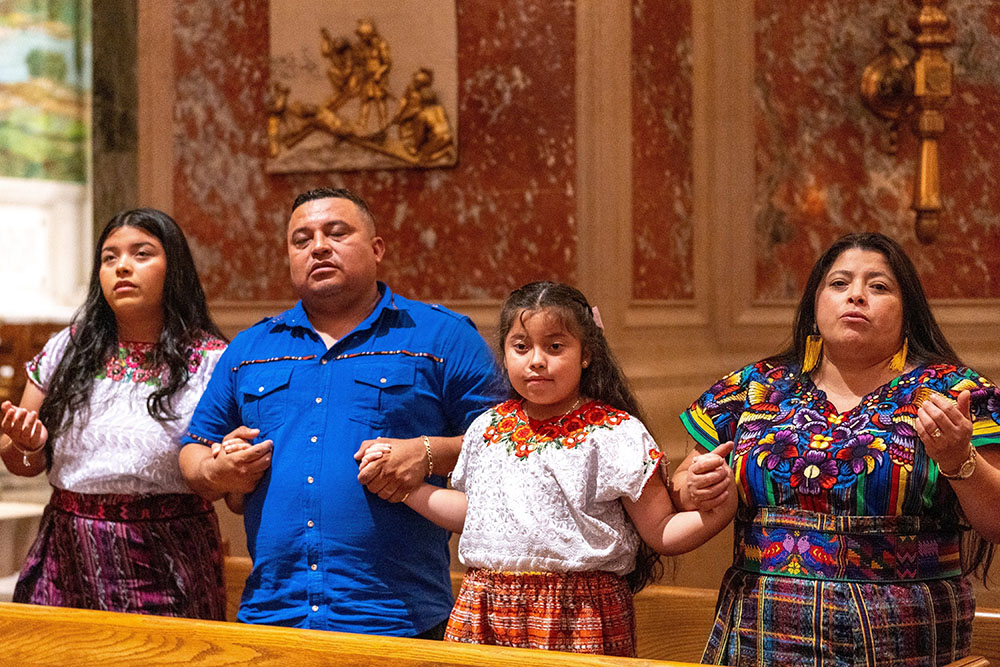
A family prays during Mass at the Cathedral of St. Matthew the Apostle in Washington Sept. 24, 2023. (OSV News/Catholic Standard/Mihoko Owada)

by Sr. Mary M. McGlone
Join the Conversation
Send your thoughts to Letters to the Editor. Learn more
The psalm we pray for the feast of the Holy Family begins: "Blest are those who fear the Lord." That's an unfortunate translation. At first glance, fear of the Lord sounds like an attitude of ongoing anxiety, a constant concern that we might do something deserving of punishment. That stage of moral development, appropriate to children between 3 and 7 years old, is ultimately a save-yourself approach to life under the rule of a God who audits our every action.
An alternative approach might translate the opening line as "Blest are those who stand in awe at the Lord." An attitude of awe follows the recognition of the immense greatness and love of God.
It's the sort of feeling one has while looking at Niagara Falls or at their spouse as they pronounce wedding vows. When we get caught up in such a feeling it's something close to fear, but it's more an experience of overwhelming goodness and beauty. It has nothing to do with disapproval or punishment.
Today, Sirach gives us advice about how to create relationships of mutual respect and love. Note his vocabulary. The prominent words are honor and revere.
A child who is afraid of parents cannot truly honor or revere. Their relationship is transactional: I do this, and you should do that. It's like a store owner and client: I provide the food, and you pay me the money. Nobody needs to give of themselves, and nobody ends up in debt to another. It might be fair, but nothing personal need happen after the exchange of goods.
In his letter to the Colossians, Paul describes an alternative to such shallow relationships. Paul calls the community to clothe themselves, with compassion, kindness, humility and more. He adds, "Most of all, put on love, that is the bond of perfection."
We might say that Paul calls for the sort of reverence and awe of others that characterizes the relationships fostered in a synodal community.
Our synod documents call for a quality of presence that attends to each person as a vessel of the Holy Spirit. One document describes it saying, "This quality of attention is an act of respecting, welcoming ... an approach that takes seriously what happens in the hearts of those who are conversing."
This is an invitation to learn how to act with attention. Joseph exhibited this virtue to an extraordinary degree. When he realized Mary was bearing a child not his own, he listened. Surely, he listened to Mary. He also listened to his tradition and then to an angel who came in a dream.
He adopted that child, creating with him and Mary a home that called forth all that each of them could be. When the innocent child was in mortal danger, Joseph gave up everything to take him and his mother to safety.
The feast of the Holy Family of Jesus, Mary, and Joseph celebrates our families and communities. It invites us to be communal centers of compassion, kindness, humility. It bears repeating: humility.
It takes humility to listen to a parent, sibling or child who is not behaving as we wish. Reverent listening becomes possible within bonds of love, the bonds that lead us to "perfection," or to the fullness of who we can become.
Advertisement
Family and community are designed to live heart-to-heart. They're webs of relationships in which we call forth one another's humanity. More than that, family and community exhibit what it means to be in the image and likeness of our Trinitarian God.
We Christians hold a unique — and to many others, strange — understanding of God as triune. We believe in the Trinity living in an eternal flow of relationship that keeps each one in being as Father, Son and Spirit. That's a family. That's the family from whom every family/community gets its name (Ephesians 3:15).
As this feast celebrates every family, every community, and every friendship that images the God of relationship, we might look to Joseph as our model. Joseph listened. In his listening, he transformed Mary the Mother of God from being a woman in great trouble to a wife. In his listening, he was the first disciple to leave tools and home (boats and nets) for the sake of the Son of God.
Why not make this a feast of thanksgiving? We can make it a day of listening to our experience and relishing our memories of God and every person — family member, friend, teacher, pastor, counselor — who has loved us into becoming who we are.
Then, from the strength of that love, let us widen our circles of relationship until we are overwhelmed by the goodness and beauty of each child of God.
We can be part of many Holy Families.