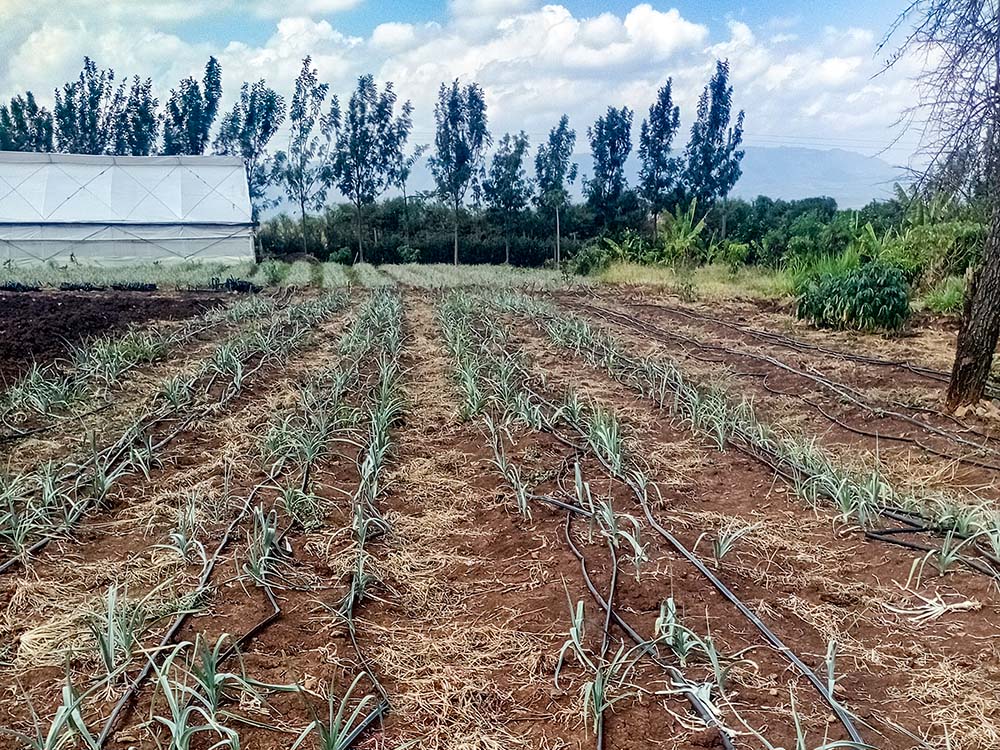
An irrigation operation runs amid an onion crop on St. Elizabeth Demo Farm in Momoi village in Lower Subukia, Nakuru County, Kenya. (Shadrack Omuka)
Scorching sun, bumpy roads, dwarf acacia trees and herds of donkeys pulling carts are the familiar backdrop in Momoi village in Lower Subukia, Nakuru County, Kenya.
Poorly cultivated arable lands, small houses made of wood and mud, and dilapidated trading centers reveal the poverty level of this area enclosed by small volcanic hills.
This is where Sr. Victorina Wanjiru, a Catholic nun born and raised in Momoi, manages St. Elizabeth Demo Farm, which she established in 2018 under the charism of the founder of the Little Sisters of St. Francis, Servant of God Mother Mary Kevin.
Wanjiru told Global Sisters Report that a deep connection to her hometown is the driving force behind the project. Having experienced the same adversities while growing up, she resonated with the struggles faced by locals. After celebrating her first jubilee, she asked her superiors if she could buy a farm in Lower Subukia, and they accepted her request.
The project has grown to become a beacon of sustainable farming and eco-friendly income activities, including beekeeping, which is also promoting better nutrition in the community.
The farm has trained many households in the area with practical farming skills to produce food for themselves and their surrounding communities. According to locals, the farm is a foundation of hope, resilience and empowerment.
One of the standout programs at the farm teaches women how to make their own cooking oil. Women first learn to plant sunflowers in their homesteads, and when the seeds mature, they meet at the farm to extract oil for personal use. They also sell the surplus to earn money, which helps them pay school fees and buy clothing.
Jane Njoroge, a mother of six from the Waseges River community, said her life greatly improved at the St. Elizabeth farm, which is about a kilometer from her home.
Advertisement
Njoroge explained that she didn't know anything about irrigation skills, despite her farm reaching the river. She said she depended on unpredictable rains, which often let her down.
Although she had enough land, she overspent on food because her farm didn't produce enough due to poor farming methods, which resulted in household hunger.
Beyond the agricultural fields, Wanjiru helps local women by forming groups to save money and start businesses or improve their standard of living. Women and men alike are taught about computer applications to keep farm records and curb computer illiteracy. A poultry farming project is also available to those interested.
St. Elizabeth Demo Farm owes much of its success to strategic partnerships, including a relationship with Missionszentrale der Franziskaner, a German development charity association of the Franciscan order. The support of Missionszentrale der Franziskaner has been vital, not only funding the programs but also helping to establish the necessary infrastructure to ensure the farm's success.
In 2021, the farm launched a beekeeping program that now trains about 200 local men, who have gone the extra mile by forming a cooperative society, the Umoja Beekeepers. Under Wanjiru's guidance, the co-op visits the apiaries once a week to ensure their hives are well cared for. The profits from honey sales are then split equally between the farm and the co-op.
"This farm is everything for the locals," Wanjiru said. "They get everything here, including farming and income-generating skills. It is a foundation of hope and a school of life."