

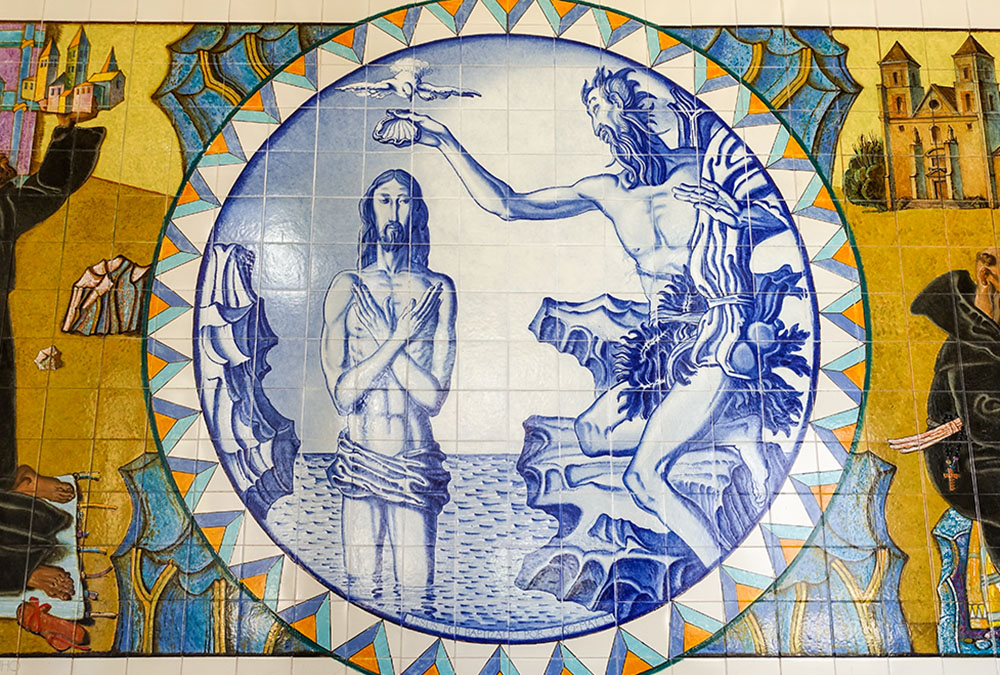
The baptism of Jesus is depicted in azulejos at the Santuário de São Bento da Porta Aberta in Rio Caldo, Portugal. (Wikimedia Commons/Jose Goncalves)

by Sr. Mary M. McGlone
Join the Conversation
Send your thoughts to Letters to the Editor. Learn more
One of the things we know for certain about Jesus is that he was baptized by John. We're sure of it because it embarrassed the early church, making Jesus appear as John's disciple, yet it was too well-known to skip over.
Mark (1:9-11) recounted it as a simple fact. Luke (3:21-22) refers to it only indirectly and John (1:32) simply mentions that the Baptist saw the Spirit of God descend on Jesus. Matthew's version minimizes the implication that Jesus followed John, claiming that when Jesus came for baptism, John protested that it should be the other way around because he was not worthy.
All of that indicates that Jesus really did turn to John and his ritual as a sign of commitment to what God was doing in their midst.
If Jesus' disciples were so worried about the implications of his baptism, we might ask, "Why did Jesus do it, and what did it mean for him?"
Jesus himself insisted that there had never been anyone like John (Matthew 11:7-14). It wasn't just his countercultural appearance or even his fiery message. Most striking of all, John attracted crowds and moved them to undergo a baptism that signified their promise to live like people happily aware that the reign of God was at hand. John awakened people to possibilities in ways the Pharisees, Sadducees and even the Essenes were unable to do.
Jesus began his public ministry in John's heyday. By asking for John's baptism, Jesus declared himself to be of a common mind with John.
Scholars and disciples have long wondered what Jesus was doing before his baptism. What direction did he see for his life? How did he use the Scriptures as a guide to discover his own vocation? The fact that Jesus' followers used so much of Isaiah's writings to interpret Jesus' vocation hints that Jesus himself may have done so and shared that vision with them.
Today's selection from the prophet Isaiah describes the vocation of a servant of God in ways that Jesus could well have incorporated into his own self-concept. He could conceive of God calling him "my servant," one who would perceive God's glory. Just as all of us are conceived in mystery and formed even before we are born, Jesus surely must have understood himself as chosen by God to carry forth a mission as unique as his own person.
The psalm we sing today could also have been core to Jesus' prayer. Like his mother who said, "Behold the servant of the Lord," Jesus could pray, "Here am I, Lord, I come to do your will." As he lived his vocation, he fulfilled the song's intent to focus on obedient listening rather than sacrifice. Jesus proclaimed the law of God as a law of the heart.
The fact that Jesus joined the circle of John the Baptist and then branched out in an alternative direction gives us the idea that, like us, Jesus needed to discover his vocation day by day. He, too, needed to listen to the call of God in his heart and discern how to collaborate with what God was working among the people. Jesus was humble enough to identify with John's followers and courageous enough to move in new ways as his prayer and love of his people led him to do.
Advertisement
We can imagine that Jesus began his mission in a posture of discernment and continued to allow himself to be led by God's Spirit for the rest of his life. Rather than having a plan and sticking to it, he grasped the freedom to respond to the needs of the moment as a sign of God's love with no other agenda.
With all of that in mind, we can interpret Jesus' baptism as a sign of his deep identification with us in all that is human — including in his desire to discern and carry out God's design in unforeseeable circumstances. We can perceive how he looked to his tradition (Isaiah) and to the prophets of his moment of time (John) and how he combined those into his prayer for guidance about how to carry out his vocation.
Jesus' baptism reminds us that he was one of us. He revealed that we humans must allow ourselves to be fragile, seeking and willing to change course when love calls for it.
As we recall Jesus' baptism, let us remember that we are baptized into him, to share the grace of his approach to life. The Spirit may not descend on us like a dove, but that Spirit enables us to share Jesus' freedom and to love in the ways our moment calls forth. We should not forget that we, like him, are beloved and well pleasing to God.