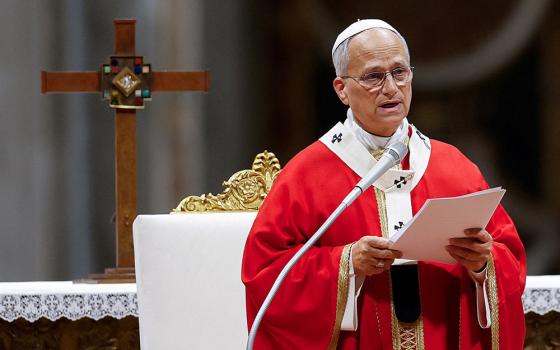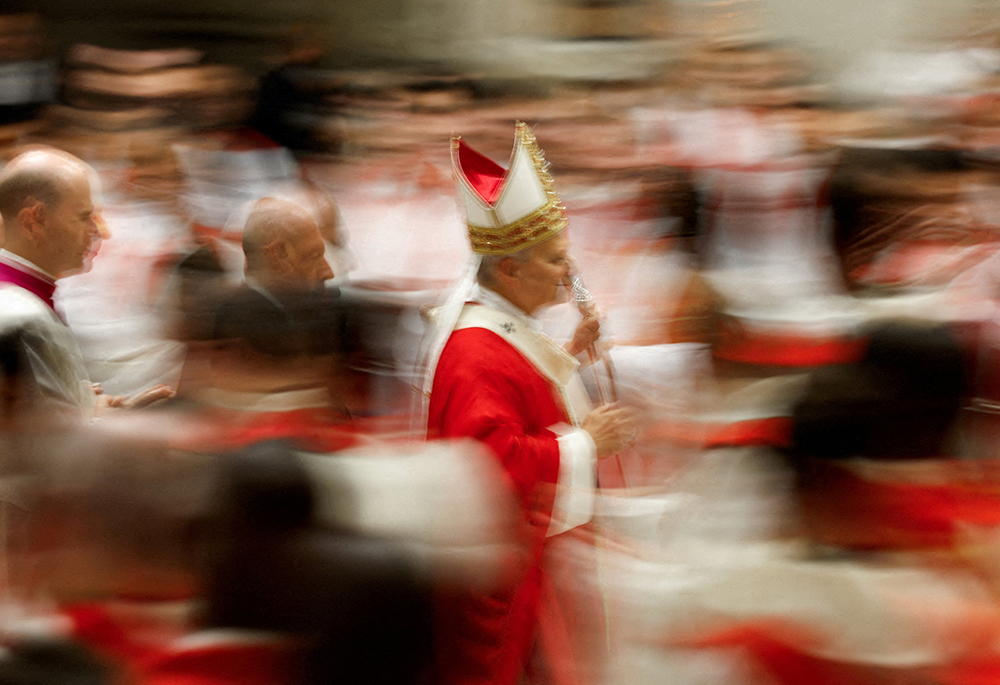
Pope Leo XIV leaves following a Mass marking the start of the academic year at the Pontifical Universities, in St. Peter's Basilica at the Vatican, Oct. 8, 2026. On Oct. 11, he announced that he would undergo surgery to remove a lung nodule. (OSV News/Reuters/Remo Casilli)

Join the Conversation
Send your thoughts to Letters to the Editor. Learn more
Pope Leo XIV's upcoming surgery to remove a lung nodule is a well-established procedure that generally carries very low risks, according to a veteran Italian lung specialist who worked for decades at a hospital that is now part of Rome's Gemelli hospital network, where the pontiff is due to undergo the operation.
"The thoracic surgery department at Gemelli is definitely of an excellent standard," said Dr. Barbara Moscatelli. "The pope is in excellent hands."
Moscatelli, who worked for 35 years as a pulmonologist and head of the respiratory pathophysiology and thoracic endoscopy service at Rome's Fatebenefratelli Hospital, now known as Gemelli Isola, said lung nodules are not necessarily cancerous and can result from infections, inflammation or scarring from previous illnesses.
The 71-year-old pope is expected to be admitted to Gemelli Hospital on Oct. 13 to undergo surgery to remove a small, localized lung nodule discovered during routine medical examinations. The Vatican has indicated that his recovery should take approximately one week.

Dr. Barbara Moscatelli (Courtesy of Barbara Moscatelli)
In an interview with National Catholic Reporter, Moscatelli explained that doctors may recommend removing a lung nodule rather than simply monitoring it when its appearance on medical scans raises concerns that warrant further investigation.
She said minimally invasive thoracic surgery allows doctors to remove the affected section of lung through small incisions, with generally limited consequences for breathing capacity.
Moscatelli, who is not involved in Leo's medical care and has not reviewed his medical records, described the pontiff as being in excellent overall physical condition and said that, for otherwise healthy patients, a week can be sufficient for a good recovery.
The following interview was conducted in Italian and has been translated and edited for clarity and concision.
NCR: Dr. Moscatelli, let's start with the basics. In simple terms, what exactly is a lung nodule?
Moscatelli: It's an abnormality that is usually visible on a chest CT scan rather than a chest X-ray, because a CT scan is much more precise when it comes to detecting small abnormalities. A CT scan is not normally ordered as a routine test, but if a chest X-ray shows a minor abnormality, doctors may request a CT scan to investigate further.
This was probably the case with His Holiness as well. He may have had some mild symptoms, undergone a chest X-ray that showed a small abnormality, and then a nodule was discovered.
When a lung nodule is discovered, should we immediately think of cancer?
No, not necessarily. There are many different conditions that can cause lung nodules. Some are completely benign. They may be granulomas, infections or scars left by previous conditions that never caused any noticeable symptoms. So a nodule doesn't necessarily mean cancer.
However, in a certain percentage of cases, some features seen on imaging can point toward a tumor. That's why it's important to establish a diagnosis.
If the nodule is large enough and close enough either to the central airways or to the outer parts of the lung, it may be possible to establish a diagnosis before removing it.
Otherwise, doctors can remove a small section of lung containing the nodule, which allows them to make a diagnosis and provide treatment at the same time. The tissue is removed and then examined.
Obviously, when we can carry out a preliminary examination of the tissue, we have a much clearer idea of what we're dealing with: whether we can leave the nodule alone, whether surgery is needed or whether some other form of treatment is appropriate.
When there is only a suspicion, without a definite diagnosis, and it isn't possible to take a biopsy beforehand, doctors may decide to remove the nodule directly.

(Dreamstime/transurfer343)
According to standard medical practice in Italy, why might doctors decide to operate right away rather than simply monitor a nodule? This seems to be the case with the pope, who is due to be admitted to hospital tomorrow.
When the appearance of the lesion on imaging doesn't reassure us that the nodule is most likely benign, we can't simply leave it alone.
So it's reasonable to assume that there is a fairly strong suspicion.
And the more important the patient, the greater the attention given to the case. Of course, you must never miss a diagnosis in any patient, but even more so when it comes to His Holiness, absolutely.
And how can doctors tell whether a nodule is benign or malignant? Is a biopsy always necessary?
Yes, absolutely. Whenever a biopsy can be performed before surgery, before removing the nodule, it can tell us whether we can be reassured or whether we still need to operate.
When a biopsy is risky, or carries risks comparable to surgery, there are procedures known as thoracoscopy. This is a minimally invasive operation performed using small tubes and fibre-optic instruments, rather than opening up the chest through a large incision, as was done in the past.
Instead, two small incisions are made, through which the instruments are inserted. One contains the camera that allows the surgeon to see inside, while the other is used for surgical instruments, such as forceps and suction devices.
So this is the kind of procedure that would normally be performed at a hospital like Gemelli in Rome, correct?
Yes, absolutely. It's a fairly routine, well-established procedure. The surgeons are highly skilled. The thoracic surgery department at Gemelli is definitely of an excellent standard. The pope is in excellent hands.
What are the main risks of this type of operation for a 71-year-old man?
In fact, His Holiness is like an athlete. He's someone who is in extremely good overall physical condition. The risks are minimal, although there are always risks.
If the operation is performed through thoracoscopy, the lung has to be temporarily collapsed. The surgeon then uses a camera to locate the nodule and remove the section of lung containing it. The tissue is then examined.
A chest drain has to be kept in place to allow the lung to re-expand after the procedure. So the possible complications are mainly related to the presence of the drain and the risk of infection. However, these procedures are performed under strict sterile conditions, so the risk of such complications is really very, very low.
Advertisement
After the operation, does the lung return to normal function? Could the patient lose some of his breathing capacity?
It depends on the size of the section of lung that needs to be removed to ensure the nodule is completely taken out. I have no idea how large that section might be in this case, because we really don't know the details.
When a segmentectomy is performed, meaning the surgical removal of a segment of the lung, the section containing the nodule is removed.
The impact on lung function depends on the size of that section. If only one segment is removed, the loss of function is really very small, essentially insignificant in terms of overall lung function.
The lungs are among the largest organs in our body, so they generally tolerate this kind of procedure very well.
There's been talk of a one-week recovery period for the pope. Is that realistic? When could he return to his normal activities, especially considering that he has several demanding flights across South America scheduled between Nov. 6-17? What kind of recovery can we expect?
For someone undergoing this kind of operation who doesn't have serious chronic illnesses, isn't diabetic, doesn't suffer from respiratory failure and doesn't have any major respiratory disease, one week is more than enough to achieve a good recovery.
That applies both to respiratory function and to the ability to do things such as flying and travelling. We need to make sure that the lung is fully re-expanded, that it is properly back against the chest wall, and check whether any pleural fluid remains.