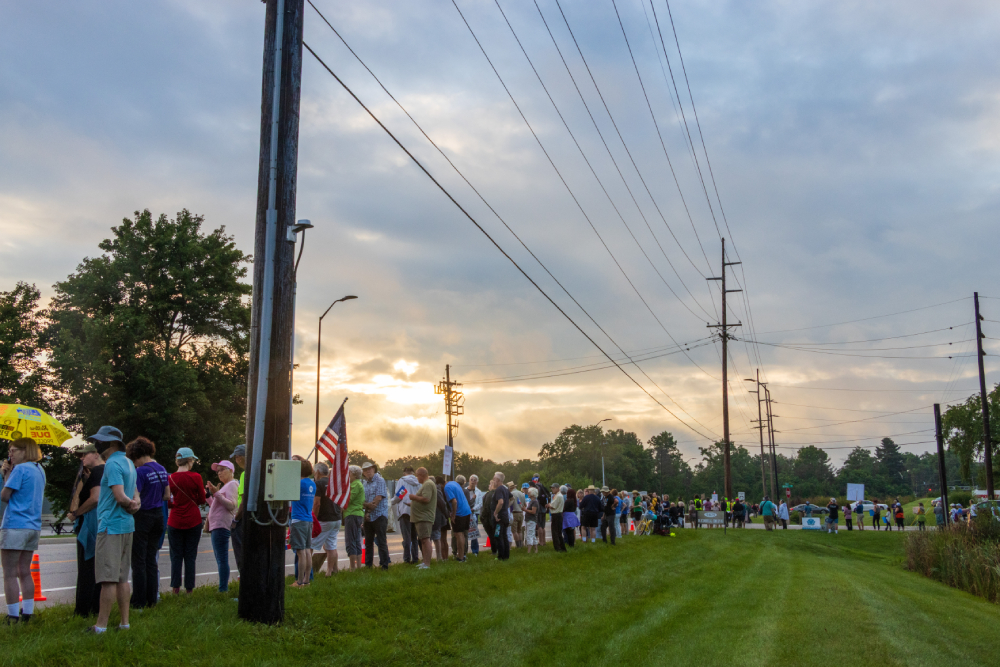
Participants of a vigil in support of Haitians immigrants losing TPS status in Blue Ash, Ohio lined up on Aug. 2. (Courtesy of Edward Goode)

Join the Conversation
Send your thoughts to Letters to the Editor. Learn more
Ohio Catholics were among a group of hundreds who gathered outside a federal immigration office near Cincinnati Aug. 9 to show prayerful support for Haitian immigrants. The gathering took place just four days after a federal judge ruled that temporary protected status (TPS) for roughly 350,000 Haitians had officially ended.
The vigil outside the Immigration and Customs Enforcement (ICE) field office in Blue Ash, Ohio, followed a previous gathering at the same location the week before, when more than 550 people lined a suburban Cincinnati road before sunrise Aug. 2, holding signs, praying and waiting for Haitian immigrants who had been ordered to report there.
The gatherings brought together Catholic sisters, parishioners, immigration advocates, lawyers and members of other faith communities. Organizers told the National Catholic Reporter that more than 600 people attended the vigils, called after Haitian residents of Springfield received letters directing them to appear at the ICE field office nearly two hours from their homes.
Ignite Peace, a Cincinnati nonprofit founded by five communities of Catholic sisters, organized the demonstrations with the Miami Valley Immigration Coalition. The groups said the gatherings were intended to support Haitian families, draw attention to immigration enforcement and call for permanent legal protections.
The second vigil was on the heels of the judge's ruling that allowed the final step for theTrump administration to terminate TPS for Haitians.
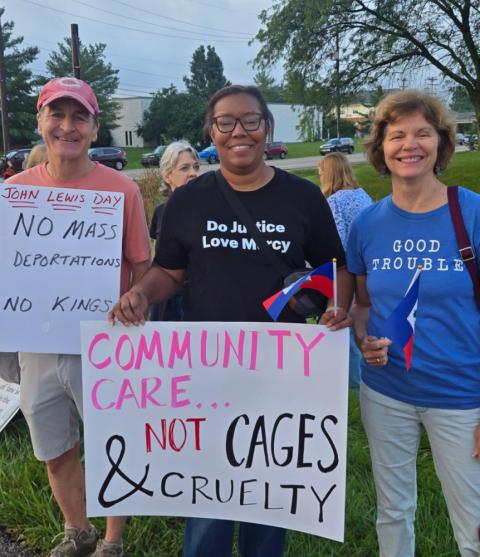
Participants of a vigil in support of Haitians immigrants losing TPS status in Blue Ash, Ohio holding their signs on Aug 2. (Courtesy of Ignite Peace/CAIR)
U.S. District Judge Ana C. Reyes of the District of Columbia had blocked the administration in February from ending the protections, but reversed that decision Aug. 5 after the U.S. Supreme Court ruled 6-3 in June that federal law bars judicial review of TPS determinations. Reyes wrote that the Supreme Court ruling meant Haitian TPS was no longer in effect, while allowing attorneys to continue pursuing claims that the termination was motivated by racial discrimination.
The decision affects about 350,000 Haitians nationwide, including an estimated 200,000 who hold jobs in industries such as health care, food service, warehousing, retail and long-term caregiving. The loss of TPS leaves many facing the possibility of losing work authorization, detention and deportation, although some Haitians may have separate immigration applications or other forms of legal protection pending.
Samantha Searls, program director at Ignite Peace and lead organizer of the vigils, told NCR the organization concentrates on how state and national policies affect local communities. Its work includes nonviolence education and criminal justice and immigration advocacy
"We've done a lot of 'Know Your Rights' presentations, and that's actually how we got tied to this campaign to help Haitians in Springfield because it is outside of our city," Searls said.
Ignite Peace had previously traveled to Springfield to conduct one of those sessions. Local partners later reported that some Haitian TPS holders had been told to report in-person to the ICE office in Blue Ash, Ohio. Searls said the unusual Sunday appointments raised fears that those attending might be detained.
Instead, she said, most were released with ankle monitors.
"Which, in some viewpoints, doesn't seem so bad, but it is a visual reminder that others, this community, instead of welcoming them as part of our community we have now literally put a symbol on their leg that makes them seem like criminals," she said.
Springfield, northeast of Dayton, has become a national focal point in the immigration debate. Haitian arrivals have filled jobs, established businesses and helped revitalize a city that had experienced years of population and economic decline, according to local advocates. The community has also faced political attacks and repeated uncertainty about its legal position.
Searls said some Haitians summoned to Blue Ash had already lost their driving privileges, making the journey particularly difficult. The appointments left families anxious about detention, separation and deportation.
The vigils were designed to offer a visible counter-message.
Among those present was Sr. Alice Gerdeman, a member of the Congregation of Divine Providence in Melbourne, Kentucky, and the Ohio Sisters Justice Network. Gerdeman said she has spent close to five decades working with immigrants or advocating on their behalf.
She described the gathering as emotionally divided between solidarity and fear.
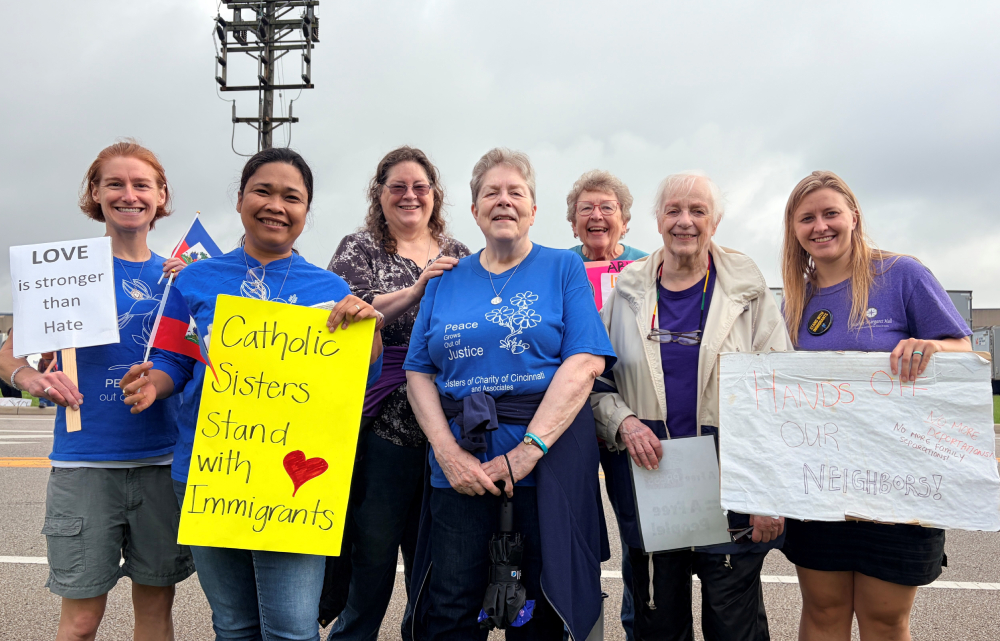
A group of Sisters of Charity of Cincinnati, Ohio taking part in a vigil in Blue Ash, Ohio in support of Haitians immigrants losing TPS status, Aug. 2. (Courtesy of Sisters of Charity of Cincinnati)
"It's a very interesting dynamic. For one thing, to be in a group of 550 along the road across from the ICE center, there is something about the companionship of so many people who care about the same thing that sort of uplifts your spirit," she told NCR.
At the same time, participants watched immigrants enter the building without knowing whether they would emerge.
"There were people who had tears in their eyes and wiped their eyes when they saw people going through the door," Gerdeman said.
She added that the previous TPS extensions for Haitians granted through Feb. 6, 2026 by the Biden administration were necessary because Haiti could not safely receive large numbers of returnees. Temporary protection, she said, should be accompanied by a route to more permanent residence when returning home remains dangerous.
"Out of Christian charity, kindness, and compassion, they have every right to be here," she said.
Sr. Sandra Howe, a Sister of Charity who attended the Aug. 9 vigil, said the second demonstration appeared larger and felt "more reverent and prayerful." She described clergy, religious and Haitians gathering near the entrance used by immigrants reporting to ICE and sharing in prayer and the Eucharist.
"The unity was palpable," Howe said.
Lacie Fischley, a member of the Miami Valley Immigration Coalition's leadership team and a community organiser at Advocates for Basic Legal Equality, attended the vigil or protest in a legal-support role. She met arriving immigrants, gathered information and connected them with lawyers who could accompany them into the ICE office.
As she walked one Haitian man towards the entrance, the crowd began cheering and chanting that immigrants were welcome.
"It was really moving because in that moment, that's when I say we need to stand up as the body of Christ, like they were feeling it as themselves, walking up, and it was just so moving that the community was there, walking with him into the office," Fischley said.
A practicing Catholic, Fischley said her advocacy was inseparable from her faith and its teaching on human dignity.
"These people are God's children, and we're called to treat them with respect and demand respect for them," she said.
Fischley said confusion was one of the most immediate problems facing Haitian families. Some had TPS, while others had applied for asylum or another form of relief, and many were unsure how one process affected another. She also expressed concern that Black immigrants could be targeted because of their appearance or accent, regardless of their actual immigration status.
Miranda Hallett, a cultural anthropologist at the University of Dayton Human Rights Center and a founder of the Miami Valley Immigration Coalition, told NCR the Haitian community had become closely connected to the region's economy and civic life. Haitians had found jobs, established homes and opened businesses in places that had previously lost population.
Advertisement
"There is a mutual interdependency," Hallett said. "Like all of those of us who live here in Southwest Ohio, we're very interdependent with the Haitian community, no matter what our own personal background is, because we're all part of the same economy and society right here in Southwest Ohio."
She said the coalition's approach was rooted in "accompaniment," namely standing beside people even when volunteers could not resolve their legal cases.
After the second vigil, Hallett said the gatherings had succeeded in increasing public visibility of the treatment of Haitian immigrants and demonstrating support for people arriving for their immigration appointments. She said the larger turnout the second week suggested growing concern over immigration enforcement and what participants see as threats to due process and constitutional rights.
At the same time, she said, the demonstrations illustrated the fear and uncertainty facing Haitians as their humanitarian protections disappeared.
That principle of accompaniment also shaped the vigils, organizers said. Searls said Catholics who had never participated in a political demonstration should not assume that silence was neutral.
That principle also shaped the vigils, organizers said. Searls said Catholics who had never participated in a political demonstration should not assume that silence was neutral.
"It's important as people of faith to speak out against what's wrong, and what they're doing to the Haitian community is wrong," she said. "So I encourage everyone to find some courage and to use their voice so that this does not go unnoticed."
"When someone is deported, it's like a grief. It's a loss. It's like a death in a lot of ways," Fischley added. "You sit with them and you pass vigil, you stay up all night with them and walk with them to the end."