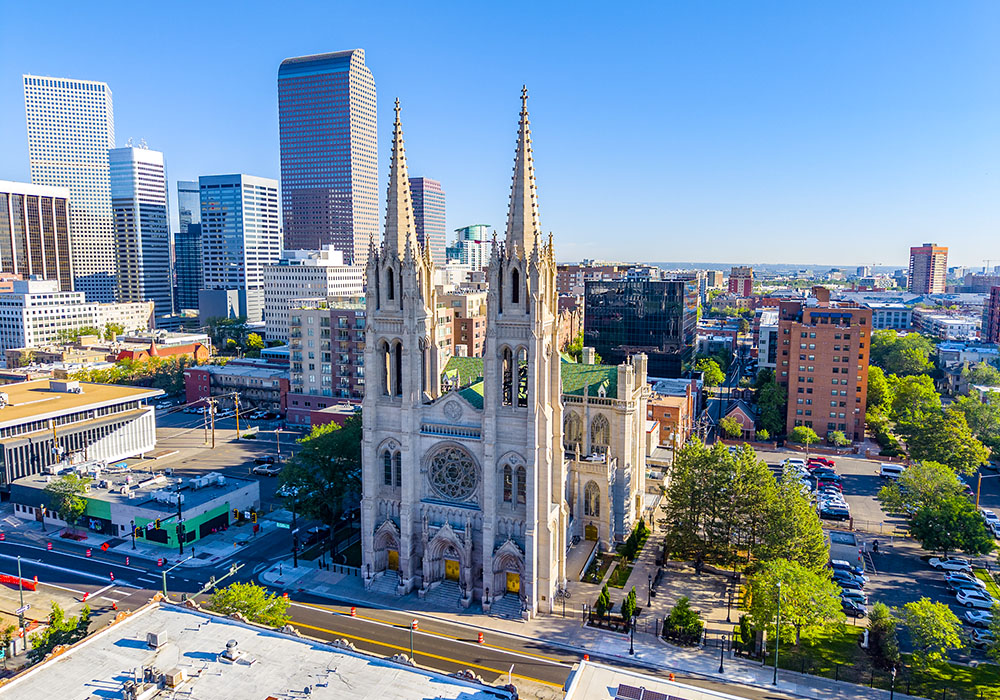
The Cathedral Basilica of the Immaculate Conception in Denver is seen in an aerial photo. The Denver Archdiocese is one of the plaintiffs in St. Mary Catholic Parish v. Roy, a case the U.S. Supreme Court will hear Nov. 3, 2026. (Dreamstime/Jiawangkun)
by Brian Fraga
Staff Reporter
Join the Conversation
Send your thoughts to Letters to the Editor. Learn more
Today the U.S. Supreme Court will hear oral arguments in a potential landmark case that could reshape the relationship between religious freedom and nondiscrimination laws in America.
At issue is whether a publicly funded Colorado preschool program violates the First Amendment's free exercise clause because it requires that participating schools abide by a nondiscrimination policy.
In 2023, Colorado enacted a program that provides 15 hours per week of state-funded preschool. The program is open to public and private schools, including religious. The schools must give children "equal opportunity" to enroll regardless of the race, religion, sexual orientation or gender identity of the students or parents.
Two Catholic parishes, local parents and the Denver Archdiocese sued the state, arguing that the pre-K program's antidiscrimination protections amount to religious discrimination against the plaintiffs because their schools do not admit children of parents who are transgender or in same-sex relationships. The archdiocese's policy is to admit students only from families who support Catholic beliefs, including on same-sex relationships and gender identity.
"While the program claims to be universal, Colorado has denied families ... the ability to use that funding at Catholic preschools, simply because those preschools have religious beliefs the state doesn't like," said Nicholas Reaves, senior counsel at the Becket Fund for Religious Liberty, a Washington, D.C.-based firm that litigates religious liberty cases.
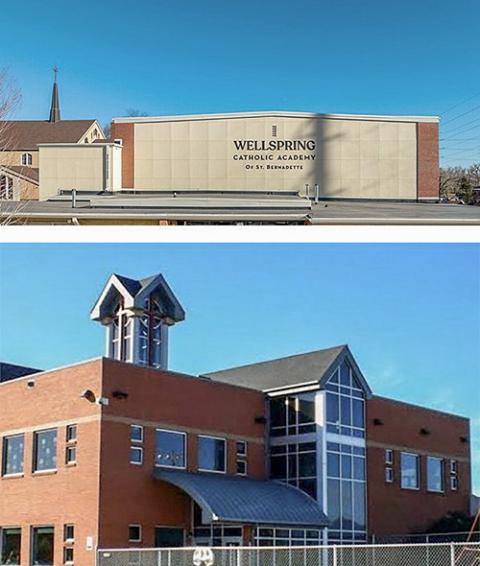
Schools at two Colorado Catholic parishes, St. Bernadette in Lakewood and St. Mary in Littleton, are named in the Supreme Court case St. Mary Catholic Parish v. Roy. (OSV News/courtesy)
Reaves, the lead attorney for the preschools and parents, will be arguing at the Supreme Court in the case of St. Mary Catholic Parish v. Roy. In press releases and video statements, Reaves said the court's recent decisions prevent Colorado from prohibiting the archdiocesan schools from the preschool program.
"Catholic families across Colorado are asking the Supreme Court to step in once more and stop Colorado from denying them equal access to a universal government benefit," Reaves said in a video.
Colorado argues that its law does not discriminate based on religion. The state says it will pay for children to attend religious preschools as long as they do not discriminate based on the sexual orientation or gender identity of the parents or students.
The case raises several questions, including how far the court might go in expanding the free exercise clause. Over the last decade, the court's conservative majority has shown it is willing to give deference to free exercise arguments in cases where religion intersects with public policy.
A trio of cases — Carson v. Makin in 2022, Espinoza v. Montana Department of Revenue in 2020, and Trinity Lutheran v. Comer in 2017 — established a precedent that the state cannot deny aid to religious schools that it provides to private secular schools.
"Under the trilogy of Trinity Lutheran, Espinoza, and Carson, this case is straightforward," the Becket Fund said in its opening legal brief at the Supreme Court.
Citing those cases, there is a strong possibility that the court could rule in favor of the Catholic schools, said Frank Ravitch, a professor at Michigan State University's College of Law who studies the relationship between law and religion in the United States.
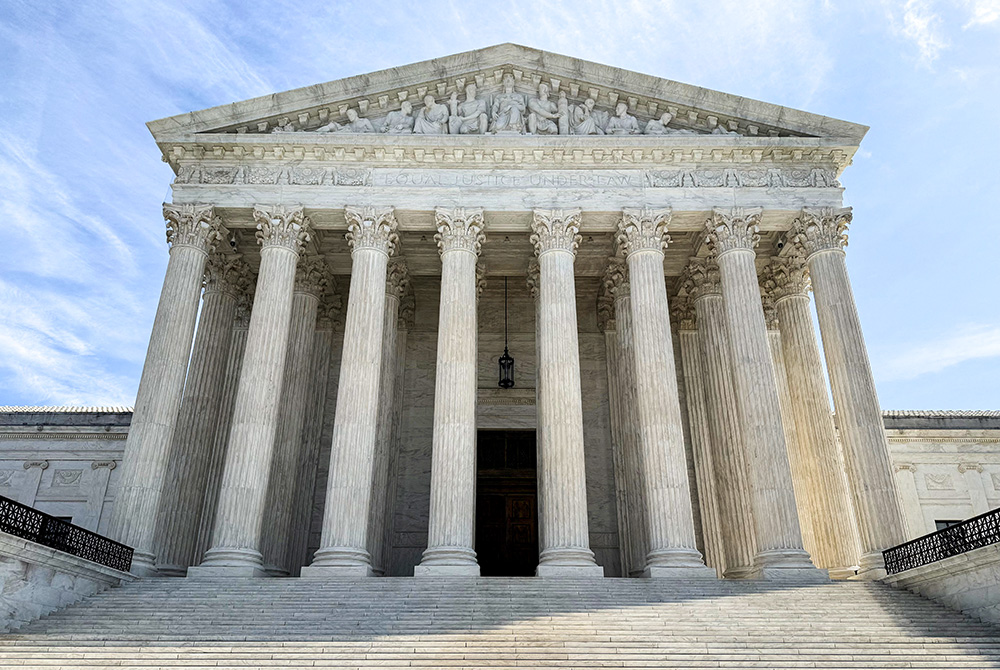
The U.S. Supreme Court is pictured in Washington March 14, 2026. (OSV News/Reuters/Will Dunham)
"I think what [the Supreme Court] is going to say is that Colorado, by applying its antidiscrimination law here, is somehow discriminating based on religion, which is a huge reach," Ravitch told National Catholic Reporter.
In St. Mary Catholic Parish v. Roy, a federal district court and the 10th Circuit Court of Appeals upheld the Colorado law by applying Employment Division v. Smith, a 1990 Supreme Court ruling that said the First Amendment does not provide a basis for religious exemptions from general laws.
The lower courts ruled that Colorado's preschool program is a neutral law of general applicability, explaining that it applies equally to all potential applicants. The court also said that the state does not deny funding to religious schools that it provides to secular schools.
"The law really was about implementing a program that said we want every kid, no matter where you live, to be able to have access to universal preschool," Steve Fenberg, who served as president of the Colorado state Senate when the pre-K program was enacted, told NPR.
One possibility is that the court will overturn Employment Division v. Smith, which appears to be what the Becket Fund in its brief is urging the court to do. Out of 18 free exercise cases the court has resolved since 1990, the court has cited Smith only twice to rule against the religious objector. Yet lower courts constantly rely on Smith, the brief says.
"But even under Smith's flawed framework, Colorado's actions fall short because they are far from generally applicable," the brief says.
In a column for Verdict, Leslie Griffin, a law professor at the University of Nevada, Las Vegas, argued that Colorado's universal preschool law fits the description of a neutral law of general applicability.
"If the schools win this case, the nation will move toward lawlessness, telling everyone that the government will pay you whenever you discriminate or break any other law," said Griffin, who co-wrote an amicus brief on behalf of a group of Catholic individuals and organizations that include New Ways Ministry, Call to Action and Women's Ordination Conference.
Ravitch added that a ruling for the Colorado Catholic schools could potentially open the door for religious schools across the country being able to discriminate based on race, gender or even immigration status while receiving public funding.
"The stakes here are much bigger than the issues just in this case," Ravitch said.
In an Oct. 26 op-ed for The Denver Post, Denver Archbishop James Golka framed Colorado's preschool law as "an attack on Catholic education," an attack that "threatens the broader culture," he said.
Advertisement
"In our age of hyper-secularization, moral relativism, and technical reductionism, we urgently need schools that teach students who they truly are: immortal souls, beloved by God," Golka wrote.
The U.S. Conference of Catholic Bishops, which also filed an amicus brief in the case, argues that Colorado has disqualified Catholic preschools from participation in the state's universal preschool program "solely because of their adherence to Catholic doctrine."
"If allowed to stand, the Tenth Circuit's decision will embolden other states and municipalities to discriminate against religious adherents' rights by enacting ostensibly neutral statutes that discriminate in fact," the bishops' amicus brief says.
The bishops also argue that the case is "the latest example of a disturbing trend" of cities and states across the country using nondiscrimination requirements to "covertly suppress particular religious beliefs."
"If this trend continues, it will impair the ability of Catholic organizations and other faith-based service providers to partner with state and local governments to serve the public. The resulting harm to the nation's social support infrastructure would be immense," the brief says.
The court is expected to rule on the case by next summer.