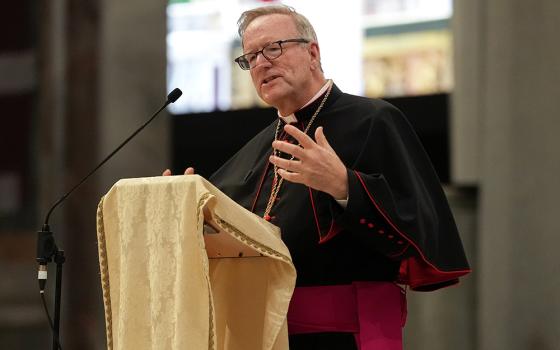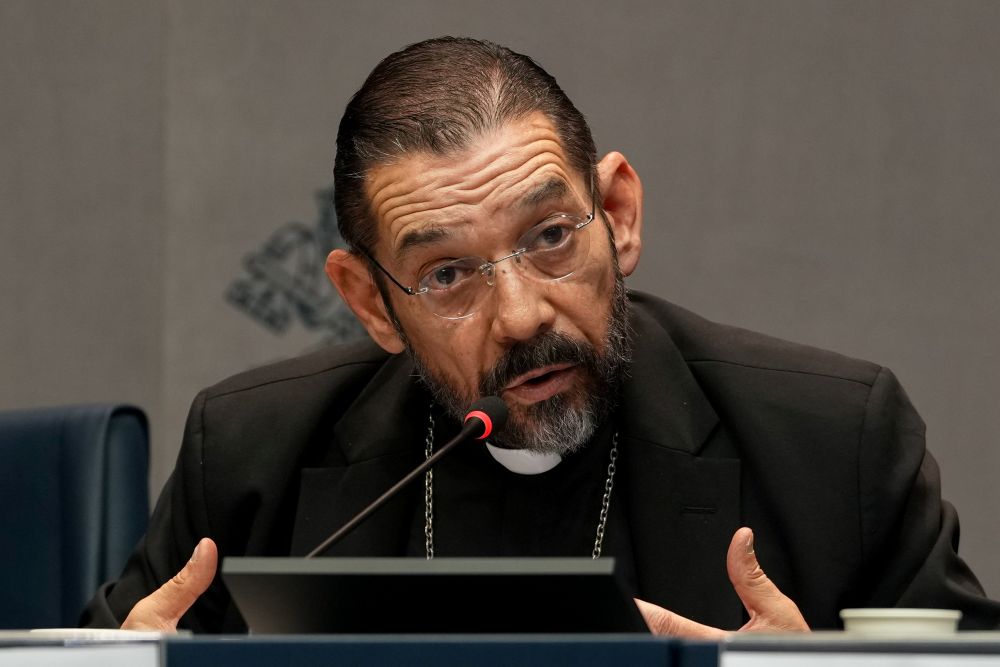
Bishop Daniel Flores of Brownsville, Texas, speaks during a news conference at the Vatican, Sept. 11, 2026. (CNS/Lola Gomez)

Join the Conversation
Send your thoughts to Letters to the Editor. Learn more
Rather than rev up the political polarization gripping the United States, the country's Catholic bishops should act to turn down the temperature of political discourse ahead of the coming midterm elections, said the vice president of the U.S. bishops' conference.
Sitting down with the National Catholic Reporter in Rome, Bishop Daniel Flores of Brownsville, Texas, said that applying the principles of synodality — the Catholic Church's effort to become a more listening, participatory body — can repair political discourse in the United States which has become "debilitated" in recent years.
"The general demeanor of the bishops in the country, I think, should be one that exemplifies before it preaches to," he said. "We need to exemplify a certain generosity of spirit that is not necessarily immediately jumping to the condemnatory or the immediately critical."
Flores, who previously led the U.S. bishops' synodal process, participated in the Vatican's 2023 and 2024 synod assemblies, attending the latter with then-Cardinal Robert Prevost, now Pope Leo XIV. The bishop was in Rome for a meeting of church officials, with leaders in labor, business and civil society to address social and ecological challenges in the Americas.
Asked whether the public support of Bishop Robert Barron of Winona-Rochester for the Trump administration hinders the church's capacity for dialogue, Flores told NCR that Catholics are "spending a little bit too much time trying to decide which bishop is on the right side of things and which one is not," and that to disagree with a bishop on a particular matter is "perfectly alright."
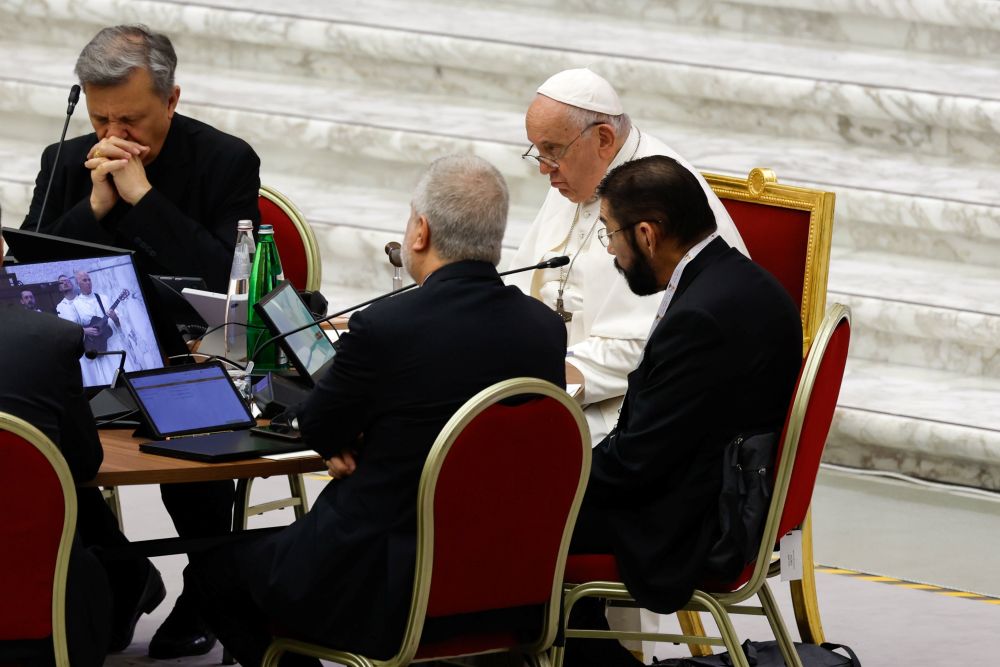
Bishop Daniel Flores of Brownsville, Texas, sits to the left of Pope Francis for prayers with leaders of the assembly of the Synod of Bishops before a working session in the Vatican's Paul VI Audience Hall Oct. 20, 2023. (CNS/Lola Gomez)
The Texas bishop also said that if the pope visits the United States he would hope for him to encourage all Americans to engage in "the kind of difficult conversations we need to have so that we can actually come to a consensus as a country, in local communities, as to what the best way forward is for the good."
The following interview has been edited for clarity and length.
NCR: We're speaking on the sidelines of a conference on organized labor where you spoke about the relationship between synodality and social justice. Drawing from your experience in the Vatican's synod assemblies and being a bishop in Texas, which is currently facing major challenges on immigration issues, how do you see synodality as shaping the church's social justice advocacy?
Flores: This conference initiated with the sense that there is a recognized synodality in the life of the church where we gather, we try to hear the reality that people are living in their own parishes, in their diocese and so forth, and then try to develop together a sense of the best way to respond to those things. That's a certain thing that we try to do in the church.
I often think, myself, that we need to do a lot better job in the church to explain what the "common good" entails, and I would argue it's not good for society if you are separating families. Regardless of whether or not they're documented. If they're peaceable families, and people are working, you need to find another way to kind of address the fact that they're in an irregular [document] situation, like an expired tourist visa which could be addressed rather than just simply deporting the father, because that causes a rupture in what is a basic good of society, which is: You keep families together, you allow them to work to feed their families, and you address whatever legal isues are there within the context of the least disruption possible.
So, synodality sort of helps you to keep it real in that way because we do have to raise the "common good" question, which is not the same thing always as the national interest question. But from a Catholic point of view, they need to be understood in light of one another.
You spoke at today's press conference about the need for the church to create spaces for people with different viewpoints and backgrounds to dialogue. As we go into the midterm election cycle, how do you see the church as able to affect the political conversation in the U.S. that is so marked by polarization?
I think we've spent a number of election cycles where the discourse hasn't been necessarily the most constructive. Our discourse has been debilitated over time. So I think what we, what the church can do, is give an example — like this conference, where you bring labor leaders and business leaders together to talk about issues that we would consider adversarial but they begin to see there's some things that could be addressed here.
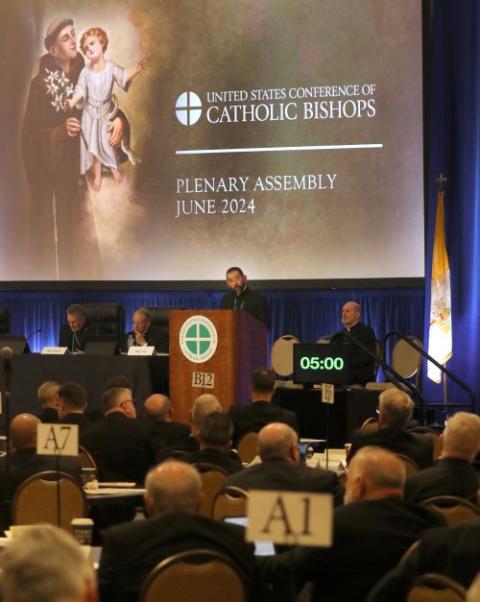
Bishop Daniel Flores of Brownsville, Texas, speaks June 13, 2024, at the U.S. Conference of Catholic Bishops' Spring Plenary Assembly in Louisville, Ky. (OSV News/Bob Roller)
And all of this only works if like the first principle of synodality is applied. That is, you really do have to listen to what the other person is saying. You may not agree with a word coming from them, but you really have to try to listen, to try and understand what and where is this coming from, and to address the person and not just the idea. This is the difference between ideology and what I call "Catholic realism."
At the same time, there are a number of Catholics in the Trump administration, such as the vice president, who cite their faith among the reasons they support this president. A theologian at Catholic University of America just took a role in the Department of Homeland Security. Do the bishops need to intervene when Catholic public officials tie faith and politics together so closely?
First of all, I think the bishops need to love their people. That's all of their people, [including] the ones that may [make us] think to ourselves: "That was a very uncalled-for statement," for example. You may think that, but it's not necessarily something that you would want to say publicly.
The general demeanor of the bishops in the country, I think, should be one that exemplifies before it preaches to. So we need to exemplify a certain generosity of spirit that is not necessarily immediately jumping to the condemnatory or the immediately critical, but as I would ask bishops to do that I think I would ask every Catholic. We need to restore a certain self-restraint. Particularly when it comes to the contentious issues because we aren't helping the situation by revving up the anger thing. It's not helping us. It's in some ways it's blinding us to possible convergence of flow.
You say that bishops should exercise restraint and dialogue, but Bishop Barron's collaboration with the Trump administration and public attacks on prominent Democrats seem to fly in the face of that. He also just said that empathy is a threat to love, in contrast with the pope's teachings on empathy. Does that hinder the church's moral witness in society?
I think the church is robust enough to be able to handle when somebody speaks in that way. I would be wary of pulling out a term used in a discourse by one bishop and a term used by the Holy Father, maybe in a different context, and saying: "Well, he uses the same word, they're saying different things." I don't think we need to be so quick to presume a bad motive or a desire to undermine. I don't think we should be so quick to do that, and if you don't agree with what one bishop or another bishop says about this or that, that's perfectly alright.
Advertisement
But the bishops I think should keep in mind, though, that we do have a responsibility, all of us, to help our people to understand — and I think this is a heavy responsibility — what the Holy Father is teaching. That's a basic responsibility. And I don't search my internet feed to figure out which bishop is doing that and which one isn't. I think we're spending a little bit too much time trying to decide which bishop is on the right side of things and which one is not. I presume good will. I just think we're overly focused on catching people at odds with other people. And there are authorities in the church who can deal with that.
There is nothing on the books yet, but there is potential that Pope Leo comes to the United States during your term as vice president of the USCCB. What would you hope is the outcome of a potential papal visit to the U.S.?
[I hope the pope would] encourage all of us, Catholics and non-Catholics, to take the time to participate, in an orderly and in a reflective way, in the kinds of difficult conversations we need to have so that we can actually come to a consensus as a country, in local communities, as to what the best way forward is for the good, for the common good, which includes for the good of families, for the good of children, for good of our elderly, for the good the poor, for those who are rejected or marginalized in life.
We're the ones for whom it rings when Cain asks the voice of God, "Am I my brother's keeper?" and the silence of God [says]: "What would ever make you think you weren't?"
The National Catholic Reporter's Rome Bureau is made possible in part by the generosity of Joan and Bob McGrath.