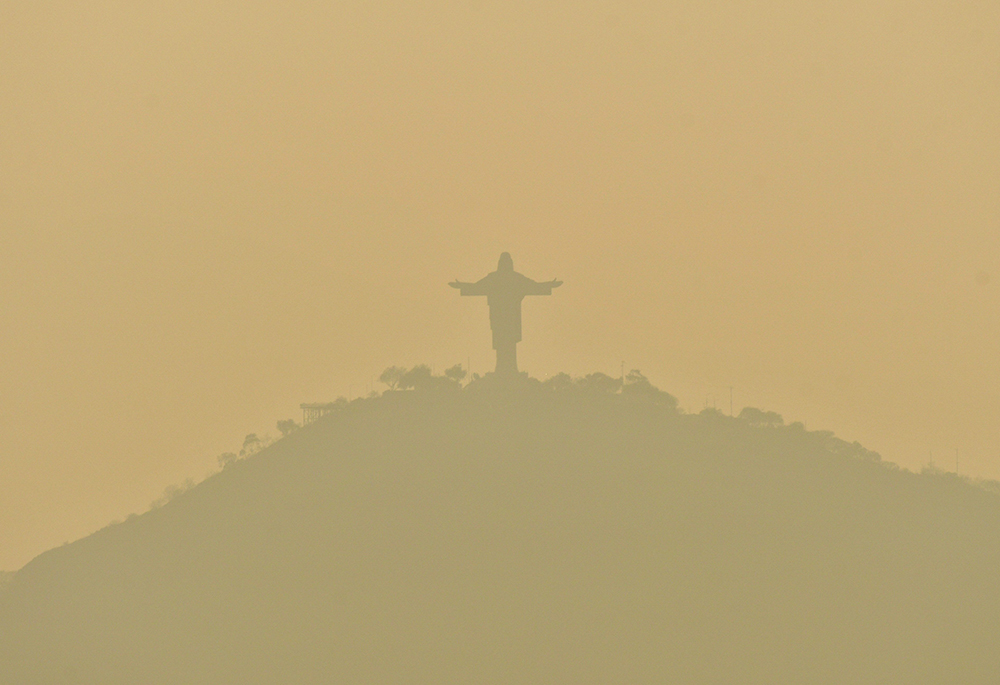
A statue of Christ of Peace atop San Pedro Hill is seen Sept. 10, 2024, shrouded in smoke caused by wildfires in Cochabamba, Bolivia. The Bolivian Bishops' Conference said in a statement the country was suffering from "an ecological disaster caused by human hands." (OSV News/Reuters/Patricia Pinto)

Join the Conversation
Send your thoughts to Letters to the Editor. Learn more
In a sprawling document articulating the duty of Christians to care for the environment, a Vatican advisory body wrote that taking action to preserve the planet for future generations is "not only an ethical requirement, but also a theological one."
"The historical moment we are living through demands urgent action from everyone, beginning with those responsible for public life, to ensure the sustainability of the planet and the habitability of our common home," the Vatican's International Theological Commission wrote in a more than 30,000-word document published in Italian Sept. 2, titled "Caring for Our Common Home: A Responsible and Fraternal Response to the Triune God."
The document, the fruit of three years of work by the commission and reviewed by Pope Leo XIV prior to its publication, makes the case for developing an "ecological spirituality" in light of the Christian understanding of the triune God — the doctrine of God as the Trinity which Catholics understand makes God inherently relational.
Texts published by the commission are not part of the church's magisterium; the advisory body is instead tasked with assisting the church, and particularly the Vatican's doctrine office, in the study and development of church teaching.
A significant portion of the text, which roots its ideas in the writings of four doctors of the church and papal magisterium, seeks to further develop the term "ecological sin" which was introduced at the 2019 Synod of Bishops on the Amazon and which Pope Francis said he was considering inserting into the catechism.
In the document, the commission proposed understanding ecological sin as "an action or omission against God, against one's neighbor, the community, and the environment," but also stated that the current term did not sufficiently express the offense of disrespecting God's ultimate aim for creation.
"An adequate formulation of what constitutes the sin in question here must express both factors: not only environmental or ecological damage, but also, and first and foremost, the refusal to follow God's intended plan for creation."
Therefore, the commission wrote, "we propose understanding this sin against our Common Home as a 'sin against creation and against the Creator,' insofar as it violates the meaning of creation intended by God the Creator," the document stated.
The document also proposed understanding sin against the environment "in a manner analogous to how the concepts of social sin and structures of sin have gradually taken shape" — referring to an understanding of sin articulated by St. John Paul II, in which the accumulation of individual sins which are consolidated, "grow stronger, spread, and become the source of other sins, and so influence people's behavior."
After laying the groundwork for the theological connection between the Trinity and the responsibility of believers to care for God's creation, the commission expressed the need to develop a spirituality guided by ecological principles where "work, rest, leisure, contemplation, our relationship with nature and with other people, and silence come together."
The commission wrote that currently, "the promotion of an authentic and effective ecological spirituality clashes with the dynamics imposed by the technocratic paradigm that currently predominates in the economic sphere and in social life."
In many modern societies, "we find ourselves trapped between an underlying malaise, which calls for drastic changes in how we handle our existence, and the need to adapt to the demands of the frenetic pace imposed by the market," the document stated, whereas an "ecological spirituality charts a path out of this suicidal spiral which mistreats us, makes us sick, and causes us to deteriorate."
"A healthy spirituality invites us to live in a balanced and mindful way, both toward the environment that sustains us and toward others and ourselves," it continued. "A healthy spirituality is mindful of personal and family consumption; it strives to make it sustainable. It seeks to minimize energy consumption at home and in transportation. It pursues a healthy and environmentally responsible diet. It helps us discern what we purchase, while aware that every act of purchasing is a moral act."
In a subsequent section dedicated to asceticism and fasting, the commission wrote that "the current situation of overexploitation of our planet imposes on all of us a moral duty to voluntarily restrict our consumption and exploitation of resources, especially in wealthy countries."
Advertisement
And discussing the collective responsibility for the causes and effects of climate change, the text stated that "it is just that the implementation of more responsible, demanding, and respectful ecological policies be more rigorous for those who cause the greatest harm to our Common Home or have caused the most harm to it thus far."
But the commission also maintained that "it would be unjust for the wealthier countries to impose unsustainable and unsupportive burdens on the poorer countries, demanding that they preserve the Earth's 'lungs' and green oases, while the wealthy countries are unwilling to give up their high standard of living and their consumption patterns."
In a section on the "universal destination of goods," a principle of Catholic social doctrine which Leo expounded in his AI-centered encyclical Magnifica Humanitas, the document also affirmed that "private property is not an absolute right according to Christian Tradition."
The idea of the universal destination of goods, which holds that all goods are given for the good and use of all people, "must be expanded to include the preservation of planet Earth for future generations and for the flourishing of life, not only human life," the commission wrote.
The document ended by expressing the urgent need for an "ecological turning point" consisting of the "shared realization that all of reality is interconnected, comes from God as a gift, and reveals his Trinitarian imprint." Such a paradigm shift "implies a profound spiritual conversion," it said.
While the text called on individuals and political leaders to make such a shift, it also noted that "the driving role of religions in promoting the common good stands out, as does their ability to inspire altruism, conservation, and respect for the natural environment, and to point to the source of a spirituality that permeates and guides daily behavior."