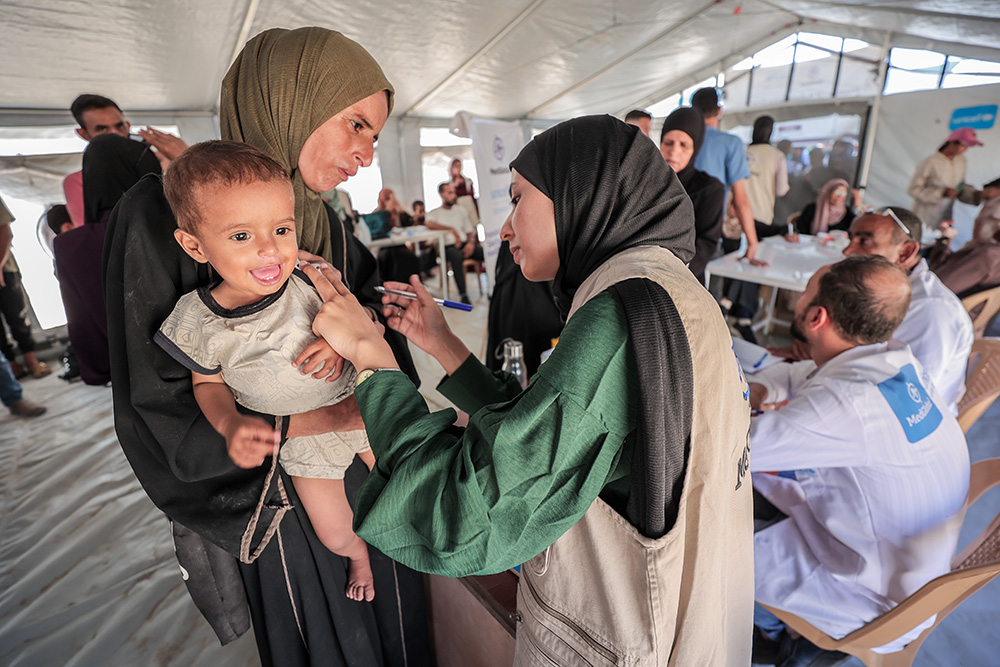
A child is screened for malnutrition in a camp in Gaza, where MedGlobal has nutrition outpatient clinics, October 2025. (Courtesy of MedGlobal)

Join the Conversation
Send your thoughts to Letters to the Editor. Learn more
When pediatrician John Kahler from Chicago walked past a garbage dump in Rafah in the southern Gaza Strip early 2024, he noticed a family of seven standing beside a parked car, studying the rubbish.
He assumed they were searching for something to salvage. Instead, the parents were looking for a place to pitch a tent for their family.
On this same trip, he saw hundreds of displaced people waiting in orderly lines for bread and water. At the primary care clinic he helped establish, medical teams sometimes saw 500 to 700 patients daily. Children arrived with seizures and chronic illnesses; their access to specialist treatment beyond Gaza had been cut off.
Kahler, a Catholic grandfather of 12, still thinks about that encounter near the dump. For him, it captured how quickly ordinary family life had become a struggle for survival in Gaza and why improved nutrition figures cannot, by themselves, mean recovery.
One new study, for example, by the humanitarian medical organization MedGlobal offers unusually hopeful numbers. It says acute malnutrition among children under 5 in Gaza fell by half, from 16.8% in July 2025 to 8.4% in July 2026. Severe acute malnutrition dropped from 6.8% to 2.1%, a 69% reduction. Released on October 13, the report, "Aid Reached Them. They Recovered," links these improvements to expanded humanitarian access and treatment after the October 2025 ceasefire.
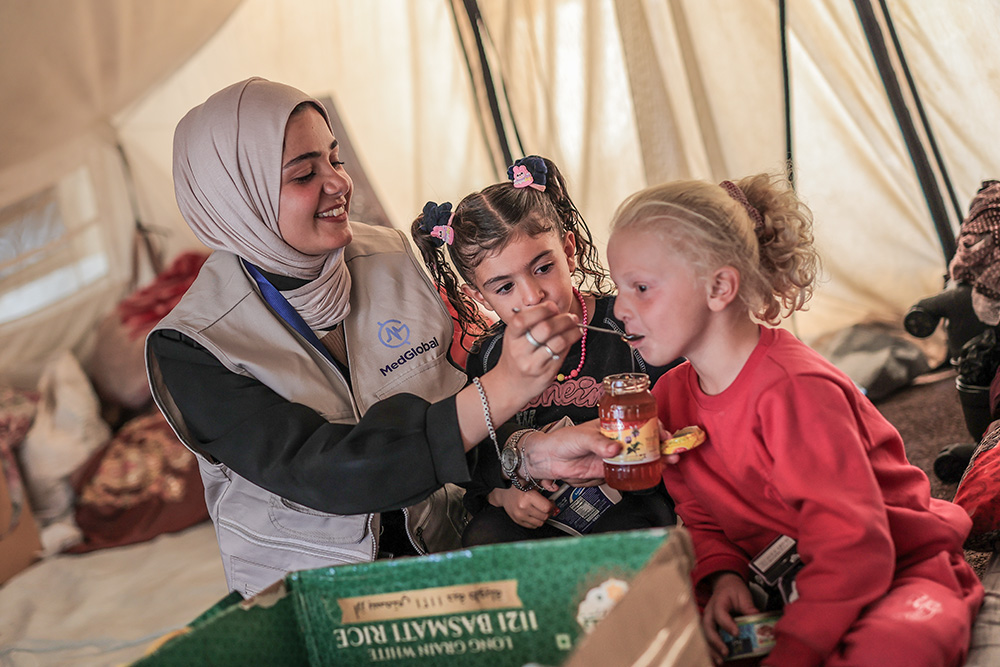
MedGlobal distributes food parcels to displaced families living in the Tabareyya Displacement Camp in Khan Younis, southern Gaza, in December 2025. (Courtesy of MedGlobal)
The findings come from surveys conducted a year apart, not repeated examinations of the same children. In July 2026, MedGlobal surveyed 1,304 households and assessed 1,250 children aged 6-59 months across four Gaza districts. The comparison reveals a striking population-level improvement, but cannot establish that each child previously diagnosed with malnutrition has recovered.
The contrast with the previous year is particularly stark in northern Gaza, where MedGlobal had measured acute malnutrition at 25.6% in July 2025. The organization credits a wider effort involving therapeutic foods, early screening, maternal support, and community outreach alongside other humanitarian agencies.
For some children, however, the report documents individual progress. Yara, a 28-month-old girl admitted to a MedGlobal-supported stabilization center in Khan Younis in December 2025, weighed just 7.76 kilograms and was severely malnourished. After medical care, therapeutic feeding and follow-up, her weight reached 9.36 kilograms.
MedGlobal president Dr. Zaher Sahloul, a pulmonary and critical care physician who helped establish the organization in 2017, told the National Catholic Reporter he has seen a very different Gaza in recent years. During an early-2024 medical mission at Nasser Hospital in Khan Younis, he found displaced families sheltering around the building and patients lying on mattresses in corridors.
"It's like you are transported to a parallel universe," he said of crossing at Rafah.
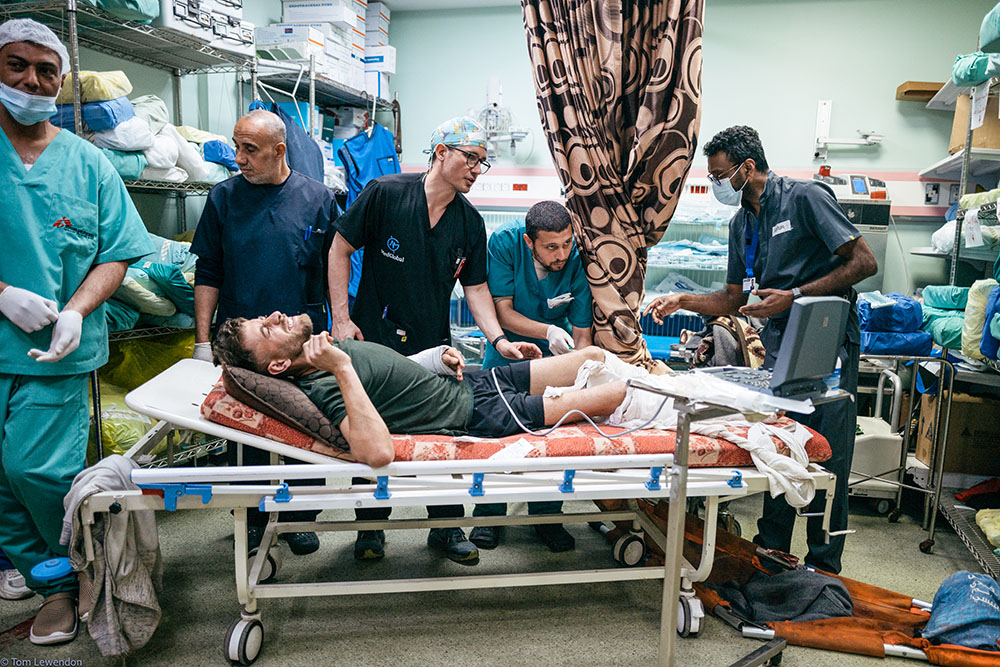
MedGlobal volunteer Dr. Jonathan Mathers assists local doctors in treating an injured patient at Al-Aqsa Hospital in Gaza, March 2024. (Courtesy of MedGlobal)
After one nearby military strike, about 200 casualties arrived at the emergency department, he said. There were too few beds, so patients were treated on the floor. Among them was 13-year-old Khalil Ahmad, who had brain and liver injuries. Despite surgery, the boy never regained consciousness.
"I still remember his name," Sahloul said. He said he later showed photographs from that mission to then-President Joe Biden, hoping to convey the human consequences of the war.
From July 2025 to July 2026, MedGlobal teams screened more than 100,000 children under 5, supported treatment for over 21,500 children and counseled 65,704 mothers and caregivers, the report said.
Sahloul said hundreds of Palestinian health workers continue running clinics and other services even as international staff face restrictions on entering Gaza. The more recent improvements sit alongside severe vulnerabilities. Citing food-security projections, the report warns that 74,200 children could need treatment for acute malnutrition through April 202. Approximately 1.4 million residents remain in crisis-level or worse food insecurity. Meanwhile, despite the ceasefire's reduction of major combat, more than 1,400 Palestinians have been killed since it took effect, according to the United Nations.
New disruptions underline the risk. On Oct. 15, the Associated Press reported that commercial goods had not entered Gaza for two days, interrupting deliveries of products, including fruit and winter clothing. Humanitarian agencies can provide staples, but functioning markets are also needed to supply perishable foods and keep prices affordable. The shutdown's duration beyond that report was not established.
Advertisement
Responsibility for the stoppage was disputed. Israel's military agency overseeing humanitarian affairs, COGAT, said Palestinian merchants had stopped coordinating shipments because of fees and threats from Hamas. Gaza's private truckers union rejected that explanation and blamed Israeli restrictions.
For Kahler, the report's findings deserve neither dismissal nor celebration right now. "If you feed children, they grow," he said. But he cautioned that the survey did not follow the same children over time and that its results cannot describe the full needs of newborns, pregnant women or older residents, or measure the social and psychological damage of the ongoing displacement.
"I'm not optimistic," he said.
Kahler, who practiced pediatrics for more than four decades, co-founded MedGlobal with Sahloul after humanitarian work in Aleppo, Syria. A Catholic educated in Catholic schools for 18 years, he traces his commitment to humanitarian service to the social justice teachings of his youth and said his faith shaped a lasting obligation to prioritize people living in poverty.
"The need and the willingness to privilege the poor," he said, is something his faith instilled in him. "That's the soul that drives the machine."
Sahloul also said he resists interpreting these numbers as evidence that Gaza's health system is secure when hospitals remain damaged, medical evacuations are difficult, and patients with cancer or other conditions still struggle to obtain treatment outside the territory. The return of some food supplies cannot replace destroyed homes, schools or hospitals.
"There is improvement, definitely, but there is a huge fragility," he said. "People are dying just waiting for treatment."