

<div style="text-align: center;"><div style="margin-bottom: 10px; padding-bottom: 10px; border-bottom: 1px dotted #ccc;" class="full_width_image"><img style="width: 624px; max-width: 100%;" src="https://www.ncronline.org/files/styles/email_newsletter_full_width/publ… style="color: #04619d; text-decoration: none;" href="

<div style="text-align: center;"><div style="margin-bottom: 10px; padding-bottom: 10px; border-bottom: 1px dotted #ccc;" class="full_width_image"><img style="width: 624px; max-width: 100%;" src="https://www.ncronline.org/files/styles/email_newsletter_full_width/publ… style="color: #04619d; text-decoration: none;" href="


(Unsplash/Pablo Heimplatz)

by Mary M. McGlone
Join the Conversation
Send your thoughts to Letters to the Editor. Learn more
When was the last time you let God have it in anger? I suspect lots of Christians balk at the idea of telling God off. It sounds irreverent, perhaps even blasphemous. Unlike us, our Hebrew ancestors knew that along with love, praise and petition, a deep relationship with God can withstand angry outbursts and even some whining.
Jeremiah is the champion lamenter of the Hebrew Scriptures — and that's saying something. (For another prize-winning complaint check out Psalm 22:7, 13-19 — and that's just one among a multitude of examples!) The Hebrew tradition of "fear of God" (utter awe at God's greatness and compassion) allowed for the expression of deep passion.
Remember Abraham? Questioning God took him to the threshold where God could make a promise greater than Abraham would have imagined (Genesis 15:1-6). Then we have Moses, who tried to avoid confronting the Egyptians by claiming a speech impediment; God reminded him of who gave humans the power of speech and then promised the human help he needed to do what he was called to do (Exodus 4:10-17).
When we hear Jeremiah cry, "You duped me," our translation has made his complaint polite, washing out its passion. A translation truer to what Jeremiah said is: "You seduced me, Lord, and I let myself be seduced." Once again, we seem to be treading toward blasphemy, right? But listen as Jeremiah continues to pray: "I want to quit this ministry, but your word is like a fire in my heart. When I try to hold it in, it explodes inside me. I can't withstand it! It's about to break my bones!" Now that's a lesson in praying with passion!
What had happened to Jeremiah was that he received a new perspective. God enticed him into a mindset and course of action that he didn't want but couldn't refuse. This is what Paul tries to encourage in the Romans as he says, "Don’t conform to this age. Let yourself be transformed to learn what is really good and pleasing and perfect." Now, if you think we've drifted out of passion and into pious platitudes, you're missing the point.
Today's Gospel invites us to enter into the Christian adventure with countercultural passion. After last week's rendition of Peter's proclamation of faith, Jesus tells the disciples that being the Messiah is not what they would like to imagine. In response, moments after proclaiming unconditional faith, Peter became Jesus' tempter. Echoing the devil who urged Jesus to use his power for himself and make God his security blanket (Matthew 4:1-10), Peter reproached Jesus for talking about suffering.
Echoing his words to the devil himself, Jesus told Peter to get behind him. Yet, Jesus' approach to Peter was not really a dismissal. Using the same vocabulary he had used when he first invited Peter to discipleship, Jesus told Peter, "You are to follow me, not vice versa."
With that, Jesus offered Peter the divine seduction. "Those who wish to save their lives …" In other words, "Focusing on your own safety is a vicious circle — you'll never have enough of it. If you are free enough to give yourself, nobody can threaten you ever again."
Advertisement
Jesus was inviting Peter to remember why he had followed him in the first place. Jesus didn't call his friends to ascetic sacrifice, but to a life full of the unique joy that comes from the freedom to be for others. This was not a call to a discipleship of cheering a prophet or studying under a rabbi. Jesus was inviting Peter and company to share his very purpose in life.
Matthew, Mark and Luke recount this story as we hear it today. John communicates the same idea by quoting Jesus as saying, "I am the vine and you are the branches" (John 15). In both instances, Jesus was inviting them to an all-or-nothing choice: Become a part of me, or make your own path to wherever it will lead.
Might we take these readings as teachings about prayer and discipleship? Both Jeremiah and Peter had a bone to pick with God. And for both of them it had to do with going where they had never intended to go. But, as we saw above, Jeremiah received a new perspective. Nothing was forced on him. Nor on Peter and friends. They had their own ideas and God enticed them beyond their safe havens.
Today we're reminded that, whether we like it or not, the God of Jesus is the great seducer. God simply can't let us settle for puny expectations and sheltered sanctuaries. This God who risked creation and incarnation wants us to share the divine passion — to provoke us into finding our life by letting go.
<div style="text-align: center;"><div style="margin-bottom: 10px; padding-bottom: 10px; border-bottom: 1px dotted #ccc;" class="full_width_image"><img style="width: 624px; max-width: 100%;" src="https://www.ncronline.org/files/styles/email_newsletter_full_width/publ… style="color: #04619d; text-decoration: none;" href="

<h2><a style="color: #04619d; text-decoration: none;" href="https://www.ncronline.org/spirituality/soul-seeing/forgiveness-reflects… reflects the depth of our connection with God</a></h2><div style="font-weight: bold; font-size: 15px; font-family: Arial, sans-serif;" class="byline">by B.G.
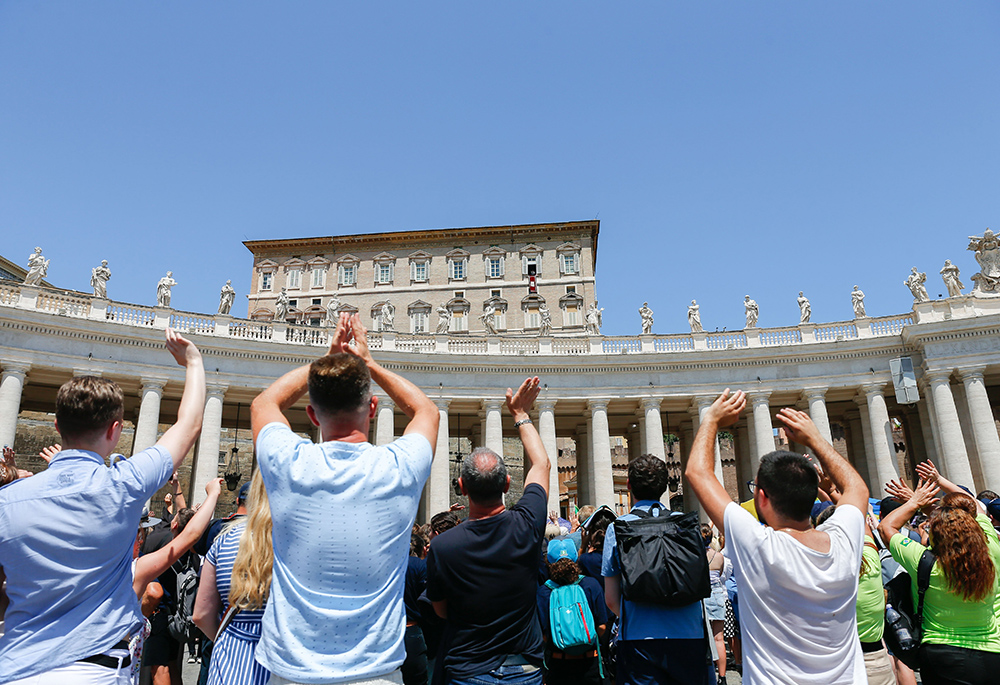
Visitors applaud and greet Pope Francis after praying the Angelus in St. Peter's Square at the Vatican July 9. (CNS/Lola Gomez)
by Mary M. McGlone
Join the Conversation
Send your thoughts to Letters to the Editor. Learn more
Jesuit Fr. John Foley, one of the St. Louis Jesuits of liturgical music fame, composed "Who Has Known" based on today's second reading. This song contemplates God's inscrutable judgments and unsearchable ways via the mystery of the Incarnation. The reverent words and mellow music conspire to help us approach the word of God, the Eucharist and our brothers and sisters with awe, as a mystery of revelation.
In today's first reading, Isaiah prophesies that God will depose an unworthy leader. When he depicts a different, worthy leader, he describes someone as committed as a parent to provide for the total well-being of the people. Such loving dedication is what gives this leader the "power of the keys," the authority/ability to help the people flourish by providing opportunities and prohibiting harmful behaviors. The exercise of this nurturing guidance gives stability to everyone blessed by the influence of such servant-leaders. Isaiah gives us the sense that leaders chosen by God inspire reverence and show it to others.
These ideas provide the background music to today's Gospel — an incident we might see as another rendition of the call of Peter.
This scene opens with the most important, intimate, and serious question one person can ever ask another: "Who do you say that I am?" The disciples couldn't dodge the question with an indirect, "They say …" So, Peter took the risk and blurted out what they had been thinking and hoping: "You are the Christ."
That was no simple statement. Although he surely didn't understand all its ramifications, calling Jesus "the Christ" entailed a commitment as radical as any vow. It's as strong a statement as, "Yes, I will marry you," or "I am consecrating my whole life to this." Peter's confession that Jesus was God's Son, implied a promise to follow, to listen, to obey Jesus as one would obey God alone. His statement indicated that absolutely nothing in the world could take precedence over his response to what Jesus would ask of him.
Of course, Peter did not fulfill his promise immediately or flawlessly. He continued to dispute Jesus' predictions about suffering, he wanted to put limits on forgiveness, he bragged and argued with other disciples. Matthew and Mark probably summed up Peter's discipleship with the sentence, "Peter followed at a distance" (Mark 14:54, Matthew 26:58). But the important point was not the distance, but the following. Peter took the risk over and over. He had committed himself by saying, "You are the Christ," and he strove to live that commitment for the rest of his life.
Upon hearing him, Jesus responded, "How blessed you are, Peter! This is not something you could figure out on your own." Peter did not figure it out alone and he could not live it out alone. His religious heritage, his relationship with Jesus, his prayer, the companionship of the other disciples — all these people and experiences were included in God's revelation to him. All of them enabled him to keep growing into the commitment he had professed.
Advertisement
It seems that Jesus chose Peter, not for what he could accomplish or for his wisdom or strength, but for his capacity for metanoia, his willing ability to change and learn, to cultivate an ever-larger vision. Peter's faith allowed him to grow into his commitment and that faith is the rock Jesus chose as the foundation of his church. Peter's faith allowed him to weep for betraying Jesus: Knowing his need for conversion, he could be a worthy leader, the keeper of the keys for a frail church.
Jesus' question was at least the second time Jesus called Peter and the disciples to their vocation. By professing that Jesus was the Christ, they pledged to follow him. They would not do it flawlessly, but they would continue on the way, faithful enough to get up and keep going after falling.
So much for Peter and company. What do we say when Christ asks, "Who do you say that I am?"
Every Sunday we profess the creed. Is it possible that its philosophical and historical language cushion us from the radicality of Peter's simple, commitment-compelling statement? Do we ever feel implicated by what we are saying? Is there any statement in the creed that feels so risky that we think twice before saying it? What phrase could move us to awe?
All the components of today's liturgy — from readings to the creed to the command, "Do this in memory of me" — conspire to shake us up. Today, we find ourselves called to answer Jesus' question for ourselves. Happily, we don't need to figure it out alone, nor live it alone. God's revelation comes through community, word and sacrament. In that, we can believe, and that's awesome.
<h2><a style="color: #04619d; text-decoration: none;" href="https://www.ncronline.org/opinion/ncr-voices/moral-lessons-trumps-lates… moral lessons in Trump's latest indictment</a></h2><div style="font-weight: bold; font-size: 15px; font-family: Arial, sans-serif;" class="byline">by Michael Sean Winters</div><div style="font-size: 19px; font-family: 'Georgia', serif;"><p>The real