

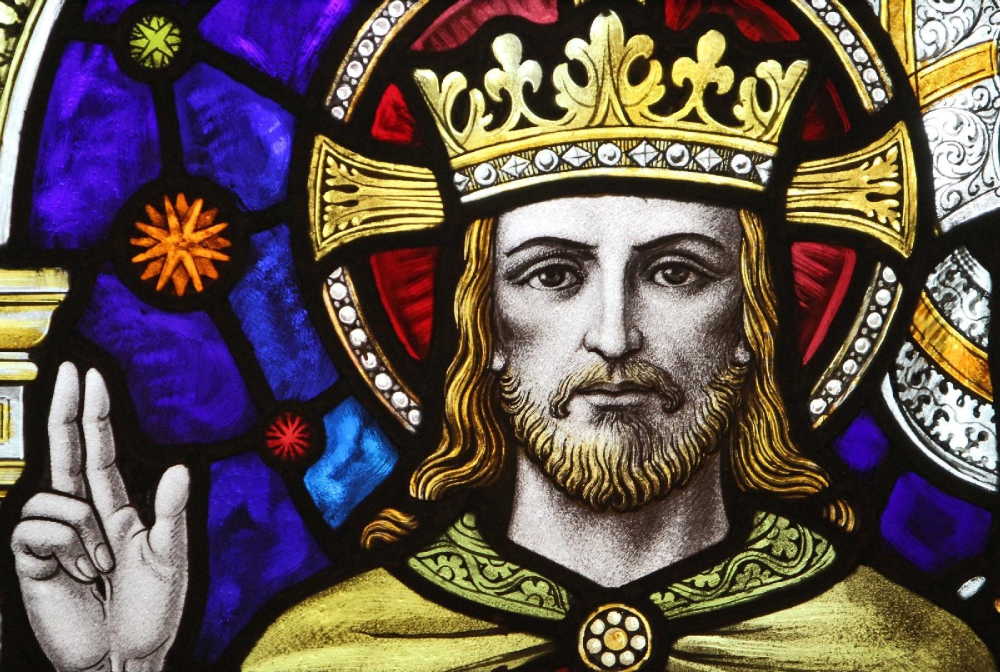
A stained-glass window of Jesus wearing a crown is seen in this 2011 photo at St. Joseph's Seminary in Yonkers, N.Y. (OSV News/Gregory A. Shemitz)

by Sr. Mary M. McGlone
Join the Conversation
Send your thoughts to Letters to the Editor. Learn more
"Save yourself!"
Don’t we hear that hundreds of times a day, in various ways? Save yourself from the embarrassment of psoriasis. Save yourself from paying too much for insurance. Save yourself from strangers by getting a door camera. Save yourself from those who would do your job for lower wages than you get. Save yourself from people horning in on your rights by supporting DEI, from the pernicious effects of vaccines and from anything that would threaten or inconvenience you. Save yourself!
Luke used the word "save" four times in his telling of the crucifixion. The people who told Jesus to save himself did so sneering and jeering, or proposing that saving himself would prove that he was the Christ. Almost everyone who called out to Jesus mocked him as a failed, disgraced messiah.
The only speaker who refused to scorn him also shared his fate. As Jesus’ companion on the hill of Golgotha, the man we call St. Dismas defended Jesus’ innocence. Then, he made an astounding profession of faith in the vulnerable and ridiculed Messiah who was taunted as "King of the Jews." Dismas prayed, "Remember me when you come into your kingdom." That statement of belief articulated the paradox characteristic of the Gospel: a criminal recognized the suffering and humiliated Jesus as the savior. In the innocent suffering victim, Dismas saw a revelation of God, the one whose power the world would never understand.
At Easter, Oriental Catholics and Orthodox Christians sing the perplexing phrase, "By death, he conquered death." This chant implies that Christ freely faced down death and that in his resurrection, God confirmed that Jesus’ love was stronger than death. That opened the way for Jesus’ followers to do the same.
The four gospels portray Jesus’ last hours differently. John depicts Jesus as the author of his own fate saying, "It is finished." Similarly, Luke quotes Jesus’ last words as, "Father, into your hands I commend my spirit." Mark and Matthew offer a more desperate version in which Jesus cried out, "My God, why have you forsaken me?" Still, each account demonstrates Jesus’ trust in the Father — whether or not he understood what the Father was about in what was happening.
The King we celebrate on this final feast of the year is no ordinary ruler. When the people chose David as their king, God confirmed the choice and told David, "You shall shepherd my people and be commander of Israel." God commissioned David to protect and defend his people. Jesus did that in a most uncommon way: he gave his life to reveal the ultimate powerlessness of death and evil. Not only that, but King Jesus actually encouraged his followers to accept a similar martyrdom if it came.
In today’s selection from Colossians, Paul calls Jesus "the image of the invisible God." What does that mean? Pilate presented the captive, beaten Jesus to the crowd saying, "Behold your king." Is that our image of God? Do we believe that the crucified Jesus presents one of the clearest images of God we will see on this earth? It’s a lot easier to think of him walking on water or rising from the grave — but, like it or not, the cross is the primary image we display in our churches.
Advertisement
Paul says that Jesus made "peace by the blood of his cross." There are two ways to interpret that. One tradition says that Jesus’ blood paid God back for human sin. A different perspective suggests that Jesus manifested God’s unrelenting outreach to us. It understands Jesus’ cross as a revelation of how God absorbs evil, overcoming it with love. From this perspective, the cross reveals the depth of God’s desire for us: a passion that cannot be stopped even by the attempted deicide of the crucifixion. The king whom we celebrate today is supremely vulnerable and loving.
Advent begins next Sunday, making this the final week of the church year. This feast and the four Sundays which follow invite us to meditate on just who this King, this God incarnate, really is — and therefore, what it means to be Christ’s disciple.
Paul says that the Father has made us fit to share in the inheritance of the holy ones, delivered us from the power of darkness and transferred us to the kingdom of his beloved Son.
God’s desire is that we participate in Christ’s Kingdom as it is revealed in the life, death and resurrection of Jesus our Christ.
Today’s feast puts us to the test. According to Paul, we have been made fit to follow Christ in absorbing evil without resorting to it. Do we want to live in the reign of a vulnerable God?
Do we want salvation in the mode of Christ the King, or shall we look for another?