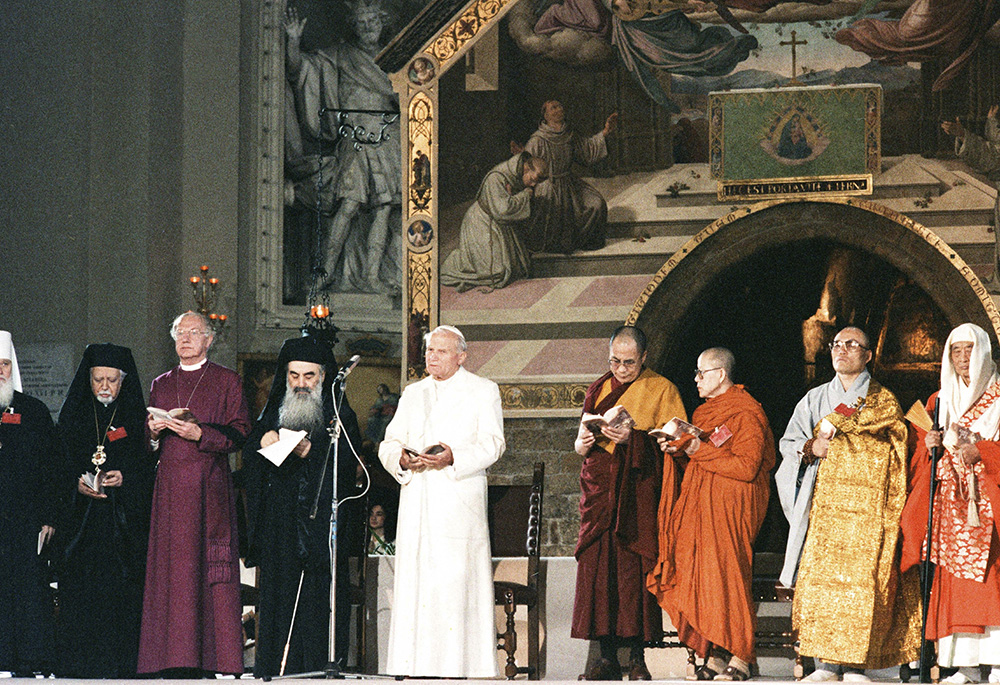
Pope John Paul II attends an interreligious peace meeting in Assisi, Italy, in this Oct. 27, 1986, file photo. (CNS/L'Osservatore Romano)

by Chris Crawford
Join the Conversation
Send your thoughts to Letters to the Editor. Learn more
This is not an easy time to work across lines of difference — especially across religious differences. Particularly since the attacks of Oct. 7, 2023, I have heard many Jewish and Muslim friends express hesitation and fear about working in interfaith spaces.
Amid these challenges, it is worth reflecting on the example of St. Pope John Paul II and his historic gathering in Assisi 40 years ago. He convened the World Day of Prayer for Peace — bringing leaders from a wide range of religions to pray alongside one another. He tried to strike a challenging balance — to gather international, interfaith leaders to each pray for peace while also being clear that his own Catholic Church has the truest religious understanding.
In the face of rising antisemitism and Islamophobia in the United States, this anniversary is an opportunity for Catholics to consider how we can be good neighbors.
The Assisi meeting had a lasting impact on John Paul II, which we can echo today.
As John Borelli, who served over 16 years at the U.S. Conference of Catholic Bishops in ecumenical and interreligious affairs, told me on a recent recording for my podcast, "Our Little Portion," this first meeting developed the idea of a "Spirit of Assisi." In his 1986 annual Christmas Address to the Curia, John Paul II spoke as if he could not stop thinking about the Assisi gathering, and seemed to consider it one of the most important events of his papacy.
This "Spirit of Assisi" has been both celebrated and contested. One writer called the Assisi gathering a "disaster," and claimed that the end result of Assisi was the sense that Catholics believe that their religion is just one among many — rather than the one true faith.
But many others believe that the Assisi gathering was a revolution in interfaith dialogue, understanding and work toward peace. The goal of the gathering was not syncretism or a blending together into one unified faith, the goal was to provide space for distinction. Catholics, of course, hold that ours is the one true faith. Peacefully coming together to pray for common goals and dialogue together does not water down our traditions. In many cases, it can strengthen our own understanding of our tradition.
Advertisement
In a reflection on the Vatican website, Cardinal Roger Etchegaray, one of the planners of the original gathering, wrote about how that the leaders were moved to tears during the closing ceremonies, including a particularly moving experience during the finale when, outside St. Francis' Basilica, "some young Jews leaped up on to the platform to offer olive branches to us, and to Muslims first of all, I found myself wiping the tears from my own face."
The Holy Spirit was moving, and the movement continues to this day. John Paul II gathered interfaith leaders in Assisi multiple times, and Pope Benedict XVI continued the tradition in his own way — including adding secular humanists to the group. Indeed, Cardinal Joseph Ratzinger was one of those leaders with concerns about the first Assisi gathering, but went on to make the tradition his own as pope.
Rabbi David Rosen attended multiple Assisi gatherings. In a recent interview with "Our Little Portion," he recalled John Paul II's powerful words to him at Assisi: "You know I have said, 'You are our dearly beloved elder brother of the original covenant, never broken and never to be broken.' " Assisi was, in many ways, the next step following the Nostra Aetate document of the Second Vatican Council that decried antisemitism in all of its forms and rebutted the idea of placing the blame for Jesus' death at the collective feet of the Jewish people.
Rosen said that interfaith engagement on areas of shared values is necessary — to not do so would be to betray those very values.
Similarly, Homayra Ziad, a scholar who was featured in the film "The Sultan and the Saint," said that shared understanding of humanity made in the image of God calls us to greater understanding. She told me:
If I believe we are each created in the image of the divine, then I am called to ardently seek that divinity in myself and in every single created being, to establish a deeper and more sustained connection with the higher energy that binds us all — or as Pope John Paul II said, "the deepest and most vivifying sources where …[humanity's] conscience is formed and upon which is founded the moral action of all people."
Through times of discord, interfaith leaders have returned to Assisi — during the Cold War, during the Balkans war, and following the September 11 attacks. They show us that even amid war, chaos and polarization, dialogue and shared action are still possible.
What, then, does the Spirit of Assisi mean for us?
Rosen defined it this way:
A recognition that we have an obligation not only to know one another but to work together especially for peace. … And for its prayer to be its own prayer. Neither syncretistic nor having to water it down in order to accommodate others, and then at the same time coming together, affirming a unity of human brotherhood.
If we are to be faithful to the Spirit of Assisi in this generation, it is going to require that we, too, find our own way of living out the truth of the Catholic faith in a way that deepens our understanding as we walk with people of other faiths. This means standing with our Muslim and Jewish brothers and sisters as they face increased hate and attacks on their religious freedom — while understanding that our own religious freedom is intertwined with theirs. Ultimately, it requires that we find inspiration to love as Jesus loved — including all of our neighbors and even our enemies.
Here, St. Francis provides us with a powerful example. In the middle of the Fifth Crusade, Francis chose to cross enemy lines to meet with Sultan Malik al-Kamil. Little is known about this meeting, other than a few essential facts: Francis preached to the sultan and engaged in dialogue with him, and he returned home alive, against all odds.
Franciscan Br. William Short has written that the meeting was unimaginable, given the hostilities of the time and the dehumanizing ways Muslims and Catholics viewed each other.
Ziad pointed out that Francis and Sultan al-Kamil were uniquely prepared for their encounter. She noted that the sultan "grew up educated both religiously and in secular matters, surrounded by scholars, scientists, and artists; knowledge and the sharing of knowledge was seen as a value and he liked to surround himself with people of learning." She also pointed out that the Quran and early Muslim tradition have high regard for Christian holy people.
She told me, "In many ways, both [the sultan] and St Francis had been 'prepared,' in different ways, for an encounter where they could be changed by the other, indeed even their forms of devotion could be shaped by the other."
Still, it was not easy for Francis or the sultan to cross "enemy lines." Gathering interfaith leaders in Assisi was not easy for John Paul II, Benedict XVI or Pope Francis. Pope Leo XIV's calls for world peace are not easy, either. But amid war, hate and division, each of us must do our part to build bridges of understanding and work together for the common good.
Ziad posed the question that our Catholic institutions need to answer:
"How can religious institutions invest in preparing our young people to engage difference with true sincerity, curiosity and divine love, understanding that the traditions we misunderstand as closed loops were shaped every step of the way through interreligious encounters?"
Indeed, as we commemorate this 40th anniversary of St. Pope John Paul II's first gathering in Assisi, we must continue the work of a more peaceful way forward for all religions.