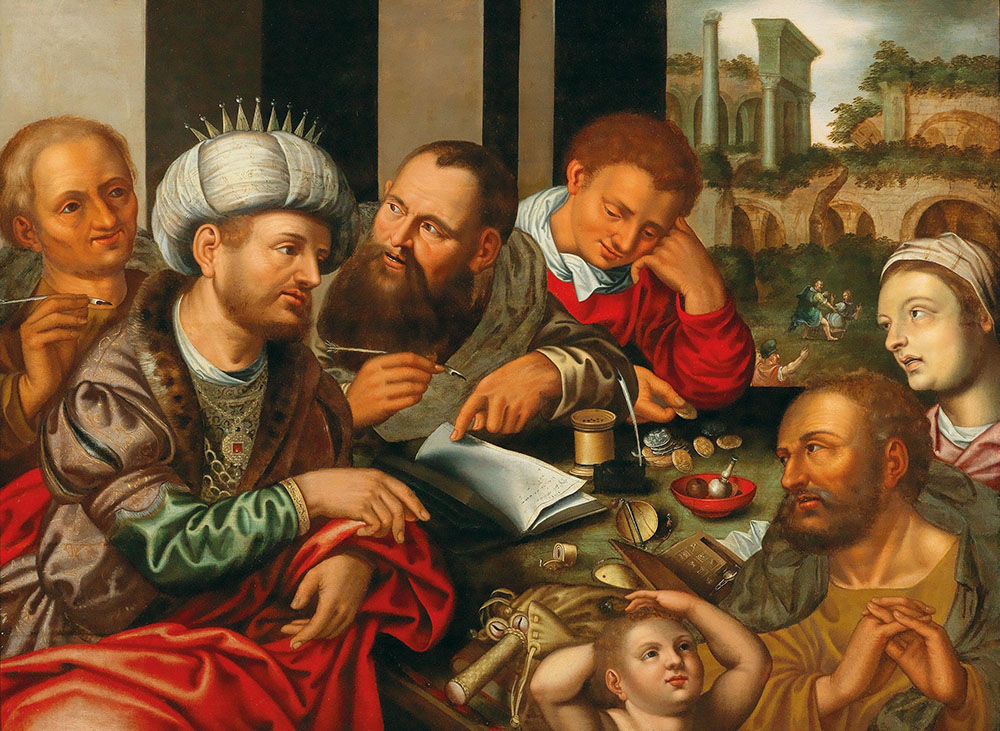
"The Parable of the Merciless Creditor," 16th-century painting by Flemish artist Jan Sanders Van Hemessen (Artvee)

by Sr. Mary M. McGlone
Join the Conversation
Send your thoughts to Letters to the Editor. Learn more
Our family lore tells us that one day, playing sandlot baseball, my grandfather hit a home run that struck a young woman walking nearby. She wasn't hurt and he ran to her, introduced himself, apologized — and here I am as a result. If he had struck out, there are generations who wouldn't be around today.
I'm not saying it's a miracle, but every human is born as the result of a phenomenal series of chances, from the time life appeared on Earth to whenever we were conceived.
Our lives are a gift that we've done nothing to earn or deserve. As Pope Leo XIV teaches in his encyclical, Magnifica Humanitas, we are created in the image and likeness of God, life is a gift, and our dignity is a gift "that precedes and transcends each person, endowed by God as an expression of his unfailing love."
"Endowed." An endowment, an inheritance, is undeserved, the result of circumstances and generosity beyond our control. Our life, our talents and all that surrounds us, is pure gift. We've done nothing to deserve it, we couldn't possibly earn it, all we can do is receive and cultivate it as best we can. Developing our gifts and using them in the best way possible is the only way we can give thanks or begin to respond adequately to what we have been given.
Awareness of our graced endowment prepares us for the parable Jesus tells us today.
Jesus talks about a fabulously wealthy king whose servant owed him 10,000 talents. Even Elon Musk would have a hard time understanding this amount, the equivalent of about 164,000 years of labor.
So, says Jesus, the king decided to sell the man and his family and repossess everything he had. That decision stripped the man of his dignity, defined him as nothing more than a hopeless debtor, and relegated his family to the status of property to be traded. In the light of the king's wealth, this punishment served as nothing more than an example. His gain would bring such a paltry recompense that it would hardly be worth the effort of arresting the man and his family.
But when the man begged, the king exercised the greatest power available to humanity: He forgave the debt. He affirmed the man's human dignity and treated the man as a fellow human being. The king acted as kings of Israel were called to act; he was a savior who fashioned a life-giving realm, an environment in which all could flourish.
Tragically, the one-time debtor snubbed the king's greatest gift, the freedom to express royal benevolence, a spirit of prodigal generosity. The pitiful man exerted petty power over his companion, severely diminishing his own humanity by valuing a sum of money over the dignity of his coworker.
Advertisement
Their fellow servants, acting as guardians of the common good, informed the king, who relegated the hardhearted servant to the sort of world he was creating by his brutal behavior.
The parable of the king and servants teaches that living Christian values is not only charitable, but wise. Everything we do affects our world and contributes or diminishes its spiritual, psychological and material ecology. Thus, every act of forgiveness, every act of kindness, every gesture of love contributes to the evolution of a civilization of love, a world in which all people and creation can flourish.
Leo begins Magnifica Humanitas by saying that each generation inherits the task of shaping its era. In Paragraphs 213-223, he explains that a civilization of love will not arise from a single or spectacular gesture, but from the sum total of small and steadfast acts.
He suggests that we can shape our era by practicing five specific types of action: disarming our words, building peace through justice, adopting the perspective of the victims, cultivating healthy realism, and reviving dialogue.
The king of Jesus' parable did just that. He spoke and listened with compassion; he acted justly, allowing the wicked servant to live in the world his actions created; he opened himself to the perspective of both debtors; he was realistic in his judgments, accepting that the wicked servant spurned the opportunity to act with compassion; he changed his opinions and course of action as a result of dialogue, accepting new information and responding accordingly.
Today, Paul reminds us, "No one lives for oneself ... we live for the Lord." Living for the Lord means that we humbly accept the gratuitous gift of our lives. God has no expectation that we pay for what we have received, only that we cooperate in the work of creating a civilization of love with small, steadfast acts that will have repercussions for generations to come.