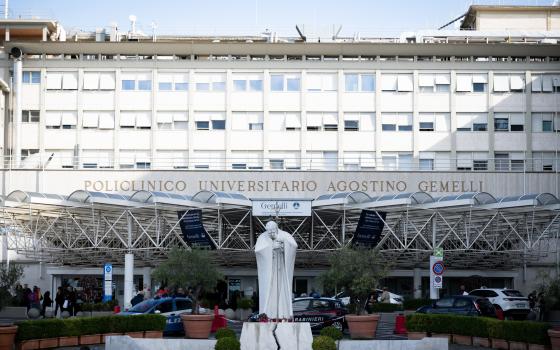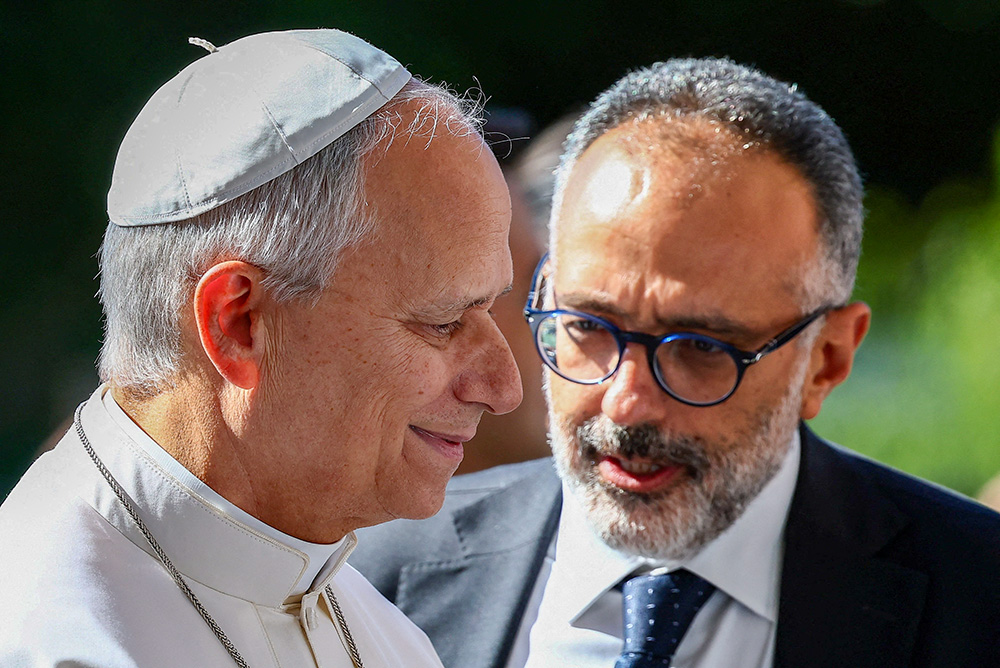
Pope Leo XIV talks with his personal physician, Luigi Carbone, as the pontiff arrives at Rome's Gemelli Hospital Oct. 13, 2026, ahead of his surgery that afternoon. (OSV News/Reuters/Guglielmo Mangiapane)

Join the Conversation
Send your thoughts to Letters to the Editor. Learn more
Pope Leo XIV continues to recover from surgery to remove a tumor in his lung, the Vatican said, but no further details about tests to determine the status of his cancer were provided.
The morning after he underwent a successful operation that removed the lower lobe of his right lung, the pope is following a "normal postoperative course" as confirmed by blood tests and a chest X-ray.
"The Holy Father underwent respiratory physical therapy and began walking around his room," said a statement from the pope's doctors provided by the Vatican Oct. 14. "He has resumed his regular diet, eating breakfast and lunch. His recovery is proceeding as expected."
The Vatican later said that the pope had concelebrated Mass in the hospital where he is recovering. The suite where the popes typically stay in Rome's Gemelli hospital is under renovation, and another space on the 10th floor of the hospital was adapted for the Mass.
Though Leo is recovering smoothly from his operation, further tests are still required to determine whether any cancer remains in the pope's body.
The pope originally said the surgery would address a nodule, or small lump, detected in his lung. Most lung nodules are not cancerous, but during the operation on Tuesday afternoon, the doctors found a malignant tumor that "confirmed the diagnosis of pulmonary adenocarcinoma, as suspected by the preoperative tests."
Advertisement
As a result, surgeons performed a radical resection on the pope's lung in an attempt to fully remove the tumor as well as a portion of healthy tissue around it. He was in the operating room for a total of three hours, and the operation itself lasted about 90 minutes.
Dr. Alexis Chidi, a thoracic surgeon at Memorial Sloan Kettering Cancer Center in New York, said that after a lobectomy like the one Leo had, doctors will have a better idea of the type of cancer and what stage it is between seven to 14 days after surgery.
"The pathologist will take a very close look at both the lung tissue that we've removed and the lymph nodes and let us know the extent of the tumor that they see," Chidi told the National Catholic Reporter. "Based on that, the total size of the tumor, whether there's one or multiple, and whether there are any lymph nodes involved, that determines whether additional things like chemotherapy, immunotherapy or targeted therapy are necessary."

Dr. Alexis Chidi (Courtesy of Memorial Sloan Kettering Cancer Center)
Chidi said that when doctors detect a tumor at an early stage, which is how Leo described the nodule found in his lung, "we think of a tumor that's small and doesn't have any evidence on imaging of there being any lymph nodes involved, so that's a good sign."
"In most cases, when they do a lobectomy, they've taken out all of the existing tumors," she added. "All of those preoperative tests would help them figure out the extent of surgery that would be necessary."
As for his recovery, Chidi recommends that her patients stay in the hospital for two to four days after a minimally invasive procedure such as the pope's, yet the Vatican has cleared Leo's schedule for a full week through Oct. 20.
With the pope's intense tour of Latin America on the calendar for next month, consisting of a dozen flights over 11 days, questions remain about whether Leo will need to postpone his highly anticipated homecoming to Peru.
Chidi said she tells her patients that they may feel back to normal after six to eight weeks, but that it largely depends on each individual's stamina. On concerns over whether Leo can fly, the surgeon said that a patient developing pneumothorax — a buildup of air around the lung — can be dangerous for individuals getting on an airplane, but "when we see our patients at their postoperative visits and even when they leave the hospital, we try to make sure that they don't have that going on."
As to whether Leo can work while in the hospital: "I have had some patients who have really high-powered jobs and in the hospital they have their laptops," Chidi said.
This story has been updated since publication.
The National Catholic Reporter's Rome Bureau is made possible in part by the generosity of Joan and Bob McGrath.