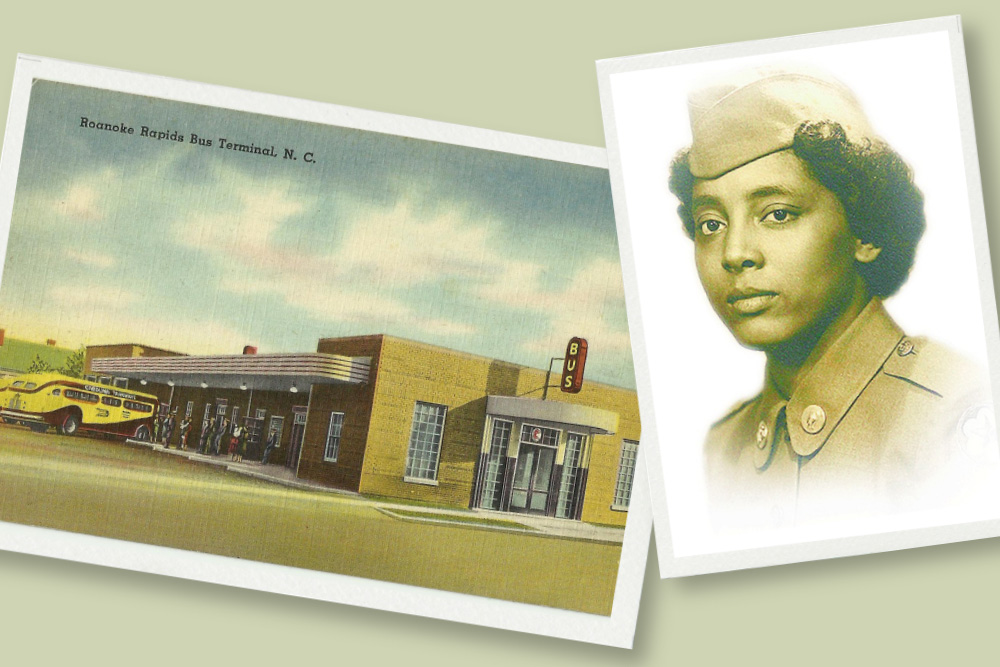
Right: Private First Class Sarah Keys in uniform in the 1950s (Wikimedia Commons/U.S. Army). Left: A postcard of the bus terminal in Roanoke Rapids, N.C., where Keys refused to give up her seat to a white Marine on an interstate bus (Wikimedia Commons/State Archives of North Carolina).

by Alessandra Harris
Join the Conversation
Send your thoughts to Letters to the Editor. Learn more
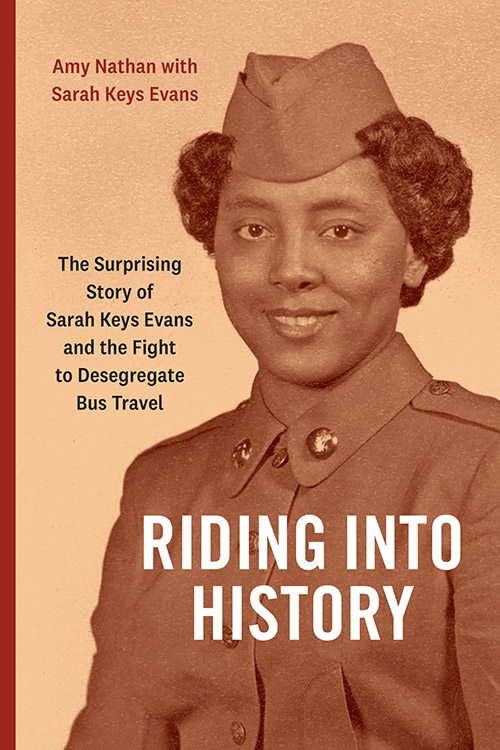
You know the name Rosa Parks, but do you know the name Sarah Keys Evans?
Keys Evans, a private first class who served in the Women's Army Corps, predated Parks in refusing to give up her bus seat in 1952. A brand new book from Duke University Press tells the important story of this lifelong Catholic.
Riding Into History details Keys Evans' fateful bus ride from New Jersey to Roanoke Rapids, North Carolina, that led to the Interstate Commerce Commission's rejection of segregation on interstate bus travel after a three-and-a-half year legal fight. Sarah Keys Evans was only 23 years old when she refused to give up her seat for a white Marine.
Yet the book doesn't limit itself to Keys Evans' isolated story; it also provides rich historical information on segregation in transportation since before the Civil War, as well as the wider story of institutional racism, mob violence and white supremacy in the United States.
Though images of Martin Luther King Jr. and the Civil Rights Movement of the 1960s often come to mind when imagining Black Americans and bus boycotts, Riding Into History illuminates the scores of those who had begun the fight for transportation equality long before.
According to authors Amy Nathan and Keys Evans herself, the desire for integration when riding public transportation was due both to practicality as well as justice. Frederick Douglass wrote that the "public humiliation of transportation segregation 'has a sting for the soul hardly less severe that that which bites the flesh and draws blood from the back of the plantation slave.' " Decades later, in 1920, W.E.B. Du Bois would write in an article for the New Republic: "There is not in the world a more disgraceful denial of human brotherhood than the 'Jim-Crow' car of the southern United States."
Advertisement
Keys Evans' genealogy goes back to North Carolina, to free Black Americans with a strong sense of pride, courage and business acumen; people who let Blacks who escaped slavery to hide on their land. Keys Evans' father, David Keys, converted to Catholicism as a young adult after leaving home and serving time in the Navy.
Initially, David Keys was one of the only Black Catholics in his hometown of Wilmington, North Carolina, where there was no Catholic church after the only one had burned down in 1864 during the Civil War. So Keys got up early on Sundays to travel to New Bern, North Carolina, to worship at St. Joseph's, a Black Catholic church founded in 1887.
It was at St. Joseph's where David Keys and a white priest began discussions about starting a Catholic school in Washington for Black children. At that time, private donations led to the creation of schools for African American children modeled after Booker T. Washington's aim for Southern students to focus on "industrial education." That model was supported by white politicians and donors both in the North and South who wanted Black people to only hone skills useful for serving and working for white Americans.
But Mother of Mercy Catholic School would follow the model of teaching a "classical academic curriculum" to Black students in grades one through 12.
Mother of Mercy School opened in September 1927. Enrollment quickly grew — from 15 students at its opening to 100 students only three months later. That same year, David Keys would marry Sarah's mother, Curley Vivian Wooten. Sarah Louise Keys was born on April 19, 1929, and was baptized in the school's chapel in March. She was later confirmed in 1941.
Sarah Keys Evans died at the age of 94 on November 16, 2023. Her funeral Mass was held on November 30, 2023 at St. Mary of the Lake Catholic Church in Lakewood, New Jersey.