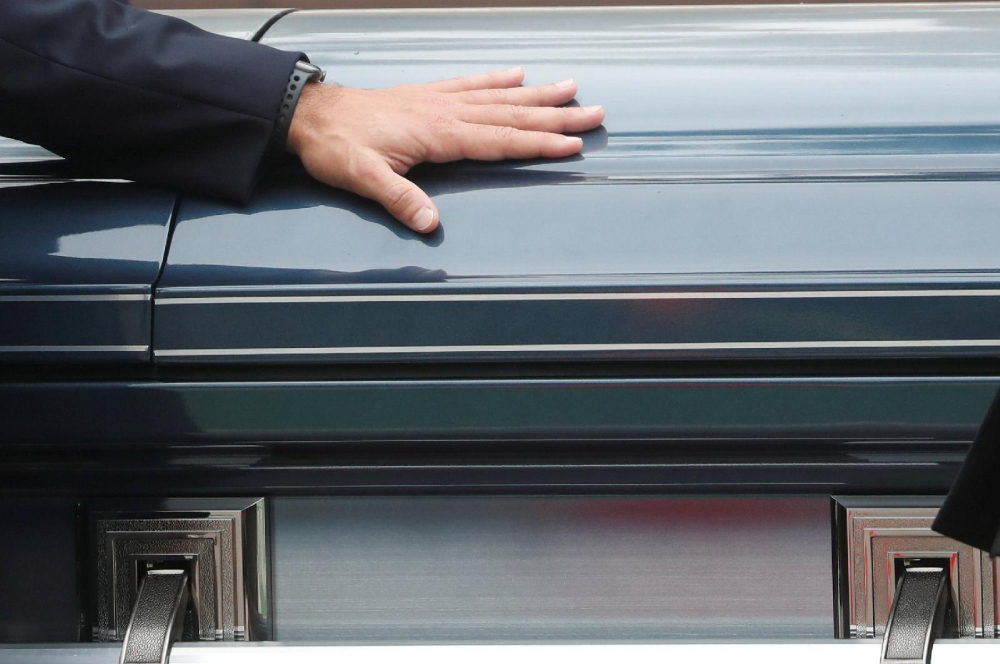
A mourner touches a casket in this file photo. (OSV News)
by Brian Fraga
Staff Reporter
Join the Conversation
Send your thoughts to Letters to the Editor. Learn more
People in the Diocese of Springfield, Illinois, are no longer able to eulogize or speak about their deceased loved ones during Catholic funeral rites after a series of new diocesan policies took effect earlier this month.
The new policies allow a reference during the rites to "how the deceased person put his or her Christian faith into practice," but any words of remembrance have to be submitted for approval three days prior to the funeral Mass and they can only be read by a priest or deacon.
Springfield Bishop Thomas Paprocki announced the changes in a six-minute YouTube video and in a statement posted on the diocesan website where he said that he and diocesan officials were looking to "address some irregular practices that have crept into local funeral services."
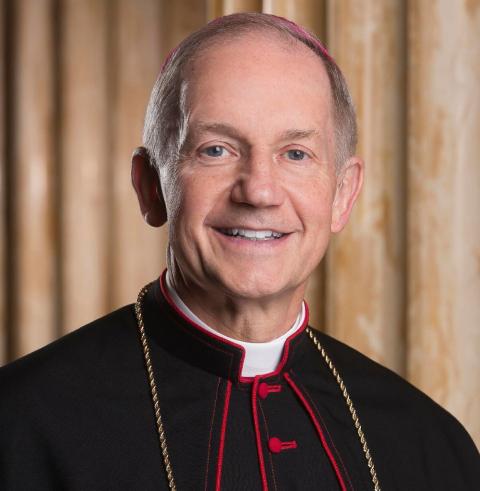
Bishop Thomas J. Paprocki of Springfield, Illinois, is pictured in a July 11, 2018, photo. (OSV News/Courtesy of Diocese of Springfield in Illinois)
Those practices, Paprocki said, include having a visitation immediately preceding the funeral Mass, as well as friends and loved ones delivering eulogies during the rites, which Paprocki said the Order of Christian Funerals does not permit.
"Unfortunately, too often people speaking at the end of a Funeral Mass say things that are very inappropriate," Paprocki said. "Even if the remarks are suitable words of remembrance, family members are often overcome with grief and have a hard time getting through their remarks."
The policies took effect, July 1, and they are intended to "ensure that Catholic funerals in our diocese will conform to the norms of the Catholic Church," said Paprocki, who is one of several bishops in recent years who have tightened diocesan policies pertaining to funerals and burials to emphasize stricter adherence to church norms.
In May, Bishop Robert McManus of Worcester, Massachusetts, issued a decree that emphasizes the church's preference for bodies to be buried instead of cremated. In October 2025, Youngstown, Ohio, Bishop David Bonnar ended funeral visitations in church buildings. In January 2025, the Archdiocese of Los Angeles updated its funeral guidelines that emphasize the sequence of funeral rites and that state delaying burial for convenience is inappropriate.
In addition to regulating how the deceased is remembered during the liturgy, the new policies in the Diocese of Springfield, Illinois, now prohibit a visitation in the church immediately preceding the funeral Mass.
According to Connecting Directors, a publication for the funeral home industry, practicalities such as convenience, cost-savings and scheduling constraints have condensed memorial observances into one-day events, with visitations often held immediately before the funeral services.
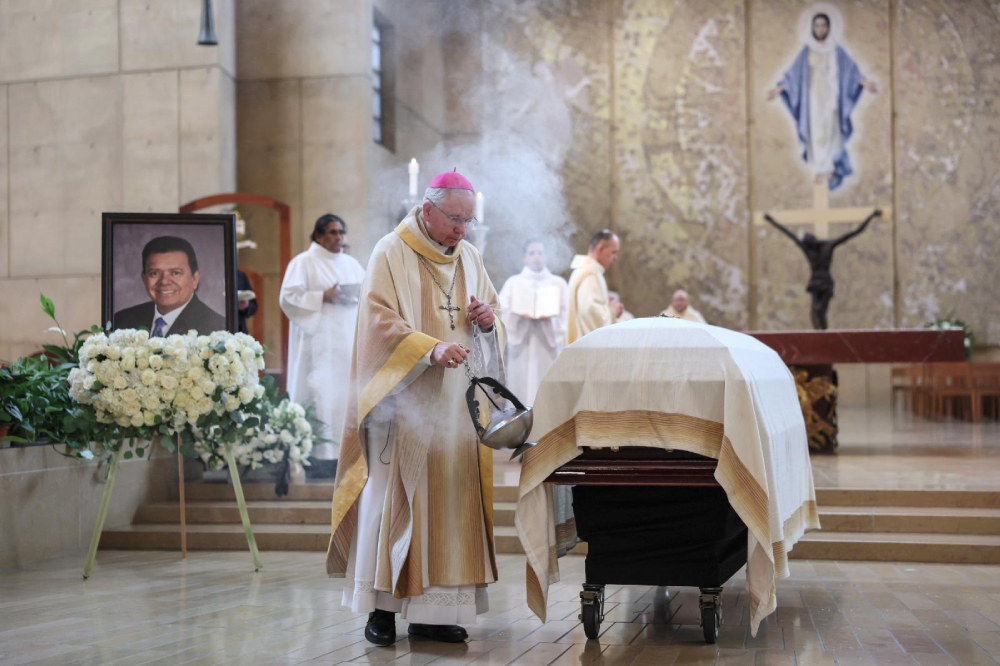
Los Angeles Archbishop José H. Gomez blesses the casket of Los Angeles Dodgers legend Fernando Valenzuela during his funeral Mass at the Cathedral of Our Lady of the Angels in Los Angeles Nov. 6, 2024. (OSV News/Los Angeles Times/Robert Gauthier)
Paprocki refers to that trend as one of several "liturgical anomalies."
"The vigil, by definition, is the night before, so the vigil prayers will be prayed then by the priest or deacon even if there is no public visitation," Paprocki said. "In such cases, it would be fitting at least for the immediate family members to join the priest or deacon in the vigil prayers."
Mourners can gather at the funeral home prior to the funeral, where a priest or deacon may preside over a brief prayer service called Transfer of the Body to the Church or to the Place of Committal. If no priest or deacon is available, a funeral director, a member of the parish staff, or a relative or friend of the deceased can offer the prayers.
"Another problematic area that has crept into recent practice," according to Paprocki, had been the practice of eulogizing the deceased. The Order of Christian Funerals permits, in certain circumstances, "speaking in remembrance of the one who died," but does not permit a eulogy.
"To speak in remembrance of the deceased is to speak about the faith-life of the one who died and to give praise to God. A eulogy makes the person being praised the main focus of attention. The homily and the words of remembrance have God as the primary focus," Paprocki said.
"In this regard, reference may be made to how the deceased person put his or her Christian faith into practice, which provides a good example for others to follow and gives hope for an eternal reward in Heaven," Paprocki added.
Advertisement
Any words of remembrance that the family would like to be spoken by a priest or deacon have to be submitted three days before the funeral. Only the priest or deacon will then read those words during the vigil, funeral Mass or liturgy, or during the Rite of Committal at the cemetery.
"If deemed appropriate by the family, words of remembrance or even a eulogy may be given by someone other than the priest or deacon in other gatherings, such as at the meal following the committal service," Paprocki said. "This should not, however, immediately precede or follow any of the Christian funeral rites."
The new policies in the Springfield Diocese also stipulate that the Catholic Church "still earnestly recommends that the pious custom of burying the bodies of the deceased be observed," even if the church does not prohibit cremation unless chosen for reasons contrary to Christian doctrine, such as denial of the resurrection of the body.
The diocesan policy requires that interment of cremated remains take place within 30 days following the funeral rites.
When cremation takes place, Paprocki said, "all of the cremated remains of the deceased person's body must be interred following the Rite of Committal. At no time and in no way shall the cremated remains be divided, separated, or interred in more than one place."