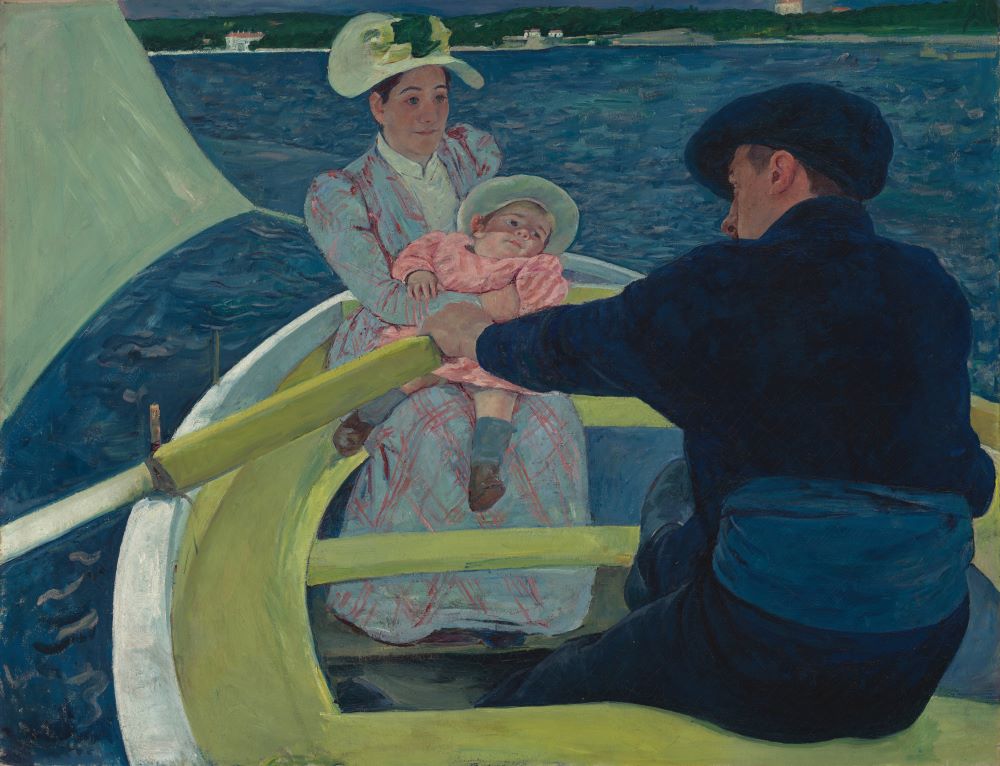
The American impressionist Mary Cassatt refused to idealize the repetitive, underappreciated labor of childcare. In "The Boating Party," the mother's fatigued expression may feel familiar to viewers who are caregivers. (National Gallery of Art)

by Jean P. Kelly
Join the Conversation
Send your thoughts to Letters to the Editor. Learn more
It might be tempting to dismiss American impressionist Mary Cassatt's paintings of women and children sipping tea in gardens, lounging on cushy armchairs and riding cable cars as traditional, sentimental, even frivolous. But not so fast.
On the centenary of Cassatt's 1926 death, a more contextualized and historically accurate portrait of the Pennsylvania-born artist has emerged, one currently on display through August at the National Gallery of Art in Washington, D.C. "Mary Cassatt: An American in Paris" offers not only a reappraisal of her contribution to modernism — as the only American and one of just three women exhibiting on equal footing with male impressionists — but also a reckoning with her thoroughly feminist views.
Beneath her work's polite pastels and loose brushwork lies an underpainting of progressive social values familiar to Catholics: the dignity of work and the pursuit of justice through community, including families.
Faith itself was not a major influence on Cassatt's work. Like many Victorians, she sought emancipation from institutions that circumscribed women's roles. She defied convention by never marrying nor having children, choosing instead to study art in Philadelphia, then Europe, finally settling in Paris, where she exhibited alongside Edgar Degas, Claude Monet and other masters. (Degas so respected the American ex-pat's mastery of printmaking that his personal collection included more than 100 Cassatts.) Her paintings, drawings and prints have inarguably increased the visibility of women in society and the arts.
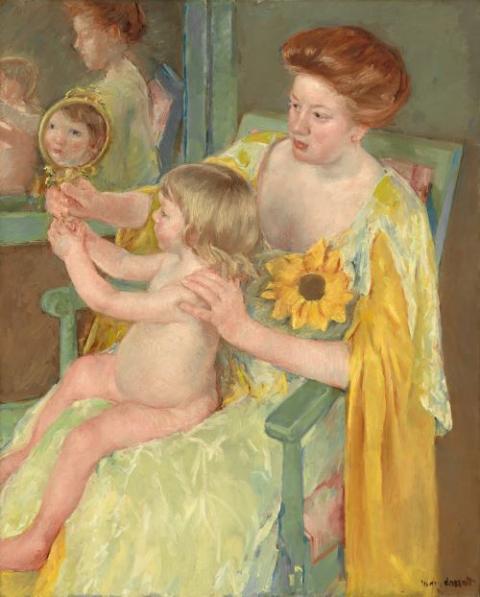
The American impressionist Mary Cassatt's "Woman with a Sunflower" reveals as much progressive symbolism as painterly skill, as the sunflower was a symbol of the women's suffrage movement. (National Gallery of Art)
The exhibition's panels explain how, eschewing the light-filled landscapes favored by her male counterparts, Cassatt almost exclusively depicted women and children in both public and private spaces, many as they defied convention by reading, traveling and attending theater without male company. She painted older women, such as her mother in "Reading 'Le Figaro,' " and younger ones, such as "Girl Arranging Her Hair," all with appearances and casual postures running counter to contemporary standards of beauty.
When she did paint domestic scenes, she refused to idealize the repetitive, underappreciated labor of childcare and home-keeping. The blank stares and fatigued expressions of mother figures in "The Boating Party" — perhaps the National Gallery's most famous Cassatt — and "In the Omnibus" may make parents feel they are looking into a mirror.
"Mother-figures" is the accurate term, because many of the women and children bathing, caressing and cuddling in Cassatt's best-known works were not related by family lines. The woman who earned her living making art also employed women as studio models. Those intimate domestic scenes that appear charmingly spontaneous were in fact carefully stage-directed, crafted through many drafts to innovate composition, style and technique.
One room in the National Gallery exhibition illustrates not only the artist's work ethic, through a series of developmental etchings that culminate in now-famous prints, but also Cassatt's masterful innovations for showing women as strong, the motherly bond as beautiful, and women's work as worthy of esteem.
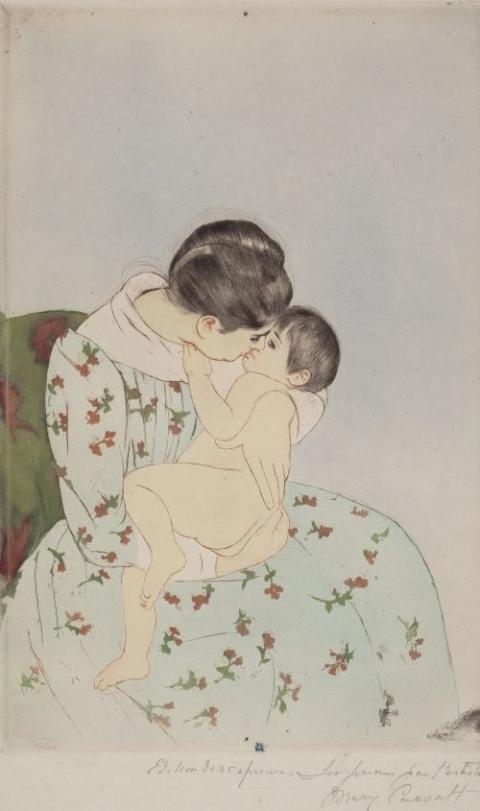
"Mother's Kiss" by Mary Cassatt, c. 1890-1891 (National Gallery of Art)
"Mother's Kiss" depicts a mother and baby with almost identical skin tone, symbolizing their emotional, not just physical, closeness. That the child squeezes the woman's neck tightly, art historians explain, represents Cassatt's belief in a then-new definition of motherhood as a balanced relationship, marked by reciprocal affection and agency. In 1915, a critic in The New York Times praised the artist's originality, saying, "Her mothers and their children are not like any other that have been painted before."
Late in her career, Cassatt leveraged more directly her art and influence for women's liberation. She participated in a U.S. exhibition raising funds for the women's vote, and even sold off paintings rather than allow an anti-suffrage family member to inherit them.
Her progressive social views are most apparent in this exhibition's final gallery, which includes three studies for a now-lost multi-panel mural commissioned for the 1893 Women's Pavilion at Chicago's world's fair. "Modern Woman" was the artist's radical reinterpretation of Eve's story in Genesis: Rather than being punished for eating from the tree of knowledge, women on ladders hand fruit down to girls — a statement about female self-determination and mentorship.
Prescient about the commercialization of Mother's Day, Cassatt in fact opposed the 1913 campaign to make the Sunday in May a national holiday, notes curator Kimberly Jones. She wrote to a likeminded friend that the mother of the congressman who introduced the bill should "box in her son's conceited ears."
Advertisement
"Woman with a Sunflower" reveals as much progressive symbolism as painterly skill. The predominantly yellow and gold palette would have been instantly recognizable to women’s rights advocates of the time, as marchers for the vote were encouraged to "show their colors" with yellow ribbons and sashes, the hue representing the "torch that guides our purpose, pure and unswerving."
If the woman in the painting is not the child's mother, perhaps she is a teacher. Both adult and child grip the mirror together, the toddler steadied by a single hand on her bare shoulder as she learns by looking. The willing pupil seems to glimpse a nascent self-understanding in her reflection, a face encircled by a halo, the mirror's golden frame.
And that oversized corsage? Sunflowers were the symbol of the suffrage movement. As Cassatt wrote to her patron, Louisine Havemyer, in 1914, "Work for suffrage, for it is the women who will decide the question of life or death for a nation."
After the National Gallery's Cassatt centenary exhibition closes in August, two additional major retrospectives will follow in Chicago and Paris: "Mary Cassatt: After Impressionism" at the Art Institute of Chicago, Sept. 6-Jan. 3, and "Mary Cassatt: The Choice of Independence" at Paris' Musée d'Orsay, Oct. 6-Jan. 31, the first major Cassatt exhibition ever mounted by a French national museum.