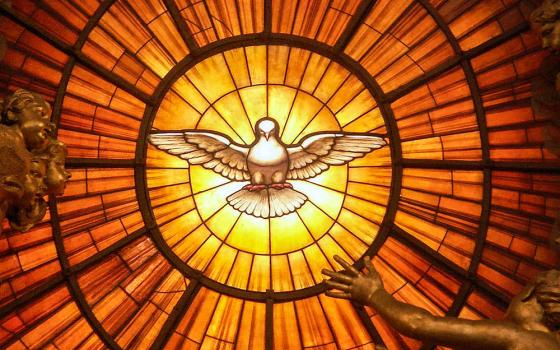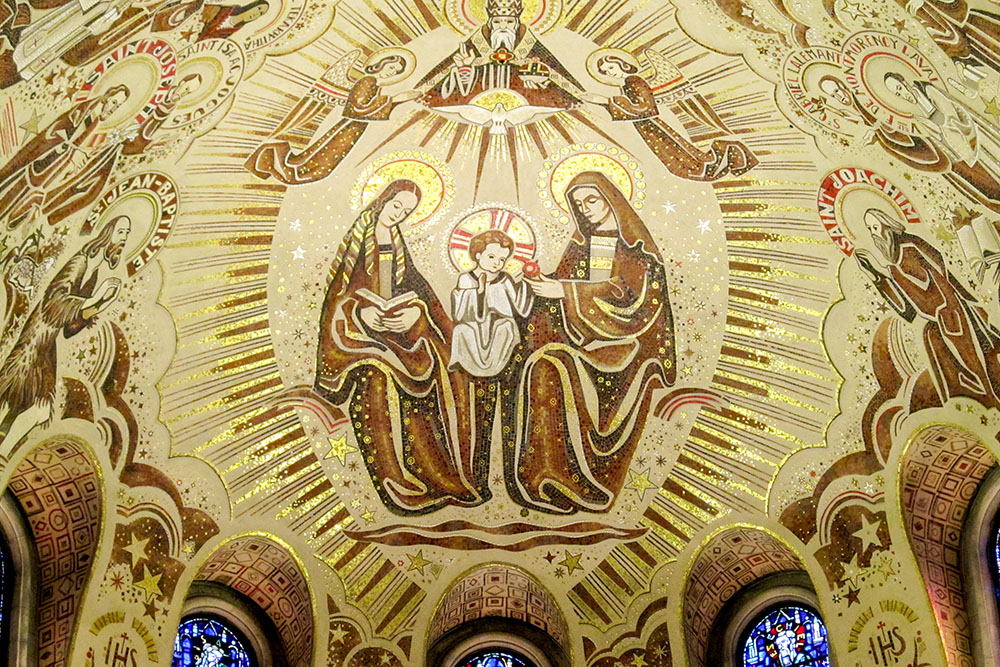
Mosaic in the Basilica of Sainte-Anne-de-Beaupré in Québec, Canada (Wikimedia Commons/J.L. Dion)

by Karen E. Park
Join the Conversation
Send your thoughts to Letters to the Editor. Learn more
Immediately after reading and reviewing JD Vance's Communion, my husband and I spent two weeks traveling through Québec, where we encountered a Catholicism that remains largely invisible not only in Vance's memoir, but also in Bishop Robert Barron's recent conversation with the vice president about his faith.
In Québec, we spent a day at St. Joseph's Oratory in Montréal, Canada's largest church and one of North America's most important pilgrimage shrines. The oratory embodies a profoundly sacramental and material vision of Catholicism. It was founded in 1904 by St. André Bessette, the physically frail and illiterate Holy Cross brother who spent most of his life as a doorman before becoming one of Canada's most beloved saints thanks to his special relationship with St. Joseph and countless intercessory healings of everyday Québecois people.
Brother André never claimed to heal anyone himself; he referred pilgrims to St. Joseph, who would then intercede with Jesus to effect miraculous healings — a chain of intercessory prayer unlikely to appeal to many evangelical Protestants. Brother André raised the original funds for the oratory by providing five-cent haircuts.
Now the massive shrine is filled with ex-votos, crutches left behind by those who believed they had been healed through this chain of intercession, thousands of votive candles, as well as relics including Brother André's heart. Today, this site welcomes more than 2 million visitors per year.
A few days later, we visited the Basilica of Sainte-Anne-de-Beaupré, one of the oldest and most beloved pilgrimage sites in North America. The basilica is dedicated to St. Anne, whose entire story comes from extracanonical writings, popular devotions, and mystical visions. Since the 17th century, millions of pilgrims have traveled there seeking healing and blessings through her powerful intercession.
Scenes from Anne's legendary life as the grandmother of Jesus adorn the ceiling, and a polychrome statue of St. Anne holding the infant Mary is the focal point of the interior. In 1887, this statue received a canonical crown authorized by Pope Leo XIII in recognition of the longstanding devotion and reported miracles associated with the shrine.
Advertisement
St. Anne is, in many ways, entirely a product of the Catholic imagination. Everything Catholics know about the grandmother of Jesus comes from tradition rather than Scripture. Yet that is precisely the point. Catholicism has never been sustained by text alone, but by the living tradition that remembers saints, preserves relics, inspires pilgrimage, and populates the communion of saints.
Next, we visited the Ursuline Monastery in Québec City. The monastery was founded by St. Marie de l'Incarnation, the brilliant and erudite 17th-century mystic, missionary and educator of girls and women who was canonized by Pope Francis in 2014.
Between St. André, St. Anne, St. Marie de l'Incarnation and the sites dedicated to them, in Québec I was immersed in a sacramental and materially rich Catholicism through which generations of believers have encountered the holy.
Experiencing these deeply Catholic and extraordinarily popular sites immediately after reading and reviewing Communion crystallized something that was confirmed when I watched Barron, bishop of the Diocese of Winona-Rochester, Minnesota, interview the vice president. Vance's Catholicism, as he presents it in his memoir and in the conversation, leaves no room for Brother André, St. Anne, or St. Marie de l'Incarnation. In fact, again and again, the only saints Vance demonstrates any familiarity with are Augustine and Thomas Aquinas — and not for their lives of holiness, but for their political philosophy and erudition.
During Barron and Vance's hourlong discussion, Catholicism emerges solely as a tradition of intellectual and philosophical ideas. Augustine, Aquinas and René Girard are all extolled, but Catholicism is not only a philosophical system. It is a lived tradition sustained by the sacramental imagination as well as the intellectual one.
As I listened to Baron and Vance wax eloquent about mimetic desire and economic theory, three dimensions that have long defined Catholic life largely disappeared: the sacramental imagination, the communion of saints, and the women who have sustained that communion. Vance's book, like his conversation with Barron, ignores nonintellectual saints like Brother André and demonstrates no familiarity with pilgrimage, intercession, relics, shrines, votive candles, eucharistic adoration, ex-votos, or the dense network of material and communal practices through which Catholics encounter the holy.
These are not peripheral dimensions of Catholicism — they are the ordinary ways Catholics have encountered Christ for centuries.
Absent, too, are the holy and brilliant women of the Catholic tradition. During an hourlong conversation about Catholicism, neither Barron nor Vance mentions a single Catholic woman. In this world, there would seem to be no Teresa of Ávila, no Dorothy Day, no Hildegard von Bingen, no Julian of Norwich — and certainly no St. Anne.
In Communion, even the centrality of Mary is dismissed quickly. Of Protestants who object to the words "Holy Mary, Mother of God, pray for us sinners, now and at the hour of our death," Vance says only, "Fair enough. Maybe they're right. I think they're wrong. But I'm not here to settle this argument." And he never returns to the Mother of God again.
When during the interview Barron asks Vance about his prayer life, he seems flustered, blames his kids for often making bedtime too chaotic for prayer, and then eventually claims to try to pray a decade of the rosary each day. Barron then advises him to carry a crucifix or other sacramental in his pocket to remind him of his faith — to which Vance responds "Good idea."
Other than these few moments at the very end of their conversation, Vance does not mention Mary or any devotional practices at all. These are wholly absent from the book as well.
The communion of saints cannot consist only of Augustine and Aquinas. It must also include the illiterate saints, the ascetics, the mystics, the pilgrims, the healers, the strange ones — and, yes, the women. St. Anne and St. André Bessette are every bit the saints that Augustine is, and the relic of André's heart, the miraculous oil that millions take from his shrine to heal their ailments, and the holy legends of Jesus' grandmother are as essential to Catholicism as The City of God. Vance and Barron cannot choose to engage only the parts of the faith that appeal to their sensibilities and proclivities.
Vance's memoir is titled Communion. Yet neither the memoir nor Barron's interview dwells on the sacrament from which the title is drawn. Vance and Barron do not discuss the Eucharist, the central mystery of the Catholic faith. In Communion, Vance's eucharistic theology is reduced to reassuring a skeptical friend that Catholics aren't actually cannibals because "something called 'the Real Presence'" is not about "the material properties of human flesh" but rather a "means for receiving God's grace."
After clearing that up, he returns to his own conversion — which involves a late-summer private baptism, with no mention of the Eucharist or confirmation that would ordinarily accompany a catechumen's reception into the church at the Easter Vigil.
In short, I returned from Québec realizing that what is missing from Communion was not corrected by Barron's interview; it was underscored. The sacramental imagination itself — the conviction that God is encountered through saints, bodies, relics, pilgrimage, sacred spaces, intercession and the sacraments, not merely through philosophical texts and ideas — is largely absent.
Equally striking is the near total disappearance of women. Mary, Sts. Monica and Anne, Marie de l'Incarnation, and the countless women who have sustained and shaped Catholic life across the centuries simply do not appear. What emerges instead is a Catholicism populated by philosophers, bishops and other powerful men, nearly devoid of the sacramental imagination and the vast and varied communion of saints.