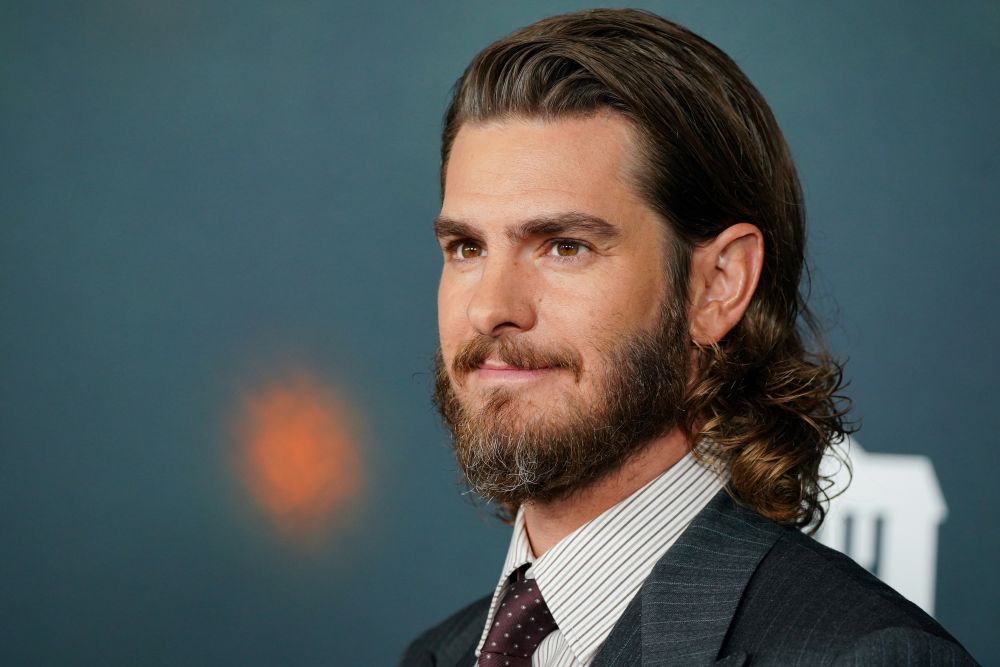
Andrew Garfield, shown arriving at the premiere of "The Uprising" on Sept. 2, 2026, has described feeling a "spiritual urgency" when choosing roles and has a reputation for gravitating toward characters with deep religious conviction. (AP/Invision/Jordan Strauss)

Join the Conversation
Send your thoughts to Letters to the Editor. Learn more
Andrew Garfield may not be the Jesuit missionary he played in Martin Scorsese's 2016 film "Silence," but he is just as adept at finding God in all things — acting roles included.
The 43-year-old has described feeling a "spiritual urgency" when it comes to choosing projects. The latest result of this compulsion is his star turn as Ploughman, the nameless everyman who becomes an unlikely leader of the Peasants' Revolt of 1381 in director Paul Greengrass' new movie, "The Uprising."
Set over the feast of Corpus Christi in 14th-century England, the film presents dueling versions of Catholicism: corrupt bishops in positions of high political office, and oppressed village peasants clinging to prayer as a lifeline. Some sincere priests and friars do exist and stand in solidarity with the people, promising that God has not forgotten them; but in the aftermath of the Black Plague and shackled to the forced labor of serfdom, most of the populace are too traumatized and disheartened to have much faith.
This is the state in which we meet Andrew Garfield's Ploughman.
"He's hanging on by a thread with the idea of a Christian God, a God that loves him and has his best interest at heart," Garfield told the National Catholic Reporter in an exclusive interview. "He's trying desperately to hold onto faith in a dying system and in a king that is supposed to be the mouthpiece of God on this earth. … What happens when there is betrayal and deception? How does the soul respond?"
Garfield's empathy for Ploughman, and for all he represents, is evident when he talks about the character, whom he describes as "a man who has been worn down to the last remaining crust of the old self." It is from this vantage point at rock bottom, face literally in the mud, that something new emerges; something akin to the mystical contemplative tradition; something the actor locates between "a spirituality of belonging to earth itself and a remembrance of his interconnection to all things."
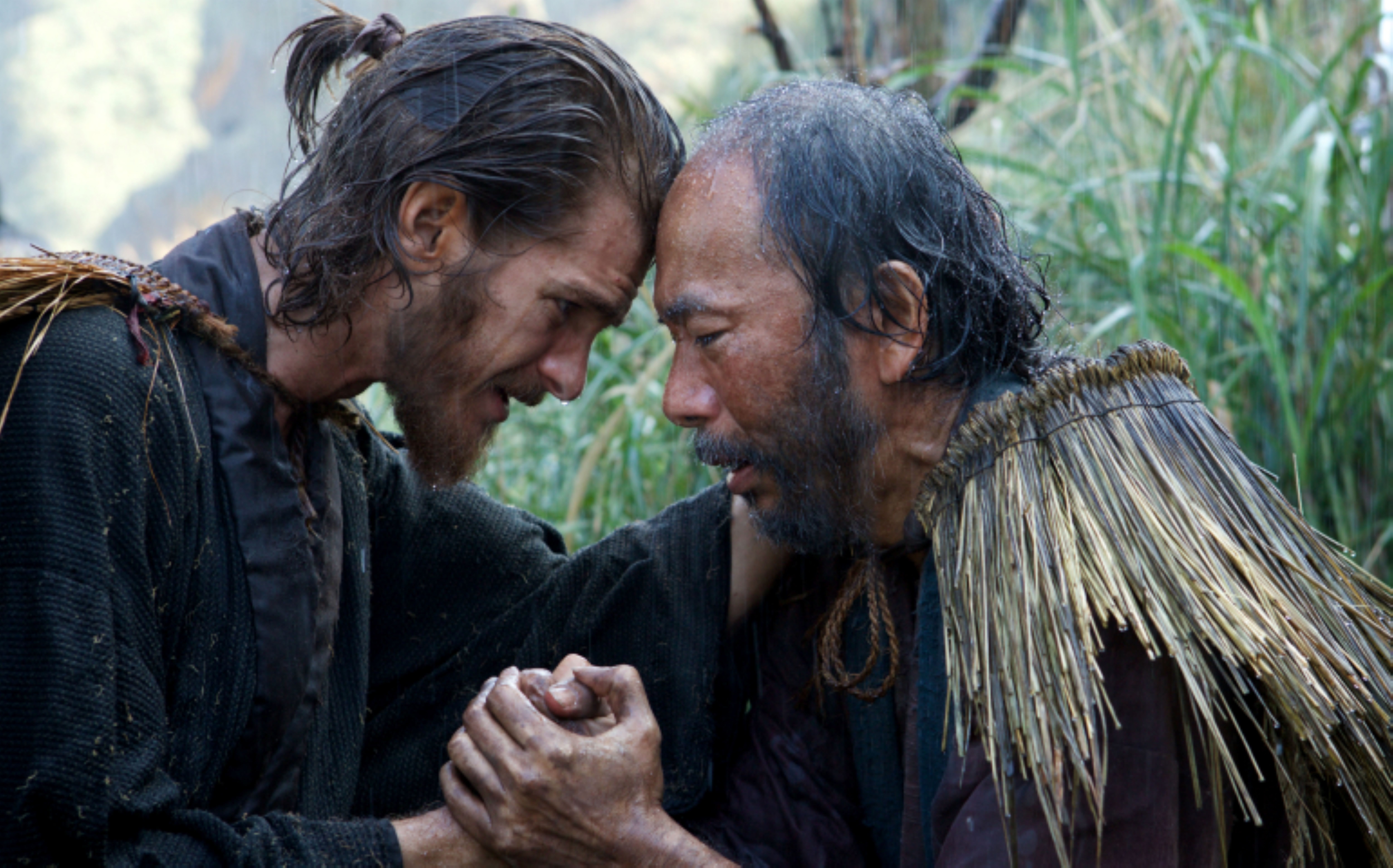
Andrew Garfield, left, plays Jesuit Fr. Sebastião Rodrigues, and Shinya Tsukamoto plays Mokichi in the 2016 Martin Scorsese film "Silence." (Paramount Pictures/Kerry Brown)
This emergence resonates with Garfield, a self-described pantheist who devoted an entire year to the practice of Ignatian spirituality to prepare for his role as Jesuit Fr. Sebastião Rodrigues in "Silence." In a now well-circulated appearance on "The Late Show with Stephen Colbert" to promote the movie, he seemed genuinely inspired to have learned that the Society of Jesus emphasizes "finding God in all things, finding God in every single human being … in the tree that was cut down to make this table. Suddenly everything becomes a miracle. I just love that; I think that's a wonderful way to see the world, a beautiful way to see the world."
Jesuit Fr. James Martin, who led Garfield through the Spiritual Exercises, describes the actor as curious and compassionate — and an impressively hard worker.
"Andrew was interested in learning as much as he could," Martin told NCR via email. "At first, I didn't think he would be ready, but after a few sessions it became clear that he was. Without breaking any confidences, I can say that he gave himself completely to the Exercises. [I was surprised] that someone with relatively little training in Ignatian spirituality was able to enter into the Exercises so fully."
But Garfield isn't the kind of guy to enter into anything halfway, least of all rigorous spiritual exploration. In the 10 years since "Silence," Garfield has portrayed Seventh-day Adventist army medic and conscientious objector Desmond Doss in "Hacksaw Ridge" (for which he received an Oscar nomination), devout Mormon detective Jeb Pyre in "Under the Banner of Heaven" and famed Christian televangelist Jim Bakker in "The Eyes of Tammy Faye."
During a conversation with Ryan Reynolds for Variety's "Actors on Actors" in 2024, Garfield said, "I only want to do the things that speak to my soul, that I feel like I am the vessel to get into the world." Clearly religion, in all its light and shadow, speaks to him. What doesn't always is the popular story arc of the hero's journey.
For Garfield, this was part of the appeal of playing Ploughman.
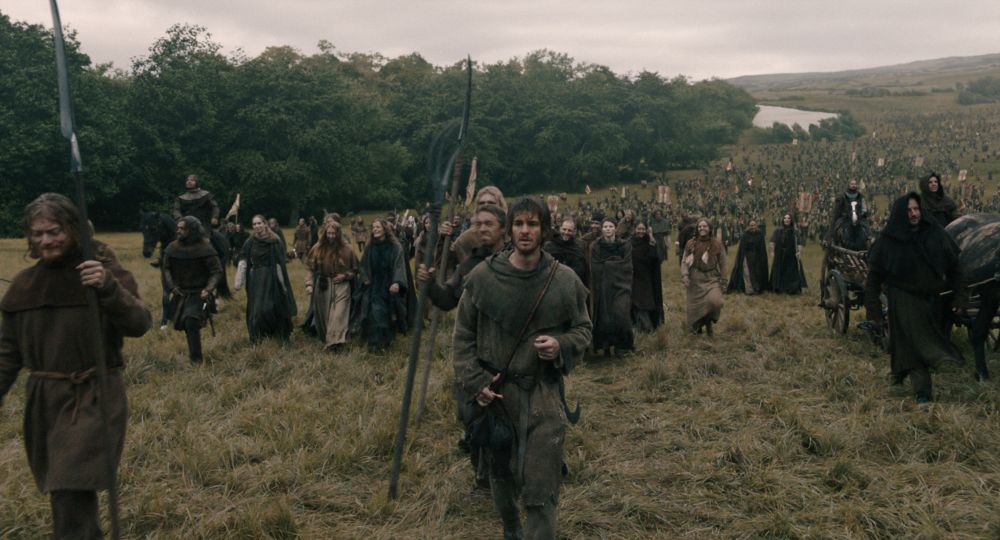
In "The Uprising," a new film about the Peasants' Revolt of 1381 directed by Paul Greengrass, Andrew Garfield portrays a serf-turned-insurrectionist wrestling with faith. (Focus Features)
"['The Uprising'] is not a hero's story to me," Garfield mused over a Zoom call with NCR. "I think the hero's story can be very misleading; the hero's story, that monomyth can actually be dangerous because it's much more egoic and full of identity. … I love the hero's journey, but the idea that there's only one story, I feel, is just inaccurate. There's a lot of other ways to heal and to live."
Though "The Uprising" shares some similarities with films like "Braveheart" and "Gladiator," it insists on bending the historical epic genre. Aside from vague references to a wife and children lost to the Black Death some years before, audiences are given scant detail about this bedraggled farmer situated in a desolate land. No flashbacks or montages fill in the gaps; no opening prologue shows us what once was; no rousing emotional monologues woo us with charisma; no steamy sex scenes prove the ability to love.
Ploughman is something of an empty vessel for the viewer to fill with themself — a mirror with which to see themself. The anonymity is the point.
By the end of the movie, Garfield's Ploughman is not an untouchable hero who has conquered the proverbial monster and returned home victorious; Ploughman is any and all of us who have reached the limit of what we can endure and must either capitulate or be deeply changed by defeat.
Advertisement
In less capable hands this could spell disaster for a leading role, but Garfield thrives on restraint, allowing the interiority of his character to take up space without explanation or apology. The risk of one-dimensionality that he is willing to take pays off: Viewers experience Ploughman as fully formed but, appropriately, utterly hollowed out.
The actor is adamant that this hollowness is the only way Ploughman could access the spiritual awakening he so desperately needed, one wordlessly communicated in the film's best and final (pre-coda) scene.
"He's able to be held and caught by his true inheritance, which is the earth, which is his deep self, which is connected to everything in nature, whether it's plant, animal or human," Garfield reflects in earnest.
If his interpretation of the scene reads like merely a projection of the performer's own theology, it's worth pointing out that his words bear a remarkable consistency with the mystical revelations of the great voices of the Catholic contemplative tradition: not only St. Ignatius of Loyola, but Sts. Francis and Clare of Assisi, St. Teresa of Avila, St. John of the Cross, Julian of Norwich and many others. The gift of spirituality, history seems to tell us, is not certainty but mystery.
As a wise actor once said: "A life of faith is not a life of certainty. A life of faith is a life of doubt."
"The Uprising" opens in theaters Sept. 10.