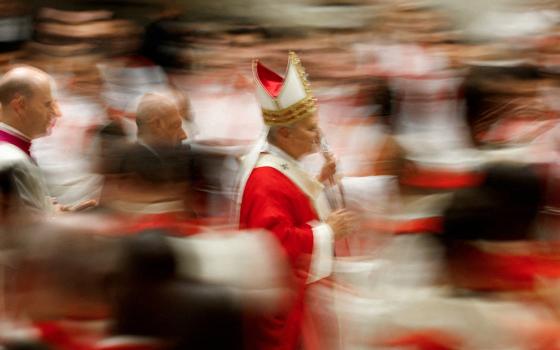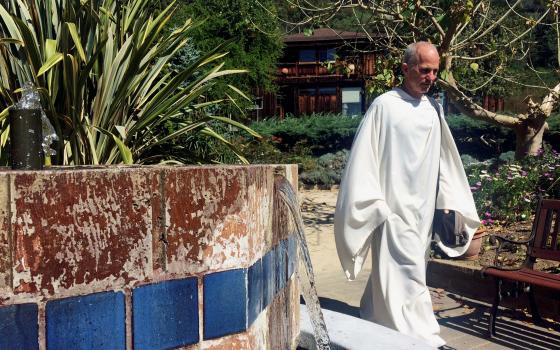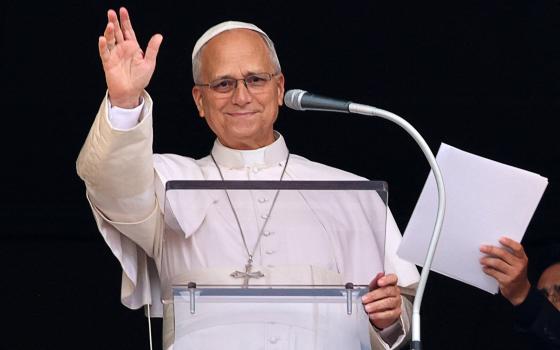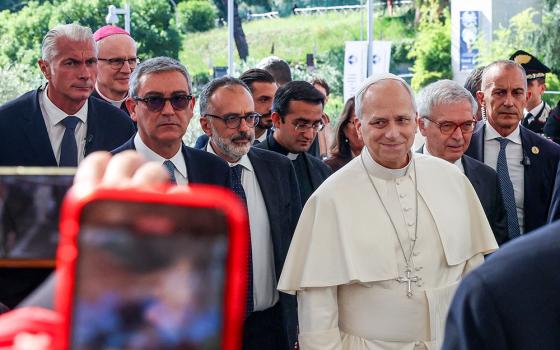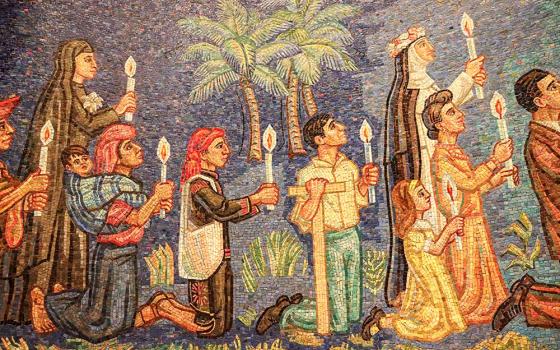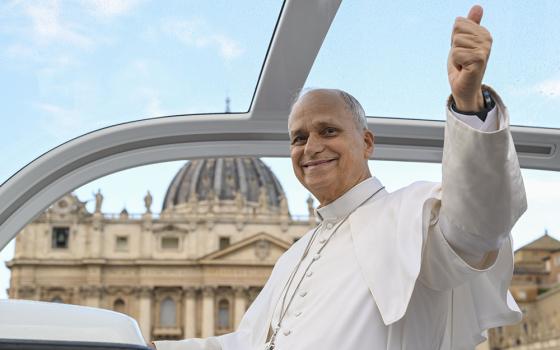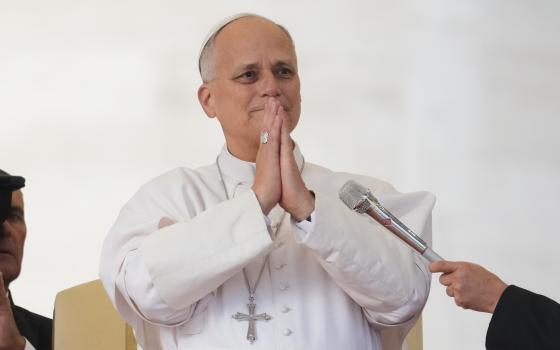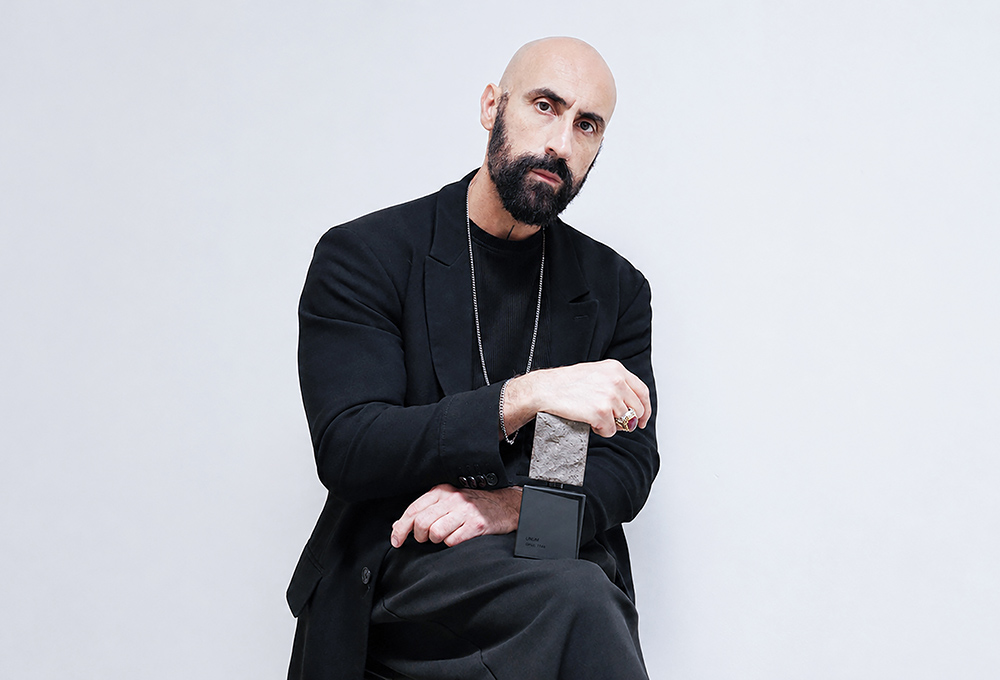
The Italian tailor Filippo Sorcinelli has worked with three popes over two decades, but the biggest change he's seen has been in himself. (Courtesy of Filippo Sorcinelli/Giovanni DeSimoni)

by Tulio Huggins
Join the Conversation
Send your thoughts to Letters to the Editor. Learn more
Like many Italian children, Filippo Sorcinelli spent much of his time as "un bambino" beside his mother as she cleaned. But unlike most kids, Socrinelli's mother didn't just clean their home; she also cleaned their local Catholic church. It was there that Sorcinelli encountered the coalescence of spirituality and beauty that would come to define his career as a papal tailor — and land his vestments in the pages of Vogue.
"Children are like sponges, they are very curious. Especially for the things that they don't know. So being in a church and this environment was like being in a Lunapark ['like your Disneyland']," Sorcinelli told the National Catholic Reporter, reminiscing on the colors, smells, lights and music that shaped his youth.
Enthralled by the church organ, Sorcinelli eventually studied the instrument at the Pontifical Institute of Sacred Music in Rome. He played regularly for Masses both in cathedrals and in his home parish in Mondolfo, a small town on the Adriatic coast. ("You have to imagine a small city center with a bar that everyone goes to, ladies at the windows or in the front doors, watching people go around ... a very good community, but everybody knows everything.")
Then, in 2001, when a friend announced he was joining the priesthood, Sorcinelli asked to make his chasuble. Twenty-five years later, Sorcinelli's work can be found on priests, bishops and cardinals from Paris to New York — and, of course, the Vatican. He made more than 50 vestments for Pope Benedict XVI and 20 for Pope Francis (including the miter he wore as he laid in state), as well as the vestments that landed Pope Leo XIV on Vogue's Best Dressed of 2025.
"Between the popes, the work and myself, I definitely think I've changed the most," he says. "I've matured a lot."
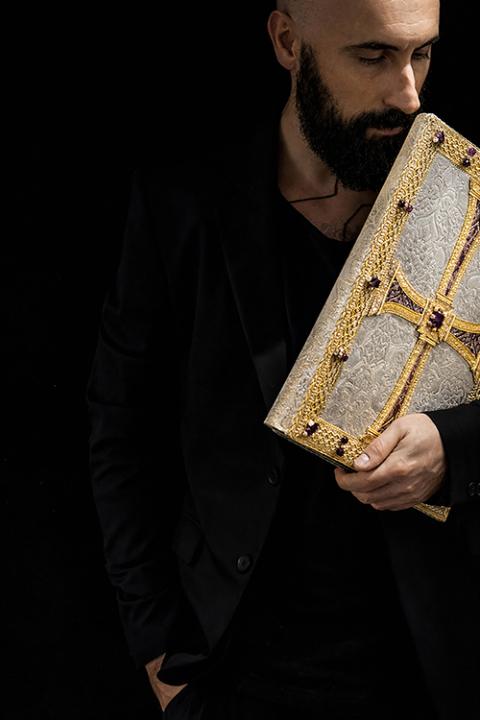
For Filippo Sorcinell, every job stems from the same source, Christ. (Courtesy of Filippo Sorcinelli/Giovanni DeSimoni)
But he's seeing a broader cultural shift in the Catholic church: a "fatigue of vision," as he calls it, citing commercialization and mass production as culprits for the devaluing of the art of the church. Sorcinelli believes that beauty should serve a "theological, pedagogical and spiritual function," but fears it's being limited to an afterthought.
For Sorcinelli, the church doesn't value the craft of the artist as much as it should. "I believe the church needs true artists, true artisans, true musicians, true architects and people able to live their work with spiritual discipline. Ecclesial beauty asks for study, inner poverty, rigor, freedom and love for mystery."
He continues on: "When the church relinquishes beauty, it relinquishes part of its most original language. When it embraces beauty with courage, it once again tells the world that the human being is destined for something greater than mere usefulness."
Sorcinelli's work isn't limited to the ecclesial sphere, but for him, every job stems from the same source, Christ.
"It's very important to understand that beauty comes from God. It's not something you can interpret in another way. It's difficult to understand if someone doesn't believe [in God], but there's no other way to think about it. Beauty comes from God. Beauty is so great and so strong, that it has to come from something else. Even if you don't believe in God, you have this 'wow!' factor that you don't know how to explain."
Soricinelli is a practicing Catholic who attends Mass regularly and prays. He also still plays the organ, sometimes in his childhood parish in Mondolfo, but he doesn't take Communion. "Since everyone knows who I am and my sexuality, this is the only thing I don't do anymore."
Sorcinelli is openly gay, but has been harmed by public homophobia. In 2013, a rival designer sent letters to various clergy clients and potential clients to tell them that Sorcinelli was gay.
"It was a painful time, because I saw certain spaces close, certain attitudes change and certain relationships become more distant. At the same time, it was a beautiful time, because it compelled me to understand my vocation beyond the protection of consensus."
Advertisement
After that, Sorcinelli felt more free to expand his artistic pursuits, keeping his roots in liturgical tailoring but expanding into other creative pursuits, such as perfumes. His first and most popular scent, Lavs, originating as a room and clothing spray for Benedict and later used by Francis.
His perfumes vary in themes; some are explicitly religious, such as Lavs and Basilica di Assisi from his Memento collection. Others, such as Cruising Area and Cyber Sex from the collection X SÉ, not so much. The X SÉ collection is described on the website this way: "Even for those who don't want to know ... sexuality is a fundamental and integral part of the human being." (I tried a few from his collections, getting the aforementioned scents, alongside Reliquia. My favorites were Lavs and Cruising Area.)
The period of life after being publicly outed was a "hard school" for Sorcinelli, but one that nevertheless pushed him further in his craft, away from the standards he had put around himself. It changed his relationship with his church by pulling him into a deeper illumination of the beauty of Christ, in spite of the hurt.
"The church doesn't condemn Filippo Sorcinelli," he said. "Of course I feel the difficulty of being in an institution that has so much beauty and darkness. That is the experience of every Christian."
Today, Sorcinelli still makes vestments, still plays the organ, still practices his faith. Through it all, he still pursues the beauty reflected in Christ. "Christian beauty, when authentic, always carries within itself a paschal form. It passes through loss, accepts dispossession and returns to speak with a truer voice."