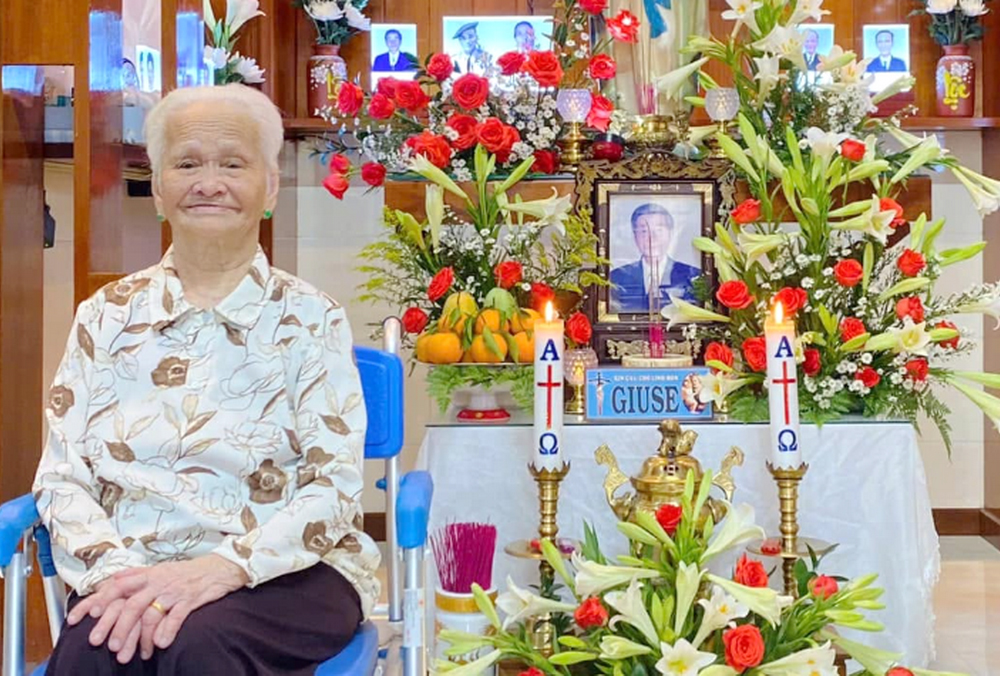
Lucy Phan sits by the altar of her husband and relatives in her home in Hue, Vietnam. (NCR photo)
Every night, Lucy Phan offers incense and prays before an altar bearing photographs of her husband and two younger brothers.
Phan places followers and fruits in front of the photographs to honor the dead.
Her spouse and siblings, who worked for the former U.S.-backed South Vietnam government, were taken away by two northern communist soldiers during the 1968 offensive on Hue, central Vietnam.
Her husband was 37 years old and her brothers were 26 and 27.
"For nearly 60 years, we have searched for them in many places, especially at mass graves but found none of their remains," the 87-year-old mother of three said.
Her relatives consistently remember the missing people on the anniversaries of their death, Father's Day and during November and Lunar New Year.
They are among many families still looking for their loved ones who were killed or disappeared during the Vietnam War ending in 1975.
Their experience raises questions about memory, dignity and reconciliation as Vietnam expands efforts to recover and identify the remains of fallen soldiers during wars.
The first nationwide 500-day campaign running until Jul. 27, 2027 aims to find about 7,000 sets of remains, collect samples from unidentified graves, and conduct DNA testing on approximately 18,000 samples.
The government estimates about 175,000 missing soldiers, mostly from the Vietnam War (1955-1975), and another nearly 300,000 graves containing unidentified remains.
In September, Vietnam President To Lam called on U.S. groups to continue to share documents, information and memorabilia for the search and provide the next-generation gene sequencing systems, specialized supplies and chemicals.
By Nov. 3, the campaign had recovered 4,196 sets of remains: 2,809 in Vietnam and 251 and 1,136 in Laos and Cambodia respectively. Those findings will need to undergo DNA testing for identification.
"We believe that they are lying somewhere and awaiting to be brought home for proper burials," Phan said of her loved ones' remains.
She said her family has received no official assistance from the government in this quest. After 1975, she said those in similar situations faced discrimination and were denied employment.
She said she didn't dare speak of her husband's missing remains publicly because officials "did not want to hear my story."
Phan currently lives alone in the house where she and her husband lived and she relies on financial support from her children abroad. She still wears the wedding ring as a compelling evidence that she awaits him.
She said many other families suffer the same inconsolable grief she does.
For Le Van Hoa, the site of the remains of his father and uncle has been a secret for the past decades.
His father, a police officer, was captured by communists on Feb. 10, 1968, while his uncle, a second lieutenant in the communications corps, was killed fighting in Quang Tri province on Mar. 17, 1972.
Hoa, 62, keeps nine photographs of them and places them on the ancestral altar.
The Buddhist father of four arranges alcohol, betel leaves, flowers, fruits and food to remember them on death anniversaries and family events.
On All Souls' Day this year, Joseph Huynh and a dozen volunteers repaired and cleared wild grass off tens of neglected graves of the former south soldiers at the old military cemetery of An Lang, which has been neglected due to the government's restrictions since 1975.
The volunteers, also former soldiers, put yellow and white flowers on the graves, offered incense and prayed for their fellow soldiers.
Advertisement
Huynh said many graves are overgrown with wild plants while some are buried by floodwaters, leaving only parts of the gravestones. Some graves have been broken by tree roots or have faded inscriptions.
The volunteers also tend other neglected graves at two other cemeteries.
They have looked after forgotten graves since 1985, when they started to visit some graves of their former comrades.
"We care for those graves as we respect the dead and believe in the resurrection of the body," Huynh said, adding that all people are "children of God and deserve to be buried properly."
He said caring for forgotten graves aims to "raise awareness of reconciliation between the two sides as all people are brothers and sisters in the country."
Fr. Peter Huynh Quang Hoa used to serve the parishes of Luong Mai and Dai Luoc in Hue, which saw fierce fighting and loss of countless lives.
Many people share with him the profound grief of losing their loved ones and seek emotional comfort from him.
"Many are still racked with the searing pain of not finding the remains of their loved ones after decades," Hoa said. They have difficulty in mourning the dead as they have no grave to visit, no remains to bury and no clues on how their relatives were killed.
"I visited, consoled and helped them trust in divine love and said Mass for their loved ones," he said.
The octogenarian priest also provided them useful personal information of their loved ones such as Christian names and dates of birth, baptism and wedding as some lost all family documents during the war.
For them, he said, tracing remains of the dead and giving them a decent burial is a way to fulfill their filial duty and bring them a sense of closure to their painful past.
He appreciates their care for neglected graves which he describes as an act of Christian charity.
The national campaign to recover and identify remains brings hope to those like Nguyen Dinh Tuoc, whose father, a squad leader in northern communist forces, was killed fighting in Hue in 1968.
Tuoc's family pays annual visits to the Martyrs' Cemetery in Hue, which is home to nearly 1,460 graves of unidentified soldiers.
"We hope his remains will be identified soon so that he can be officially honored, which would give us great comfort," the father of two said.
"The fighting has long been over. I no longer hate those who killed my father as they died or went to jail after the war," he added.
For those like Phan and Hoa, however, reconciliation demands more hard efforts than calling people to move beyond the past.
They want their suffering to be recognized, their loved ones respected, and the remains brought home so that they can bury and mourn them.
"I really long to trace their remains and bury them before I die. Only that would make my pain wear off," Khue said.