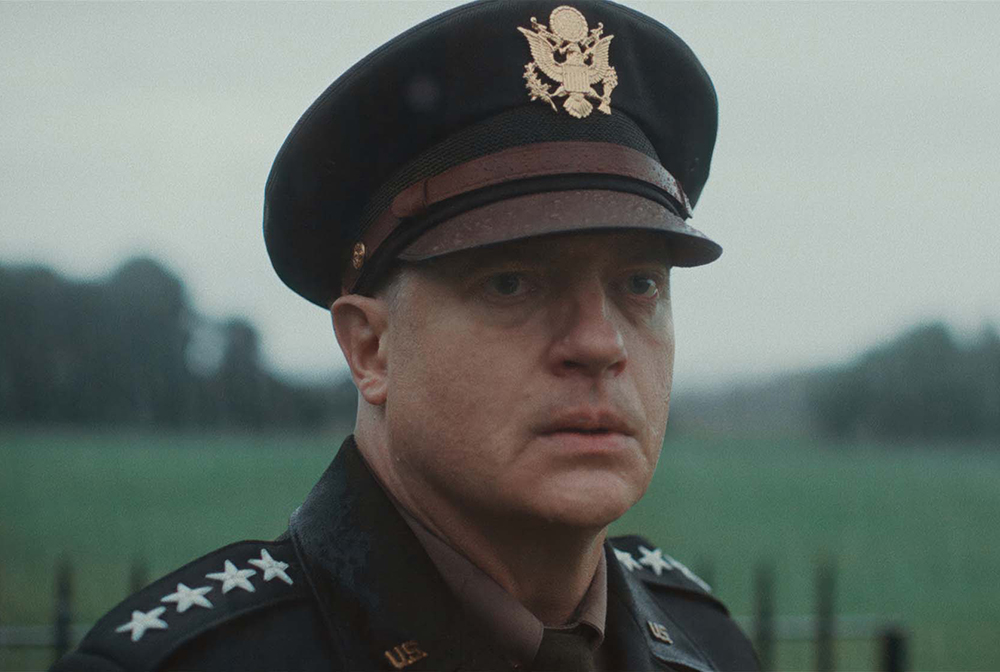
Academy Award winner Brendan Fraser as General Dwight D. Eisenhower in "Pressure" (Focus Features)

by Zachary Lee
Join the Conversation
Send your thoughts to Letters to the Editor. Learn more
In "Pressure," director Anthony Maras has created a thrilling and satisfying war drama about the 72 hours before D-Day and the high-stakes decision-making of General Dwight D. Eisenhower (Brendan Fraser) and chief meteorologist Captain James Stagg (Andrew Scott).
One might not expect themes of the coexistence of faith and science to appear in a war movie, but in "Pressure" it's a central tenet — and it works. In one scene, the generals are in church singing the hymn "All Creatures of Our God and King" and grappling with what is out of their control.
"It was very satisfying to film that scene," Maras told the National Catholic Reporter. "These characters, when the chips are down, find strength in their faith, and to see them come out of the church and meet the scientist, and somehow these two groups have got to reconcile and work together, it says a lot."
Fraser delivers a towering, vulnerable performance as "Ike" Eisenhower, showcasing a man tormented by the decision over whether to deploy troops on D-Day. It could have easily been a one-note role, not unlike the many stern generals we've seen onscreen before, and Fraser is more than capable of playing the hits.
Instead, Maras saw the actor "dare to access a vulnerability inside himself and a humility beside himself that makes Eisenhower more multidimensional ... not just the diplomat, not just the strong leader, but someone who had to grapple with demons to get where he got to. There's heroism in that."
Advertisement
NCR sat down with Fraser over Zoom to discuss playing such an iconic American character.
This interview has been edited for length and clarity.
NCR: "Pressure" is about the 72 hours before D-Day, but one might also say it's about the tension between certainty and confidence. How did you navigate that tension to play General Eisenhower?
Fraser: I developed a certain admiration for Eisenhower through the course of this film. He was not a perfect person by any stretch of the imagination. I'm sure the faith he had was likely challenged, considering that 749 soldiers died in a friendly fire accident, a rehearsal for D-Day called Operation Tiger. I didn't know about this incident before [making the movie]. So I can personally only imagine the state of mind that he had on that weekend before he was about to deploy 300,000 more soldiers in the largest seaborne assault in human history to end the scourge of tyranny and fascism, knowing that, again, the grim statistic of their survival is not looking good.
For him to have made that decision, he was the type of leader who didn't just hear people; he listened. There's a difference. He solicited the opinions of the experts around him, formulated his commands and stood by them.
Your director, Anthony Maras, said the film sets an example for how to think about the problems we face, centering these characters who have the humility to admit what they don't know even as they try to understand the world around them.
1944 was modern life at that time; our modern life is today, 2026. What we both have in common as the ages go by is that we can't shake our fists at the sky and expect a different result when Mother Nature says, "No, this is what you get." We have to be submissive in so many ways.
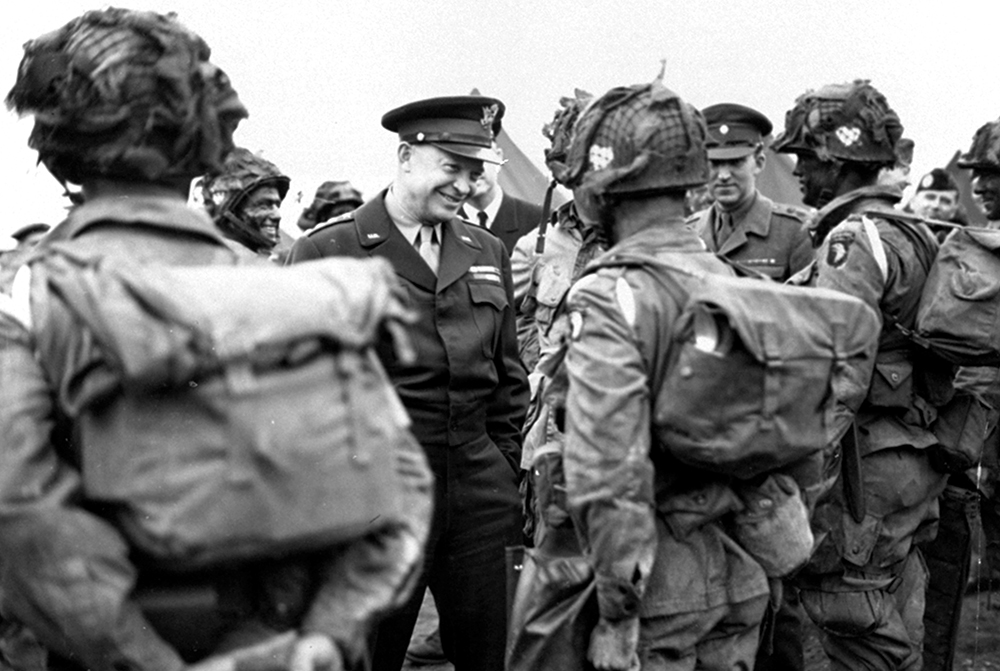
In this June 6, 1944, file photo, provided by the U.S. Army Signal Corps, General Dwight Eisenhower gives the order of the day, "Full Victory — Nothing Else" to paratroopers in England just before they board their planes to participate in the first assault in the invasion of the continent of Europe. (U.S. Army Signal Corps Photo via AP)
How did you approach playing Dwight Eisenhower as both a person and a leader, balancing his stern and tender sides?
I think about the fact that he wrote a letter, in the event of victory, to be read to the world — and he also wrote a letter in the event of defeat. [The latter] wound up in his coat pocket, and then it found its way to an autobiography some years later. In the victory letter, he gave credit to the troops. In the letter of defeat, he put it squarely on his [own] shoulders. So that's the type of leader he is.
I'm a father of three sons in their 20s, and he at that time did have a 20-year-old who had graduated only recently from West Point. If you look at the file photos of the 101st Airborne the afternoon before they deployed on the gliders to make the first wave of attack, the connection he makes with them is authentic. He does care deeply for the well-being of the troops, and it's reciprocated. He's connecting with them in a way where he really is seeing over them in a way, almost as if they are all his sons, too.
If we put this character in conversation with two recent roles of yours, Charlie from "The Whale" and Phillip from "Rental Family," the latter two have a deficit of faith and hope. In "Pressure," Eisenhower needs both of those.
Eisenhower put his faith and hope in God when he needed to pray, and he put his faith in science and facts when he trusted his captain to provide an accurate weather report on a very important weekend. I don't know what science fiction we would be living in right now if things didn't shake out the way that they did, but it would be a certainly different world.
The Focus Features film opens in theaters across the country this weekend.