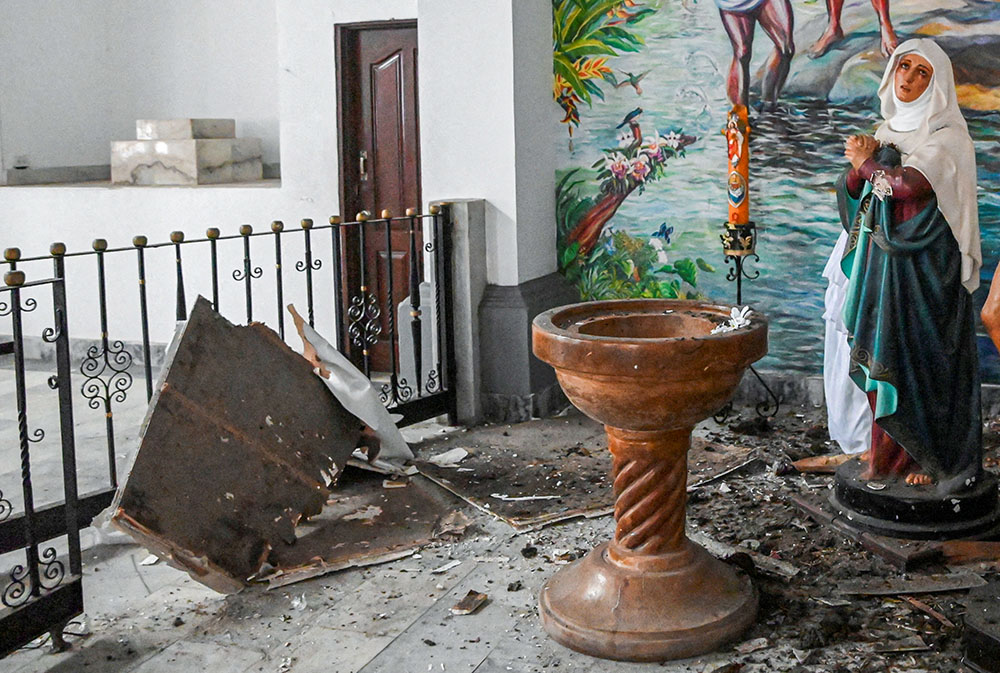
Debris lies inside the Cathedral of San Buenaventura in Colombia, Aug. 16, 2026, following the 7.4 magnitude earthquake. (OSV News/Reuters/Ever Andres Mercado)
by Rhina Guidos
Join the Conversation
Send your thoughts to Letters to the Editor. Learn more
Nuns in Colombia are using reels, photos and stories on places like TikTok, Instagram and Facebook to tell the world about the damage their convents and ministries have suffered after a 7.4-magnitude earthquake on Aug. 10 shook their country, resulting in more than 300 deaths and thousands of injuries.
"We have no water. We have no food," a sister who identified as Ana Maria said in a trembling voice in a video that went viral from San José Senior Care Center in Pereira.
The sadness in her voice moved those who heard her plea. Like thousands in Colombia, the sisters have experienced electrical failure, landslides and damaged bridges and roads, making it difficult for help to arrive.
"Please don't abandon us just because we're a nursing home. Every life counts. The elderly matter," she said, nearly in tears. "They are alive. We are not going to abandon them, but please, don't abandon them. They haven't brought us water or food. ... Please, the elderly are important."
With little or no physical contact outside their communities, sisters have reached out to acquaintances, benefactors, anyone who will hear their pleas via a variety of platforms.
It is difficult at the moment to assess the full extent of the damage from the earthquake, but the Convent of La Merced in Cali and the Monastery of the Poor Clares in Quindío are among the structures under the care of women religious that appear to have suffered the most destruction. An unnamed Poor Clare nun in a video showed collapsed walls, broken beams and destroyed roofs at her convent in Quindío.
"Half of our monastery literally collapsed," the sister says in the reel. "But we hold fast in our hearts to the hope of our Lord."
Colombia is in the midst of a social media boom, Sr. Diana Herrera Castañeda, of the congregation of St. Catherine of Siena, told Global Sisters Report Aug. 18.
"Now everything is on social media, which is why religious communities chose to ask for help" in such a way, she added.
Advertisement
The Colombian Conference of Religious has been requesting aid for the affected communities and has launched the campaign "With Colombia, to the Outermost Corner" to raise funds in collaboration with the National Secretariat for Social Ministry — Caritas Colombia.
"The earthquake also caused damage to churches, rectories, convents, chapels and other church buildings. In addition to their religious and heritage significance, these places are spaces where the daily life of numerous communities unfolds," the national conference said in a statement.
Reported damage includes collapsed towers, the destruction of many churches, cracks in the central dome of the Basilica of the Lord of Miracles in Buga, collapsed roofs, and partially or completely collapsed walls.
"The full extent of the damage is still being assessed due to ongoing communication difficulties in some communities," the conference said.
The region known as Chocó, a remote and impoverished area, was at the epicenter of the earthquake. Bishop Wiston Mosquera of Quibdó, capital of the Chocó Department, told the Italian Catholic news agency SIR that problems that already existed are now worse.
"Chocó is known as one of the most neglected areas in the country. This is no secret to anyone. We all know this, because practically every government has made promises — many promises — but very little has actually been done here," Mosquera said. "Starting with access roads. There are only two highways connecting Chocó to the rest of the world, and they are not in the best condition."
The local hospital lacks the capacity to handle emergencies like the one that just occurred, he added.
"And this has forced many injured people to be transferred to highly specialized hospitals outside the department of Chocó. This, obviously, already poses difficulties for a community and for people with limited resources," Mosquera said. "Because, when they're told that their sick or injured family member must be transferred to a more specialized hospital, then, for that person, for the family member, everything becomes complicated, since they often have no relatives in Medellín, Cali, Barranquilla, Bogotá, or any other city in the country where they are told a bed has become available to transfer the patient."