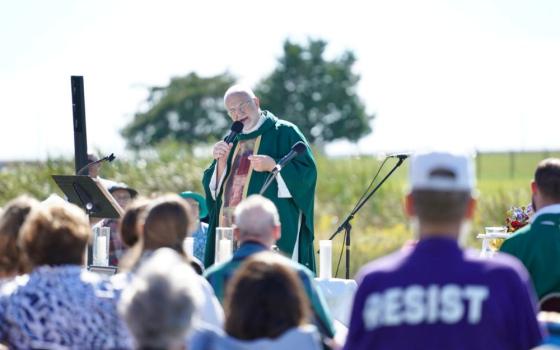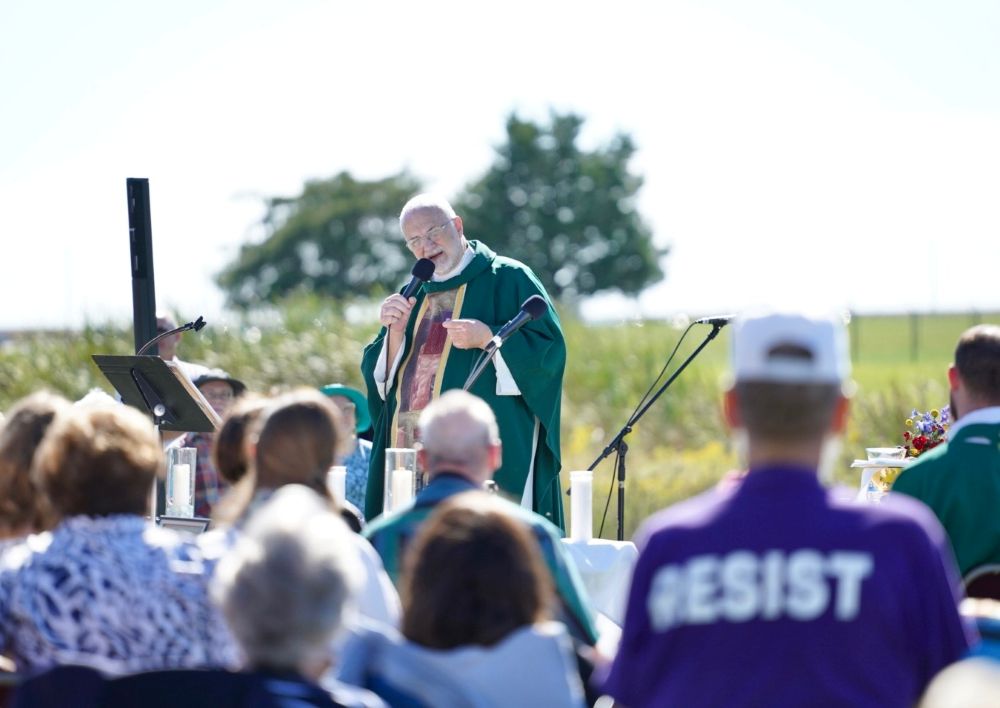
Fr. Jim Farrell of the Archdiocese of Indianapolis delivers the homily at the Sept. 27 Mass at Miami Correctional, a facility that houses approximately 800 ICE detainees. About 450 people attended the Mass. (Courtesy of Allison Mayer)

Join the Conversation
Send your thoughts to Letters to the Editor. Learn more
On the last Sunday of September, Catholics marched through the city of St. Louis in support of migrants and refugees. The same day, St. Louis Archbishop Mitchell Rozanski for the first time called on U.S. leaders to end "indiscriminate detention and mass deportation."
For Rozanski, the urgency was local and painfully concrete.
He pointed to Nixon Perez and Glendy Gonzalez de la Cruz, a Guatemalan couple who had lived in the St. Louis area before Perez was deported and Gonzalez followed him with their family. Rozanski said the couple was later found murdered in Guatemala, their infant nearby in a severely dehydrated condition.
The archbishop said their deaths deeply affected the parish community that had known them.
"I'm so proud of our pastors who are ministering in immigrant communities who are facing such difficult conditions because of the crackdown on immigration," he told the National Catholic Reporter Oct. 5.
St. Louis is far from alone.
What happened there was part of a broader shift unfolding across the country. In recent weeks, Catholic bishops, priests and laypeople have gathered outside detention centers, celebrated public outdoor Masses, marched through city streets and joined vigils and demonstrations in support of immigrants –– in California, Indiana, Rhode Island, New Jersey, Tennessee and Washington, D.C.
These actions are not part of a single coordinated campaign, but together they point to a growing national Catholic momentum that is moving immigration advocacy from statements and pastoral letters into increasingly visible public witness. Bishops have joined processions; Catholic priests have celebrated Masses outside prisons holding detainees of the U.S. Immigration and Customs Enforcement and dioceses have organized public prayer directly outside detention facilities.
Rozanski sees this shift as rooted primarily in faith. "It all comes down to the Gospel and basic human dignity," he said. "When we see human dignity being trampled on in so many ways, particularly with our immigrant and refugee communities, we have to speak out. It is the mandate of Christ that we do."
One of the largest recent examples of this was Sept. 27 in San Diego, where more than 4,000 people joined Bishop Michael Pham in a 1.1-mile procession through Balboa Park proclaiming "All Are Sacred." Priests, deacons, religious and about 20 leaders from other faith traditions joined the walk, while participants carried signs supporting immigrants and sang hymns in English and Spanish.
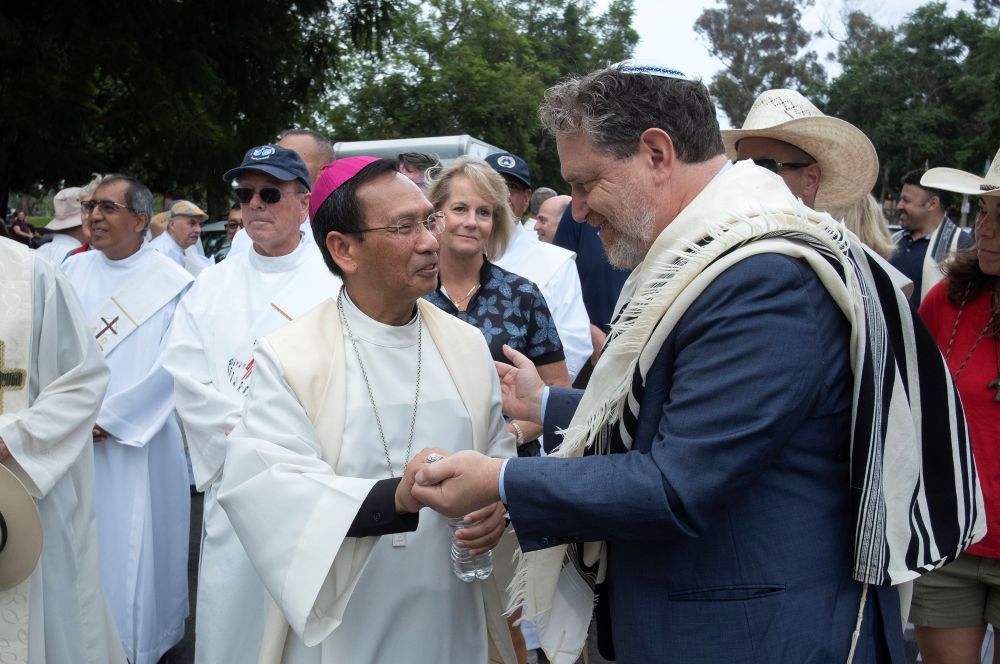
San Diego Bishop Michael Pham shakes hands with Rabbi Mike Rothbaum Sept. 27, 2026, after the bishop led more than 4,000 people in a procession on the World Day of Migrants and Refugees. (OSV News/David Maung)
On Sept. 15, Catholics in Washington gathered for Mass before processing to Capitol Hill in a public witness for immigrants organized by the Archdiocese of Washington and several Catholic groups.
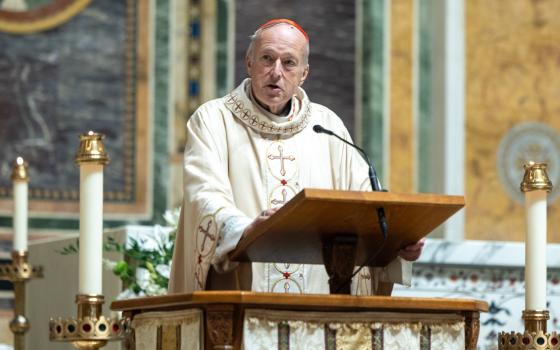
Less than two weeks later, Washington Cardinal Robert McElroy used a Sept. 27 Mass for the World Day of Migrants and Refugees at St. Matthew's Cathedral in Washington to call for a stronger response to mass deportations. Invoking the parable of the good Samaritan, he said Americans could "pass by no more" and urged Catholics to challenge policies that harm undocumented immigrants, asylum-seekers and people with Temporary Protected Status.
In Rhode Island, the Diocese of Providence has invited Catholics to walk together to the Wyatt Detention Center in Central Falls and pray the rosary on the public sidewalk for migrants detained inside. Bishop Bruce Lewandowski led the Sept. 5 gathering and again joined the Oct. 3 procession.
And in Newark, New Jersey, Catholics are participating in a monthly prayer vigil outside Delaney Hall, an ICE detention center. Instructions from the Episcopal Diocese for the Sept. 27 gathering warned participants that checkpoints could force them to walk nearly a mile and advised them to come prepared for the possibility of pepper spray.
The state of Indiana similarly offered a sign of support when Catholics gathered outside Miami Correctional Facility in Bunker Hill Sept. 27 for what organizers called a "Catholic Public Witness for Human Dignity, Prayer, and Hope." With support from the South Bend and Lafayette dioceses, the gathering centered on an outdoor Mass for detainees, immigrant families and communities affected by immigration enforcement.
The event followed an August "Weekend of Public Witness" in which thousands participated at dozens of locations across Indiana calling for an end to ICE detention at the facility, according to organizers.
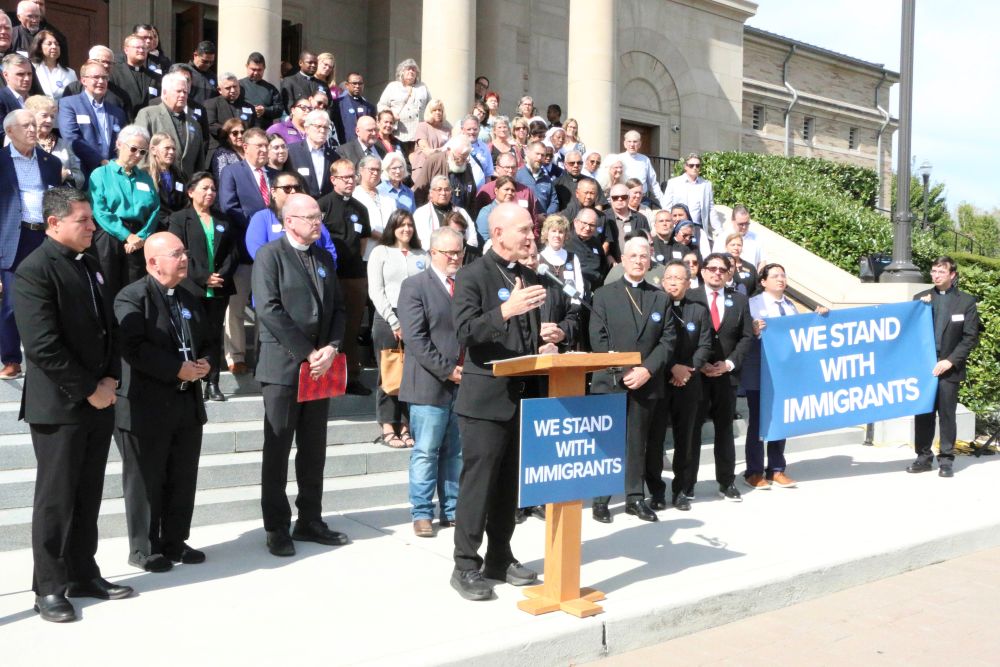
Bishop Mark Beckman of Knoxville, Tennessee, speaks at a Sept. 30 press conference in Knoxville with local faith and business leaders from Tennessee and Kentucky about the impact of increased immigration enforcement in the region. (Courtesy of Hope Border Institute)
In Knoxville, Tennessee, the public witness took a different form. On Sept. 30, Catholic, Episcopal and business leaders stood on the steps of the Cathedral of the Most Sacred Heart of Jesus during "Deepening Our Moral Witness," a regional gathering organized by the Hope Border Institute and hosted by the Diocese of Knoxville. Bishop Mark Beckman recalled meeting immigrant Catholics shortly after becoming bishop there and said their welcome had created a responsibility to stand with them now.
"When one person is suffering, as Paul puts it, all of us are suffering," Beckman said at a press conference after the event. "We have a responsibility to care for the dignity of each and every human person and to respect the rights and due process that are due to citizens and anyone who lives on U.S. soil."
Advertisement
For Dylan Corbett, executive director of the Hope Border Institute, the geographic breadth of these events is significant. Over the past year, he told NCR, his organization has worked with Catholic leaders from New England to Arizona, Texas, Wyoming, California, Tennessee and Washington.
Corbett described pressure from church leadership and pain rising from Catholic communities as the two forces driving the change.
"These are people in our pews; these are people in our Catholic schools; these are people who go to our Catholic hospitals," he said. What is changing, Corbett said, is the church's posture.
"We're moving from accompaniment to solidarity," he said. "We realize that our destinies –– immigrant and non-immigrant, first generation, second generation, seventh and eighth generation –– we're all in this together." The public demonstrations, he said, are "a manifestation of that conversion."
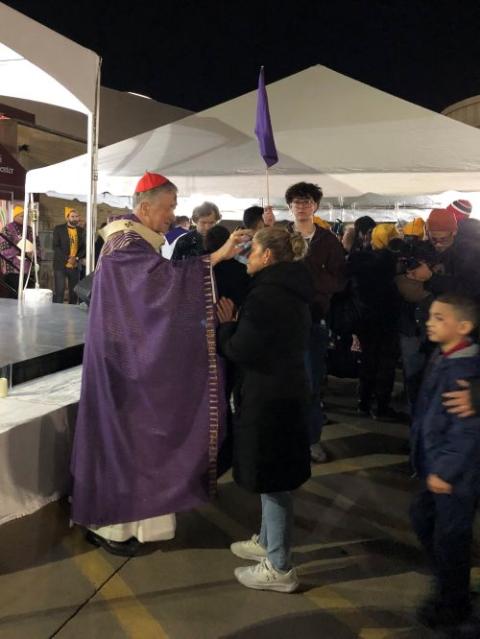
Chicago Cardinal Blase Cupich distributes ashes to the faithful at Ash Wednesday Mass for Chicago-area migrants in Melrose Park, Ill., Feb. 18, 2026. (OSV News/Simone Orendain)
Other bishops are reinforcing that message in increasingly explicit terms.
In Iowa, Davenport Bishop Dennis Walsh wrote to the Homeland Security secretary Oct. 2 over the detention and threatened deportation of Iowa City mother Fatou Traore. He called her removal a "grave injustice" and asked that she be returned to her four children.
In Chicago, Cardinal Blase Cupich used an Oct. 3 homily to argue that Catholic advocacy for immigrants is inseparable from religious practice. "Advocacy for immigrants belongs to every single disciple of Jesus," Cupich said, calling it "an act of divine worship." He urged Catholics to press lawmakers for immigration reform, demand humane law enforcement and insist on pastoral access to people in detention.
That same emphasis on faith over politics was echoed in New York, where J. Antonio Fernández, CEO of Catholic Charities of New York and C. Mario Russell of the Center for Migration Studies used National Migration Week to stress the church's responsibility toward migrants and refugees.
"We do so not because of politics, but because of who we are and what our faith calls us to be," the leaders said in a joint statement. They said that migrants should be seen as people whose dignity, hopes and contributions must remain at the center of the Catholic response.
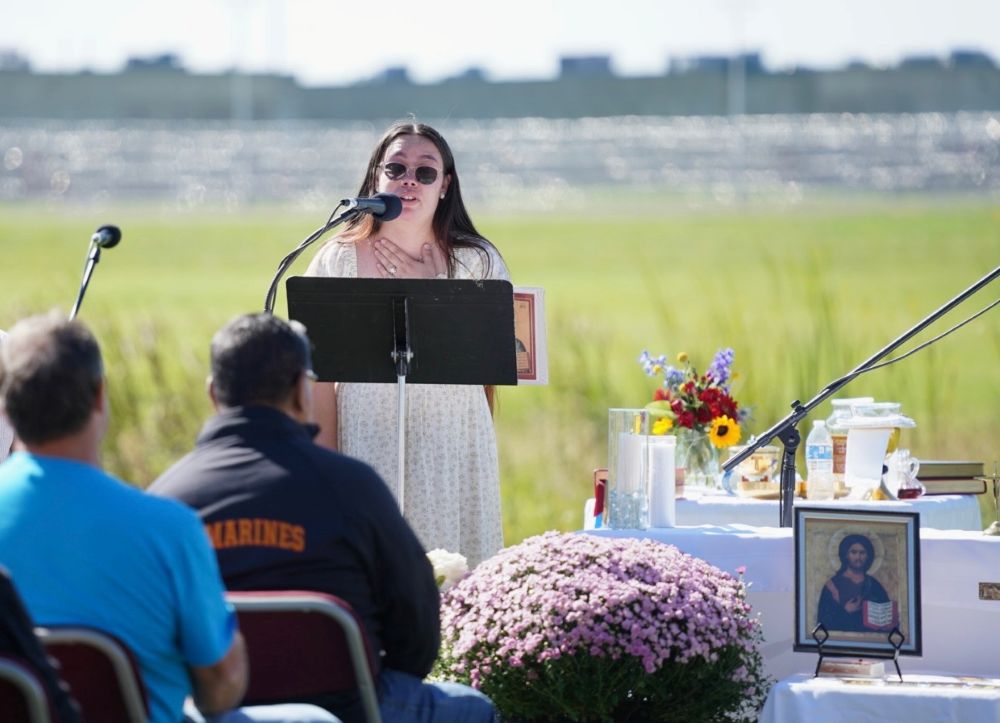
Lindsay Reyes, a 25-year-old U.S. citizen and lifelong resident of Indiana, speaks at the Sept. 27 Mass at Miami Correctional. Reyes' husband, a legal permanent resident for more than 30 years, has been in ICE detention for seven months. (Courtesy of Allison Mayer)
Rozanski said the issue is likely to follow the bishops from local streets to their annual national gathering in Baltimore in November. He added that the unjust treatment of immigrants "will certainly be a major topic" at the November U.S. bishops' Baltimore meeting.
"I think the experience of many of our bishops and their dioceses, and seeing the way that immigrants and refugees are treated, and what is going on in our streets, and the fear that is being engendered in people, will certainly be a major issue and a major topic at our November meeting," he said.
Corbett believes the demonstrations point toward something larger: a Catholic Church increasingly willing to treat immigration as a test of solidarity within its own community.
"I think we're going to go through a dark night of the soul as a country on this issue. I think that there's a lot of pain ahead of us," he said.
"But I do have a lot of hope, and I think that the church is going to have a real opportunity to contribute to the renewal in our country around immigration policy, and hopefully move the needle to make some essential reforms."