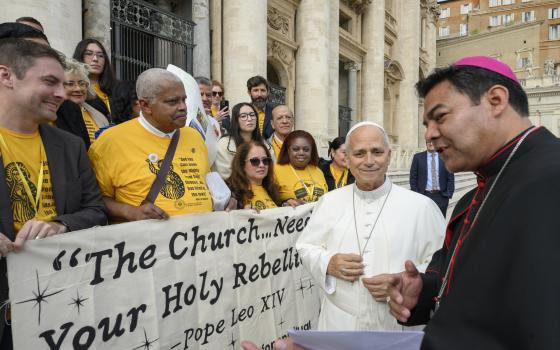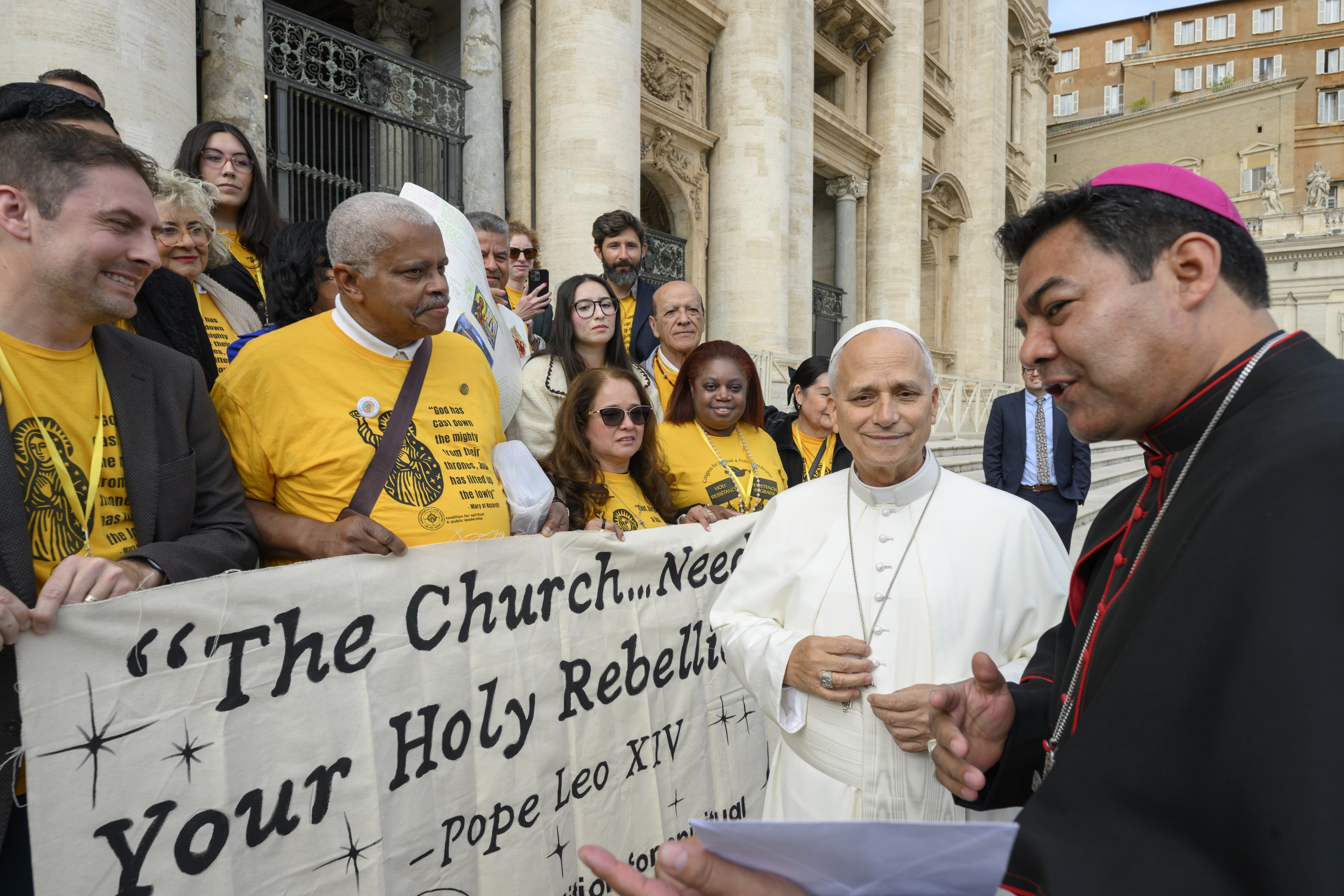
Chicago Auxiliary Bishop José María Garcia-Maldonado speaks with Pope Leo XIV in St. Peter's Square at the Vatican Oct. 28, 2026. The bishop was part of a delegation for the Coalition for Spiritual and Public Leadership, which provides pastoral care to detainees in an ICE processing facility near Chicago. (CNS/Vatican Media)

Join the Conversation
Send your thoughts to Letters to the Editor. Learn more
"I'm not afraid of what happens to me. I'm afraid of not being with my family."
The words were written by a man detained at the Broadview immigration enforcement facility outside Chicago on Aug. 25, 2026. He worried about his younger sisters and a 2-year-old niece who saw him as her father. His letter, asking Pope Leo XIV to pray for them, became part of a collection that just traveled to Rome.
In September, Michael N. Okińczyc-Cruz, co-founder and chief executive of the Coalition for Spiritual and Public Leadership (CSPL), brought letters from Broadview detainees to the Chicago-born pontiff. Then, on Oct. 28, a larger coalition delegation stood before Leo in St. Peter's Square, presenting a handmade album of photographs, prayers and messages.
It was an encounter that would have seemed improbable a year earlier, when a very different delegation stood before a locked gate.
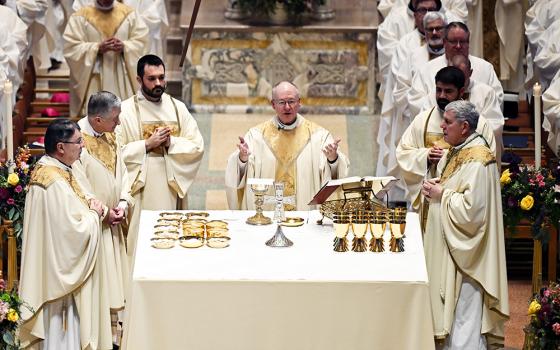
On Nov. 1, 2025, more than 2,000 Catholics and supporters gathered outside Broadview for an All Saints' Day Mass and a Día de los Muertos "People's Mass." More than 50 clergy and women religious joined the procession. Chicago Auxiliary Bishop José María Garcia-Maldonado and Mercy Sr. JoAnn Persch approached the Immigration and Customs Enforcement facility, hoping to give Communion to people detained inside.
They were turned away. "The answer was no," Persch told the gathering.
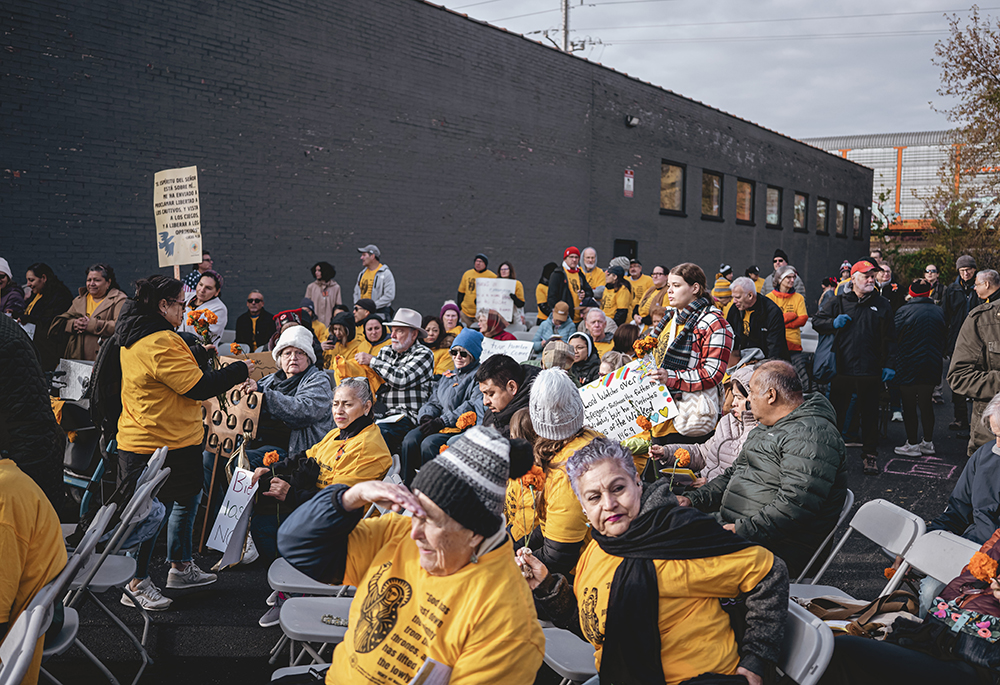
Participants attend an All Saints' Day Mass organized by the Coalition for Spiritual and Public Leadership outside the Broadview ICE detention center near Chicago, November 2025. (Courtesy of CSPL/Bryan Sebastian)
The refusal followed another denial during an October Eucharistic procession. For Persch, who had spent years praying at Broadview alongside fellow late Mercy Sr. Pat Murphy, the closed door interrupted a long-standing tradition of accompaniment. Persch died Nov. 14, more than a month after the Mass. Her final campaign would become a legal fight she did not live to see succeed.
The urgency had already become personal in surrounding neighborhoods. Irma Hernandez, an immigrant from Mexico and social justice coordinator at Our Lady of Mount Carmel Parish in Melrose Park outside Chicago, remembered learning that Silverio Villegas González had been fatally shot by an ICE officer in September, only blocks from her home.
She received videos, alerted her parish network and called her pastor, Scalabrinian Fr. Leandro Fossá. On another occasion, hearing that immigration officers might be approaching two churches during Sunday services, she urgently warned parish contacts to protect worshippers and parents bringing children to religious education. No arrests occurred there, she said, but the fear remained.
"We have to begin to go outside into the streets," Hernandez recalled telling fellow organizers. "People are really scared. People are blocked by fear."
The Coalition for Spiritual and Public Leadership had been preparing for such actions long before the 2025 raids. Okińczyc-Cruz traces his organizing vocation to the 2008 financial crisis, when his parents nearly lost their home after taking out predatory loans.
Advertisement
Years working with immigrant, refugee and Black communities around Buffalo, New York, convinced him that faith and grassroots organizing could reinforce one another. The coalition, founded around 2017 and now encompassing more than 65 parishes, universities, religious orders and community organizations, combines Catholic spiritual formation with campaigns on immigration, public health, economic and environmental justice.
"Our relationships are our most valued resource," Okińczyc-Cruz said.
That foundation, he said, made it possible to respond collectively when the Trump administration launched Operation Midway Blitz in Chicago.
Fossá had prayed the rosary outside Broadview since 2007. But as immigration arrests intensified, he felt the ritual outside was no longer enough. "We need to be inside," he remembered deciding.
A volunteer warned him that federal authorities would never permit it. "I'm not going to rest until I'm in," he replied.
The coalition filed a federal lawsuit on Nov. 19, 2025, arguing that the ban on clergy visits violated the First Amendment and the Religious Freedom Restoration Act. According to the suit, ICE had cited safety and security concerns and the facility's temporary processing function to justify restrictions.
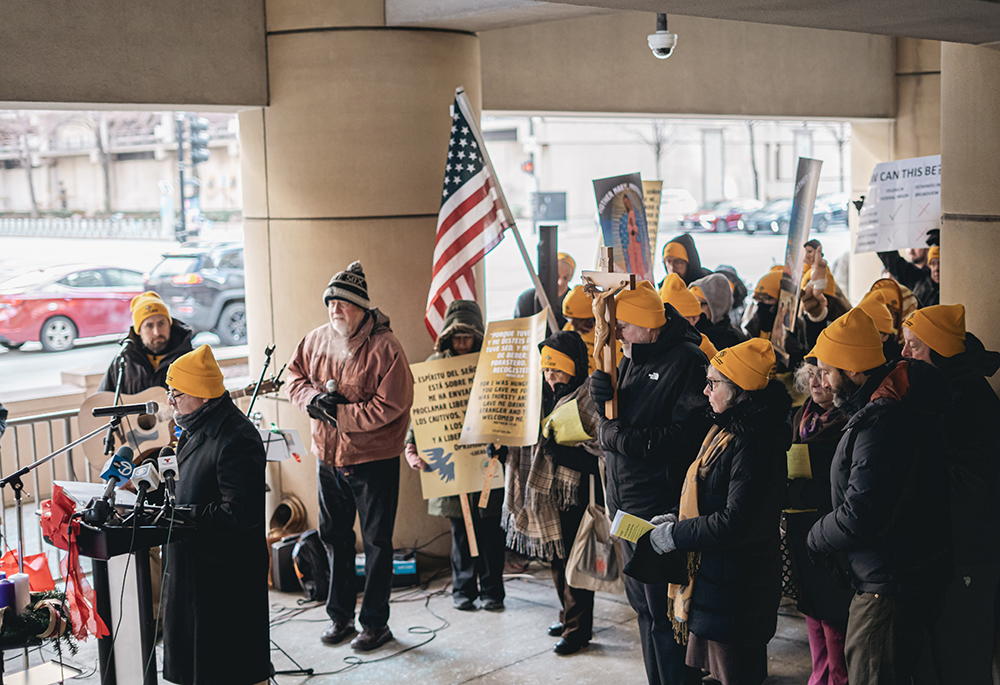
Catholic activists gather outside the U.S. Immigration and Customs Enforcement's Chicago field office to request permission to bring Communion to detainees, Dec. 19, 2025. (Courtesy of CSPL/Bryan Sebastian)
In February, U.S. District Judge Robert Gettleman found that the government had substantially burdened the plaintiffs' religious exercise, opening the way for a limited Ash Wednesday visit. Another order allowed Holy Week services and an April 7 injunction required regular access and negotiations over safety and security protocols.
Daily pastoral visits finally began May 15 under a court-ordered agreement. The protocols permit a coordinated team of up to five approved clergy members or volunteers each day.
For ministers, the difference between limited visits and daily access is measured in human contact. On Ash Wednesday, detainees met clergy under restrictions. By May, ministers could sit face to face, pray and sometimes embrace them.
"There are stories and faces that will never leave my heart," Fossá said, recalling parents separated from small children and people detained on their way to work. "I don't go into Broadview to minister. I go in to become a better priest."
Claretian Fr. Paul Keller, who joined the campaign personally at the November Mass, found that spiritual care rarely follows a script. One person might be too distraught to speak, while another group might want to sing, discuss Scripture or ask a minister to contact a relative.
"It breaks your heart and makes you furious," he said. "We were in Rome for one reason, and that is to continue to highlight the plight of migrants."
The coalition says its rotating corps of about 75 volunteers made more than 135 pastoral visits and ministered to over 725 detainees by late October.
Dominican Sr. Christin Tomy, who works at Dominican University, just outside Chicago, describes the visits chiefly as "a ministry of listening." Some detainees, she said, have almost no opportunity to tell anyone beyond the facility walls what has happened to them.
For Jesuit Fr. David Inczauskis, ordained in June 2025, the Broadview campaign became inseparable from his first year of priesthood. The church's calling, he said, requires both direct compassion for those suffering and efforts to confront the structures producing that suffering.
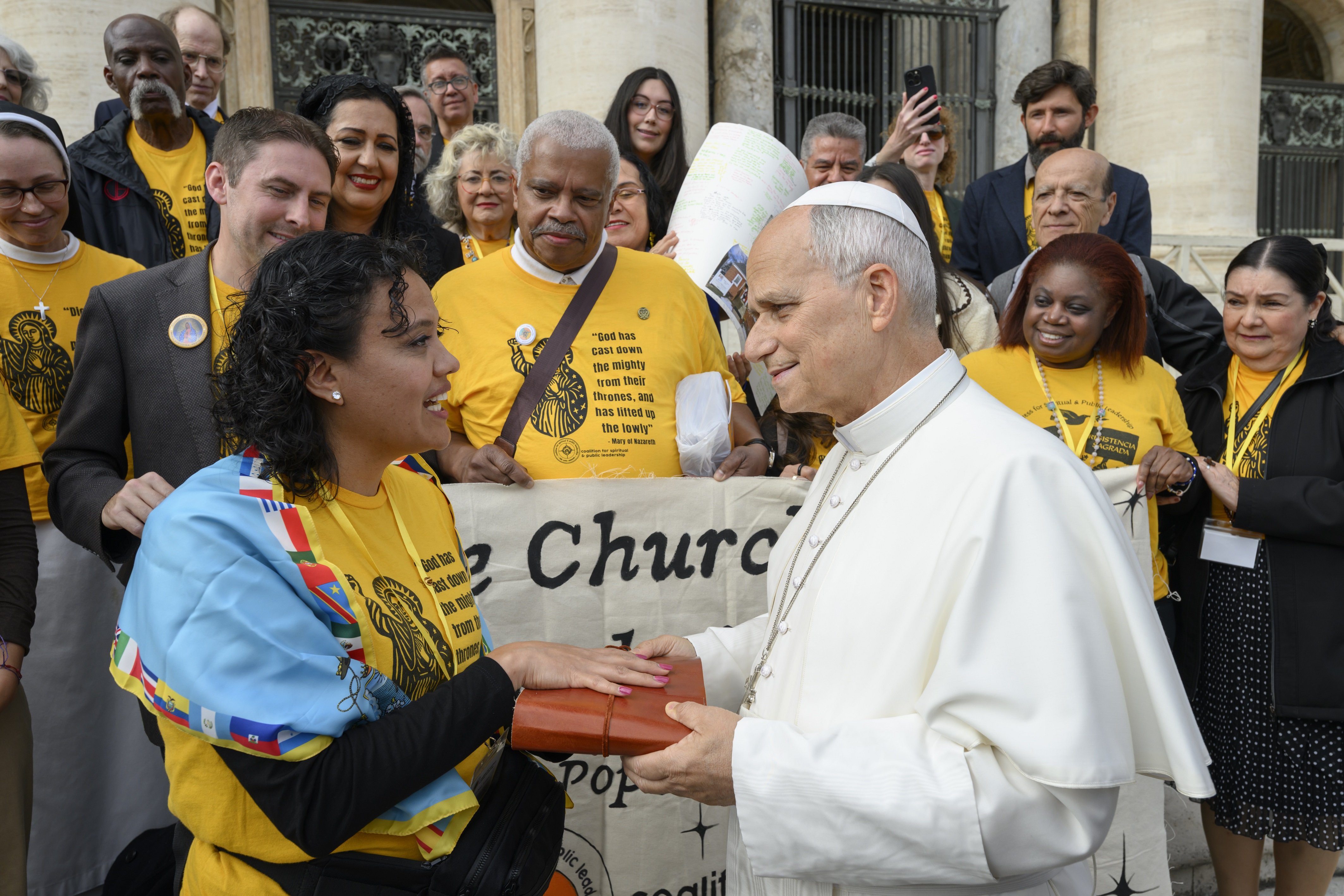
Lay Scalabrinian Abigail Ortiz Valles presents Pope Leo XIV photos and messages from the Coalition for Spiritual and Public Leadership and detainees in an ICE processing facility near Chicago, after the general audience in St. Peter's Square at the Vatican Oct. 28, 2026. (CNS/Vatican Media)
The letters carried to Leo make clear why. A Nicaraguan father wrote that he was being separated from two young daughters in Wisconsin. "I only ask God to be reunited with my daughters," he pleaded.
A Venezuelan man detained at Broadview wrote of his wife and sons remaining in Chicago: "My little one knows nothing of his country, and taking him out of the United States would be very hard for him."
Leo had already publicly supported the coalition's central request in November 2025, urging authorities to allow pastoral workers to reach detained migrants. Now, almost a year later, the organizers could thank him face to face.
At the Oct. 28 papal audience, lay Scalabrinian Abigail Ortiz Valles handed Leo the album and spoke about encountering Christ in those detained, including a mother of three, one of them a child with special needs, arrested at a bus stop.
CSPL member Tiffany Swann-Covington thanked Leo for supporting pastoral access and requested a recorded message for CSPL's 10th anniversary next June.
A banner carried by delegates borrowed his words from a speech to young Catholics: "The Church … needs your holy rebellion."
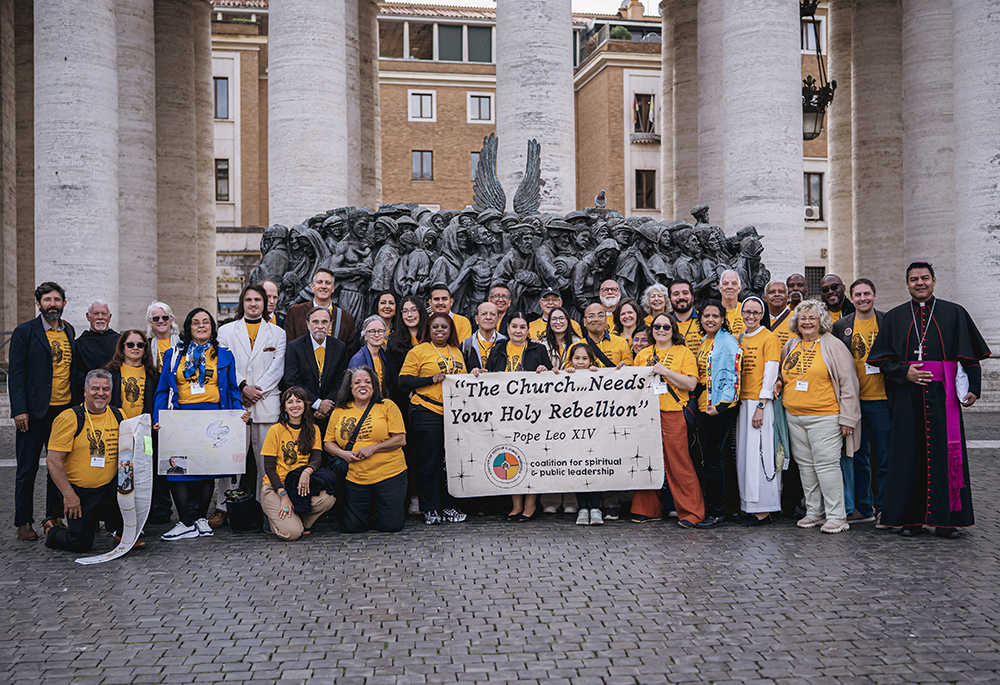
A CSPL delegation that met Pope Leo XIV in St. Peter's Square on Oct. 28 stands by "Angels Unawares," a permanent installation in St. Peter's Square that portrays immigrants of multiple generations and ethnic backgrounds. (Courtesy of CSPL/Bryan Sebastian)
Some of the group's members also met Vatican officials working on migration and social justice. Okińczyc-Cruz said Leo told the group to "Keep up the good work."
For Joanna Arellano-Gonzalez, CSPL co-founder and director of training and formation, the encounter reflected both the coalition's years of grassroots organizing and her own roots in Chicago's South Side immigrant communities.
"Because of that work over the last nine years, we were prepared to face the challenges during Operation Midway Blitz and we were able to meet the moment with courage," she said. "And that courage rippled across the country, all the way to our Holy Father."
After the audience, Tomy stood with the delegation near "Angels Unawares," the sculpture of migrants in St. Peter's Square. Only then, she said, did the emotion strike her, as she said she realized their local work was part of a global story of displacement.
"We weren't there for us," she said. "We were there to bring those stories forward."