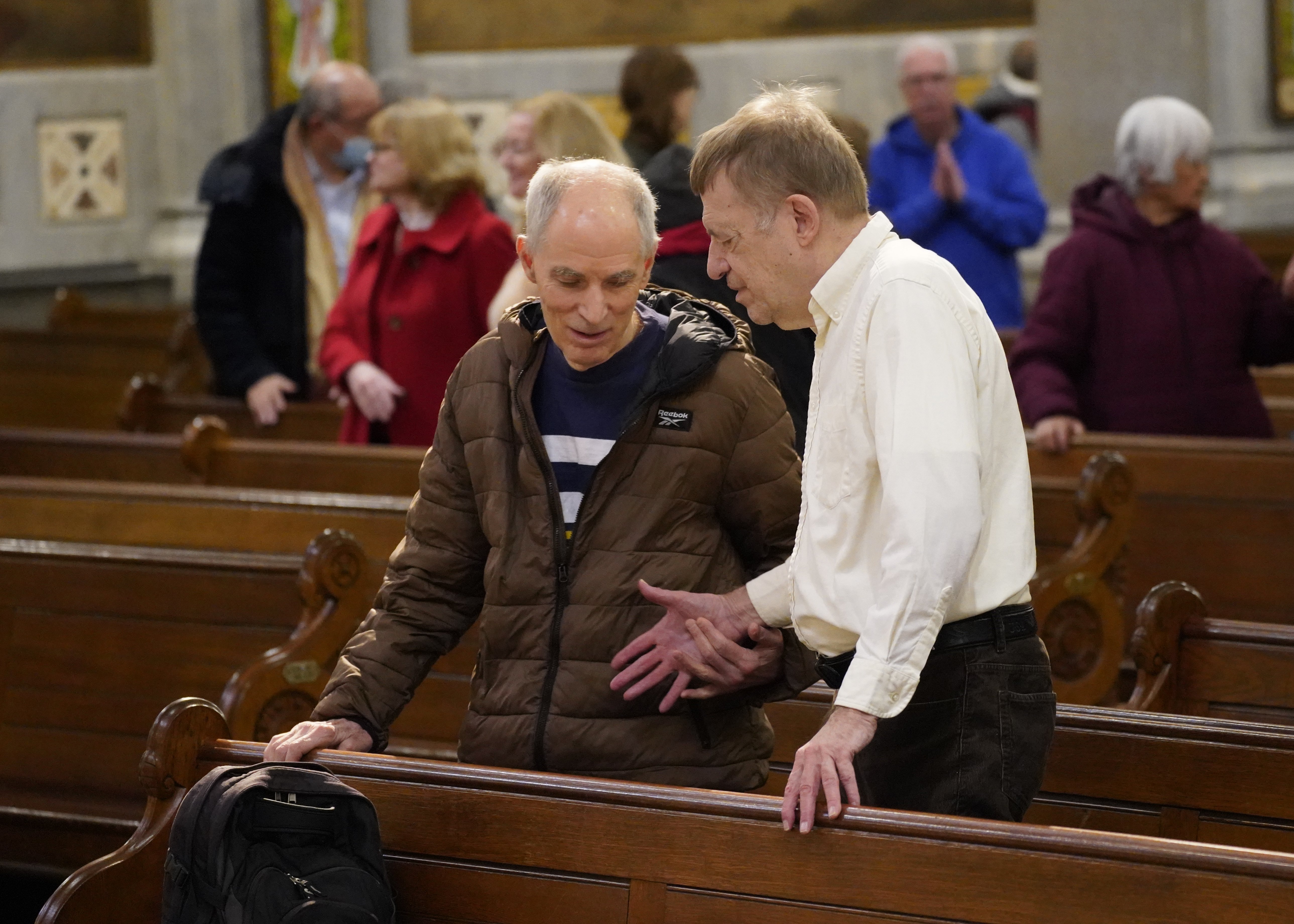
Joe Ciccone, left, of Rego Park, N.Y., and Bob White of Co-op City, N.Y., both of whom are blind, exchange the sign of peace during a Mass marking the feast of St. Lucy, patroness of the blind, at St. Francis Xavier Church in New York City Dec. 13, 2024. The liturgy is hosted annually by the Xavier Society for the Blind. (OSV News/Gregory A. Shemitz)

OSV News
Join the Conversation
Send your thoughts to Letters to the Editor. Learn more
Key Catholic organizations, including the U.S. Conference of Catholic Bishops, sent a joint letter to Congress calling a recent Department of Justice guidance lowering the threshold for institutionalizing persons with disabilities "deeply troubling."
Olmstead v. LC, a landmark 1999 ruling by the U.S. Supreme Court, held that persons with disabilities have the right to receive care in integrated settings, rather than be segregated to institutions, as long as certain conditions are met, such as a program's ability to provide appropriate care.
But a DOJ slip opinion issued in June — a document that does not have the force of law but is rather internal guidance concerning actions taken by the Executive Branch — argued neither section 504 of the Rehabilitation Act nor Title II of the Americans with Disabilities Act requires states to provide such services in integrated settings.
"We recognize that this view of Olmstead's import is out of step with the common understanding of that decision within the federal courts," the slip opinion said.
"Legitimate justifications," it said, "could include concerns about the safety of the individual or the community."
In their Oct. 14 letter, six Catholic leaders raised alarm at the prospect. They are: Archbishop Shelton Fabre of Louisville, Kentucky, chair of the USCCB's Committee on Domestic Justice and Human Development; Bishop Edward Burns of Dallas, chair of the USCCB Committee on Laity, Marriage, Family Life and Youth; Sr. Mary Haddad, president and CEO of the Catholic Health Association of the United States; Leo Zanchettin, board chair of the National Catholic Partnership on Disability; Kerry Alys Robinson, president and CEO of Catholic Charities USA; and Jesuit Fr. Christopher Kellerman, secretary of the Office of Justice and Ecology at the Jesuit Conference of Canada and the United States.
"Subsequent actions taken by DOJ call into question its commitment to enforce the integration mandate and will lead to widespread pain and suffering among persons with disabilities and their families," the letter said.
"We urge Congress to do everything in its power to affirm the rights of persons living with disabilities to flourish in their families and communities," it said. "Congress must act to protect the programs, policies, and resources that persons with disabilities and their families rely on to thrive."
A spokesperson for the Department of Justice said in a written statement to OSV News, the slip opinion "answered an ordinary-course request about updating guidance documents and the proper scope of Olmstead. It interprets statutes Congress enacted and a decision the Supreme Court issued."
Michael Waddell, a member of the National Catholic Partnership on Disability's Ethics and Public Policy Committee, told OSV News the Trump administration's new interpretation "represents a radical departure from how the mandate has been understood for more than thirty years."
"In other words, they're saying that people with disabilities do not have a right to live and receive services in the most integrated appropriate environment," he said of the memo. "This is the exact opposite of how these matters have been understood by virtually everyone for the past several decades."
Advertisement
Waddell said that "neither the Americans with Disabilities Act nor section 504 of the Rehabilitation Act nor Olmstead v. L.C. can be fundamentally altered by the DOJ's mere statement of an opinion about the integration mandate. Until either Congress or the courts say otherwise, those statutes and precedents would still seem to entail a right for people with disabilities to live and receive services in the most integrated appropriate environment."
"However — and this is really important — the statements the DOJ issued last summer suggested that they would no longer protect this right for disabled people if states should choose to provide services only in segregated, institutional contexts," he continued. "And actions that the DOJ has taken in the wake of those statements have borne this out.
"So, it really looks like people who have disabilities will no longer be able to count on the federal government to help them defend their right to live and receive services in the most integrated appropriate environment. For those who aren't in a position to fight to defend that right for themselves — for example, through expensive lawsuits — the result might be that they are forced to live in institutions. And that is really scary."
A bipartisan resolution introduced in the U.S. House of Representatives in September would affirm "the Olmstead decision's vital importance to ending the unjustified institutionalization and segregation of individuals with disabilities" and urge federal and state officials to uphold the longstanding interpretation of the decision.