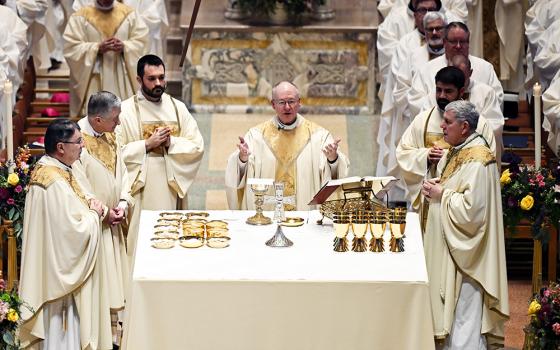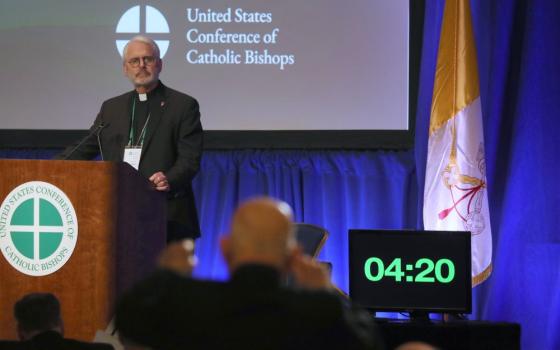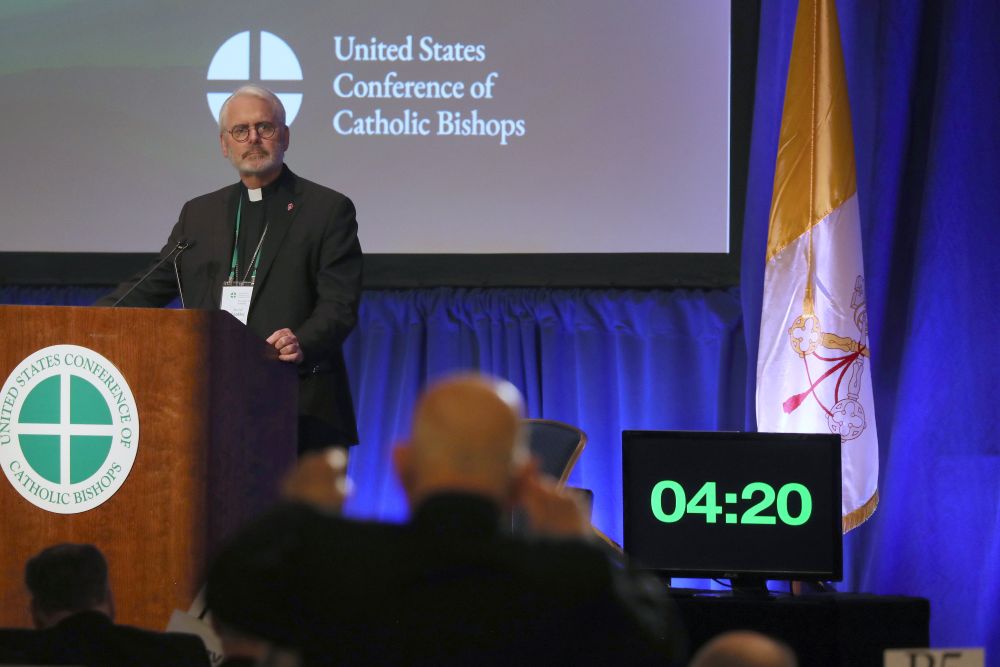
Archbishop Paul Coakley of Oklahoma City, now president of the U.S. Conference of Catholic Bishops, speaks during a Nov. 12, 2024, session of the fall general assembly of the USCCB in Baltimore. The bishops meet Nov. 16-19 in Baltimore. (OSV News/Bob Roller)
by Brian Fraga
Staff Reporter
Join the Conversation
Send your thoughts to Letters to the Editor. Learn more
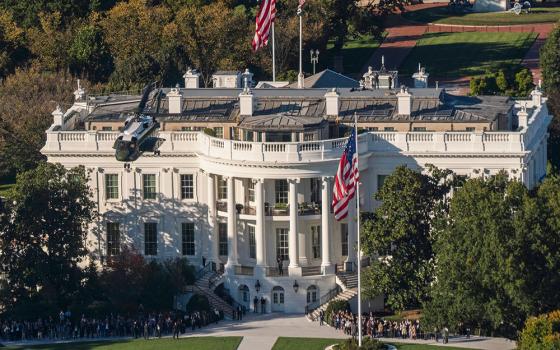
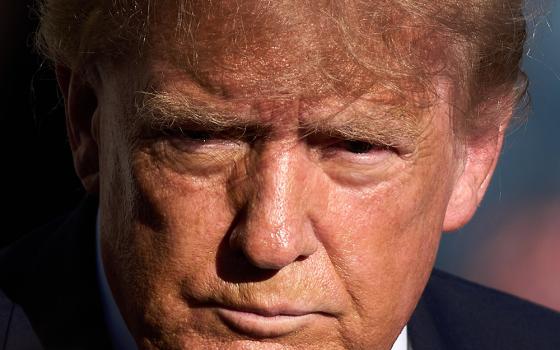
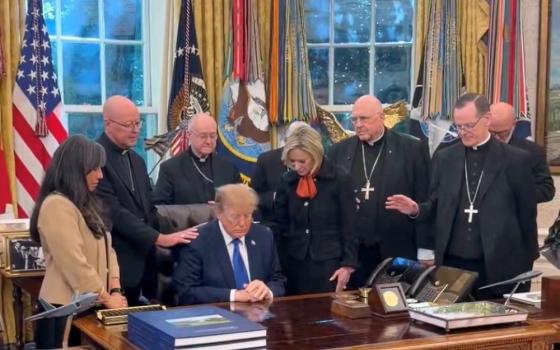
The U.S. Conference of Catholic Bishops made it clear early on that it had no involvement in the controversial Oct. 22 meeting at the White House, during which several Catholic bishops were recorded praying over President Donald Trump in the Oval Office.
"This was not something that the USCCB organized. It is not affiliated with the Conference," Chieko Noguchi, a spokeswoman for the bishops conference, wrote in an email to National Catholic Reporter on Oct. 22 shortly after a White House aide shared the video on social media.
Since then, several of the 12 bishops who participated in that meeting have tried to distance themselves from it, with one apologizing for his presence and saying that the bishops were "manipulated" by the White House.
With so much controversy following the meeting, some experts were left wondering why the bishops failed to utilize the professional staff at the USCCB, who could have provided counsel on the risks of the meeting or highlighted the controversy behind one of the individuals the White House served as a liaison between it and the bishops.
"They should have consulted with the U.S. Conference of Catholic Bishops before they did this," said Jesuit Fr. Tom Reese, a journalist who has covered the bishops conference for decades.
Reese told NCR that he at first thought the video of bishops praying over Trump, with their hands extended, was produced by artificial intelligence.
"I never thought the bishops would be so imprudent to do that, just a few weeks before the election," Reese said. "I think they were manipulated by the White House. I really don't think they were consciously doing this out of political motives. I think they were just naive."
"I think it says more about the 12 bishops than it does about the USCCB," Reese added. "It may in fact strengthen the USCCB because it's reminding all the other bishops, 'Talk to [the conference] before you do something stupid.' "
David Gibson, the director of Fordham University's Center on Religion and Culture, said the episode is embarrassing for the bishops involved and for the bishops conference itself.
"It indicates a decline in the prestige and the status of the wider USCCB," Gibson said. "In past days, you never ever would have taken a meeting like this without consulting the president of the conference and other officials, but [the bishops conference] has been so downgraded that bishops are freelancing left and right. That's a problem, I think, of the wider conference."
But at least one former bishops' conference official thinks that the White House is to be faulted, not the bishops who took the meeting.
Stephen Colecchi, a former director of the Office of International Justice and Peace of the U.S. Conference of Catholic Bishops, told NCR that it is not unusual for individual bishops to meet with public officials.
"There's no requirement they go through USCCB," Colecchi said. "And to be honest, I don't think going through USCCB would have necessarily changed the outcome of how the meeting was used. It's really unprecedented for a group of bishops to be recorded without their knowledge and for that recording to be released in an election season. I never encountered anything like that when I was at USCCB."
The bishops will meet Nov. 16-19 in Baltimore for their fall plenary assembly.
Advertisement
How the meeting in the Oval Office came about remains a contested matter.
At least two bishops who participated said they were invited by the Heritage Foundation, the Trump-aligned conservative think tank based in Washington, D.C. Mario Enzler, a lay Catholic with connections to the Heritage Foundation, joined the bishops. The White House described him as a "a Catholic liaison to the bishops."
A former member of the Swiss Guard who describes himself on his LinkedIn profile as a "saint in training," Enzler has faced serious allegations of misrepresenting his own background, with one former colleague describing him as a "charlatan and a con artist."
Enzler is listed on the website of the Heritage Foundation as a senior adviser to the president in the chief officer strategy department. The Heritage Foundation is the group behind the controversial Project 2025, an initiative that seeks to reshape the U.S. federal government by consolidating executive power in favor of right-wing policies.
On the Heritage website, Enzler's sole contribution as an author is a link to an article he co-wrote in June, in which he criticized U.S. bishops for their support of temporary protected status for migrants from Haiti and Syria. Bishops have repeatedly urged the Trump administration to extend TPS status.
An Oct. 22 article in The Pillar reported that Enzler organized the gathering. Bishop Scott Bullock of Rapid City, South Dakota, told NCR on Oct. 23 that a representative of the Heritage Foundation had personally invited him to the White House meeting. Archbishop Jeffrey Grob of Milwaukee said in a statement that the meeting was the second of two such gatherings arranged by the Heritage Foundation.
However, Marguerite Bowling, a spokesperson for the Heritage Foundation, told NCR that Enzler was simply a participant.
"Heritage didn't organize this meeting. Mario Enzler was in there, but he didn't set anything up. We aren't commenting beyond that," Bowling wrote in an email.
That Enzler found himself included in a relatively small gathering inside the White House is bringing renewed light to his background and questions about his influence with Catholic bishops.
In 2022, Enzler resigned as the dean of the Cameron School of Business at the University of St. Thomas in Houston after serving two years in the role. His resignation followed allegations that he had falsified his academic credentials.
Faculty members at the business school investigated his background and found evidence that he lied about his credentials. He said he earned a Ph.D. from a music conservatory in Italy that does not offer doctorates and a bachelor's degree from an Italian high school, according to The Chronicle of Higher Education.
The Houston Chronicle also reported that several professors started looking into his resume after becoming uncomfortable with Enzler’s leadership style. An accounting professor told the newspaper that Enzler was a charlatan, a fraudster and a con artist.
Enzler did not return messages seeking comment for this story.
After leaving St. Thomas University, Enzler landed a job teaching ecclesial management and administration at Catholic International University, an online school based in West Virginia. He has not taught at the university since February 2025, a university official told NCR.
Enzler previously worked four years as a professor teaching business and finance at the Catholic University of America's Busch School of Business.
According to his website and media interviews he has given over the years, Enzler was born and raised in Northern Italy, in a small town in the foothills of the Italian Alps. He studied music in Milan and Verona, then joined the Swiss Guard and served under St. Pope John Paul II as a soldier and conductor of the Swiss Guard Band.
Following his service at the Vatican, Enzler worked for almost 20 years in investment banking and wealth management. He eventually left the financial industry and moved to the United States. In 2020, he founded a classical K-12 Catholic school in New Hampshire, which has since closed.
In 2022, Enzler started Borromeo Project, a consulting firm to aid Catholic dioceses, parishes, religious orders and apostolates with financial problems and behavioral crises. The nonprofit's website advertises Enzler's services as a consultant and adviser, business coach and public speaker.
His personal website also offers Enzler's services for speaking engagements. In 2020, he wrote a book about his time in the Swiss Guard titled, I Served a Saint. The website features testimonials from several bishops praising his book, among them former Detroit Archbishop Allen Vigneron, Cardinals Daniel DiNardo, the former archbishop of Houston, and Pietro Parolin, the secretary of state of Vatican City.
The controversial meeting and the role played by such a polarizing figure in the church highlights the political fractures in the country and the church, experts said.
"I think the orientation of the USCCB as a whole in this last year and a half has become much less confident in the honesty of the Trump administration," said Massimo Faggioli, a theologian and church historian at Villanova University, pointing to the administration's hard-line stance against immigration.
"I think for those bishops who have apologized, they have decided that it's better to look extremely naive than it is to look like they're aligned with Trump," Faggioli said.