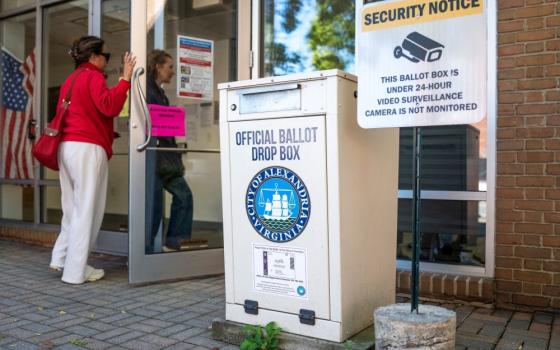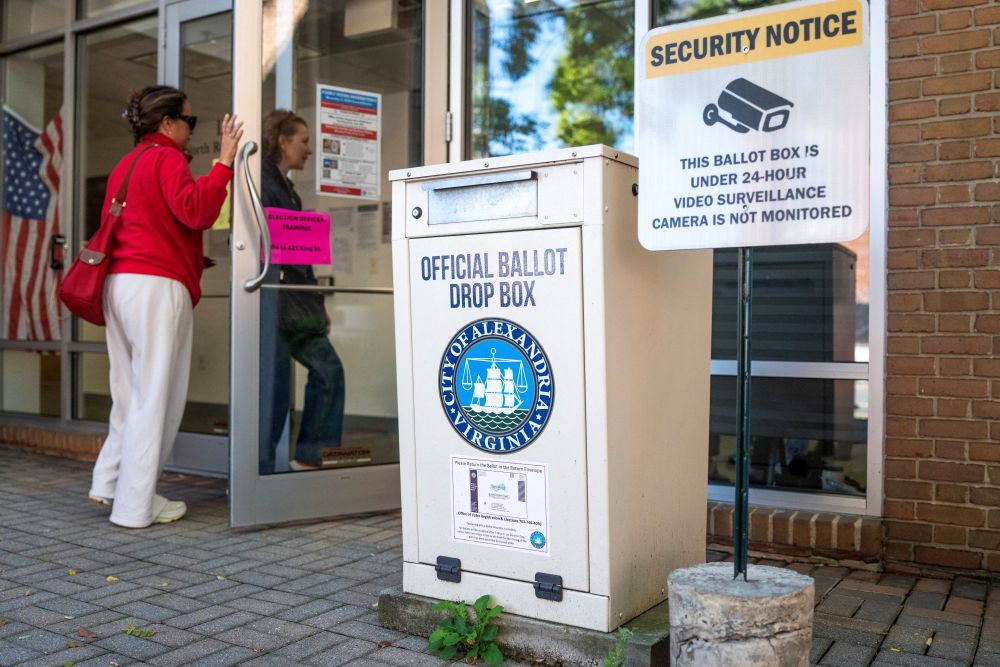
People walk past a ballot drop box during early voting at the Alexandria City Registrar Office in Virginia Oct. 7, 2026. (OSV News/Reuters/Nathan Howard)

by Brian Fraga
Staff Reporter
Join the Conversation
Send your thoughts to Letters to the Editor. Learn more
St. Joseph Sr. Susan Francois did not trust the U.S. Postal Service to deliver her mail-in ballot to her local elections office.
Francois, 54, who has been voting by mail almost exclusively since 1990, filled out her ballot, then went to an elections drop-off box at City Hall in Jersey City, New Jersey. She recorded herself dropping off her ballot, then posted the video on social media.
"To have what is supposed to be a nonpartisan voting system be weaponized is super disturbing," said Francois, who referenced President Donald Trump's efforts to restrict mail-in voting, which prompted a legal battle that reached the U.S. Supreme Court.
"For the first time in my life, the integrity of democracy was something I'm seriously concerned about and that I considered in my voting," Francois told National Catholic Reporter.
A recent survey by Pew Research Center finds that Francois is not alone: 73% of registered voters said the future of democracy was an important issue for them in the Nov. 3 midterm elections, second only to the economy.
Majorities of Republican and Democratic voters said the future of democracy is very important to their vote, though Democrats are more likely to say that than Republicans (85% vs. 69%, respectively), according to Pew.
"I think it's an abstract concept, and I think the people who may see the health of democracy as particularly salient are probably going to vote Democratic anyway," said Geoffrey Layman, chairman of the political science department at the University of Notre Dame.
Layman noted that emphasizing democracy did not help President Joe Biden or Vice President Kamala Harris in the 2024 election. But he said the issue may play differently amid corruption allegations in the federal government and billionaires seemingly profiting from their connections to power.
"I think that's closely related to democracy, but I think, especially when the economy is in a down period and people are struggling to make ends meet, I think that kind of corruption and profiteering off power sits particularly poorly with people," Layman told NCR.
Interviews with Catholic voters concerned about the future of democracy indicate they believe the executive branch under Trump has demonstrated autocratic tendencies and has gone unchecked by Congress and the courts. They also see an erosion of democratic norms and a weakening of the nation’s social fabric under Trump’s leadership.
"For me the biggest issue in the election is preserving the republic. Civil liberties have been ignored. The Constitution no longer protects us. There is no due process of law," said Gerald Ladouceur, a resident of Slingerlands, New York.
Ladoucer, 72, said the president is "a significant factor" in how he is voting. He said Trump "is trying to turn this country into a Christian nation, and as a Christian I am choosing candidates who are more inclusive of people from all faiths and no faith."
David Egan, 70, a Catholic deacon who lives outside Knoxville, Tennessee, told NCR that he sees the Trump administration as being contemptuous of constitutional checks on its power.
"I think that's probably the biggest issue, respecting the Constitution," Egan said.
Don Weigel, 72, a Catholic deacon in Buffalo, New York, had a similar view.
"Maybe the most important issue to me is electing a Congress, both the House and the Senate, that will be able to reign in the very autocratic tendencies that our president has," Weigel told NCR.
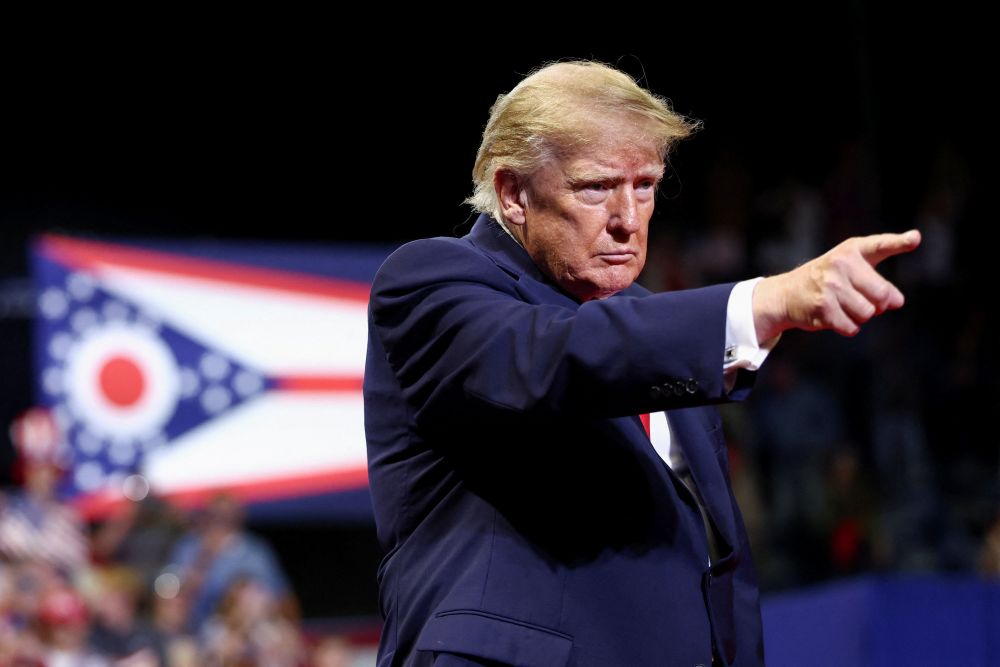
U.S. President Donald Trump gestures during a campaign rally in Youngstown, Ohio, Oct. 12, 2026, for Sen. Jon Husted, R-Ohio, and gubernatorial candidate Vivek Ramaswamy. (OSV News/Reuters/Kevin Lamarque)
Jason Rodarte, 49, of Albuquerque, New Mexico, who teaches American government in high school, said he also wants elected officials who are going to restore checks and balances in the federal government.
"Executive orders are not law. The president does not have the ability to levy tariffs on people, but nobody's checking him on it," Rodarte said. "The Congress and the Supreme Court are allowing him to do what he wants, and it's not what the Constitution says."
Christopher Otero, 52, of Rochester, New York, said restoring the nation's civic character is the most important issue for him as a voter.
"I grew up with the civic character of the United States being prudent, restrained and tolerant of others. Those cardinal attributes are the kind of things I grew up with," Otero said. "But what I've seen, certainly over this presidency that we're currently experiencing, but certainly in the last 20 years, I've seen a really bad erosion of that civic character of the country, being replaced by sophism and the glorification of greed, and that is not sitting well with me. I think many of the problems we're facing right now are kind of the terminal expression of that."
Advertisement
Marcy Meldahl, 75, of Knoxville, Tennessee, told NCR that she despairs over the "degradation of American life," and added that she is voting with the hope of seeing creative thinking into rebuilding the nation's institutions.
"I feel that we have some up-and-coming talent and I'm holding my breath to see if we can really pull this off," she said.
Joe Paprocki, 67, who lives just outside Chicago, told NCR that restoring a sense of truth in government and holding elected officials accountable for corruption are driving his voting decisions.
"It seems that people, starting with President Trump, have gotten away with anything," Paprocki said. "There are no consequences for bad actions anymore, even just speaking poorly of people there are no consequences. You can get up and call people names and it's just another story."
Paprocki, who worked for Loyola Press as a national consultant for faith formation but is now retired from full-time ministry, said things "have only gotten worse" since Trump first ran for the presidency in 2015.
"If we're going to have any kind of possibility of restoring trust in government," Paprocki said, "There has to be a respect for the truth, and consequences for people who are taking advantage of us."