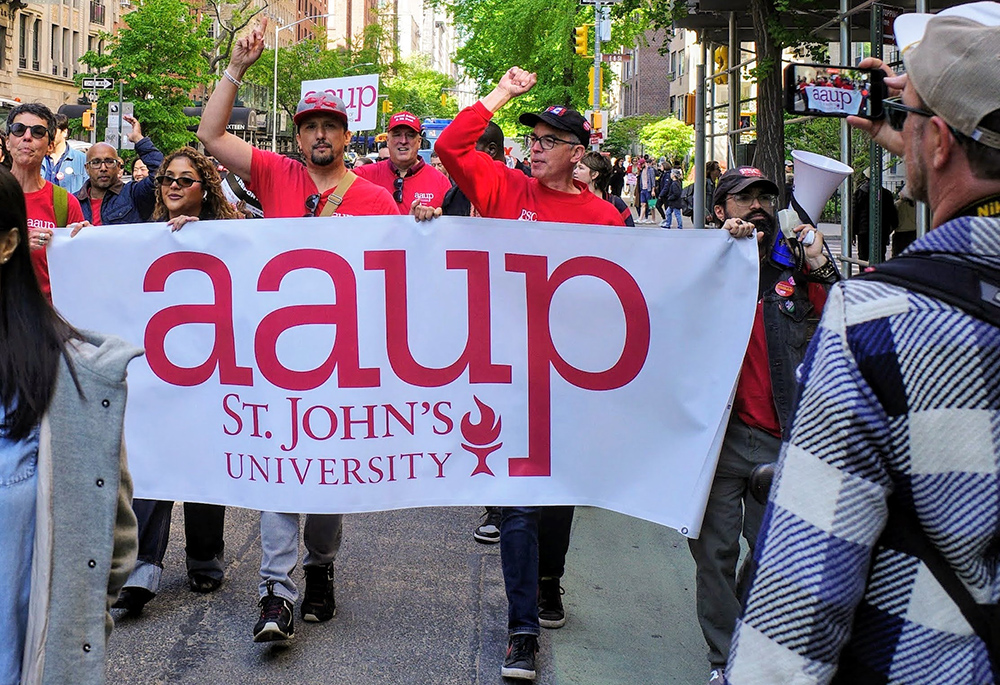
Members of the St. John's University chapter of the American Association of University Professors march May 1, 2026, in New York City. (Courtesy of the St. John's University chapter of the American Association of University Professors)

by Brian Fraga
Staff Reporter
Join the Conversation
Send your thoughts to Letters to the Editor. Learn more
The two faculty unions at St. John's University have filed an unfair labor practice complaint charging the Catholic university in Queens, New York, with violating state labor law when it announced in February that it would no longer recognize the unions.
The complaint also alleges a pattern of illegal surveillance, harassment and intimidation that the administration at St. John's University is said to have undertaken against faculty members for their union organizing on campus.
"It's outrageous behavior and we won't stand for any of it," said Sophie Bell, a core studies professor who is the acting president of the American Association of University Professors chapter at St. John's University.
Christopher Denny, a theology and religious studies professor who serves as president of the university's Faculty Association, told National Catholic Reporter that the unions have been certified as collective bargaining units by the state of New York since 1970.
"In the opinion of our attorneys, the university cannot raise a First Amendment claim that would preempt its contractual recognition of the unions for the past 56 years," Denny said.
The New York State Public Employment Relations Board scheduled a conference on May 5 to review the unions' complaint, which was filed on April 13.
The complaint accuses the university of violating several sections of the New York State Employment Relations Act by withdrawing recognition of the unions, circumventing the collective bargaining agreement, unilaterally implementing new terms of employment, including salary changes, and interfering with faculty members' protected union activities.
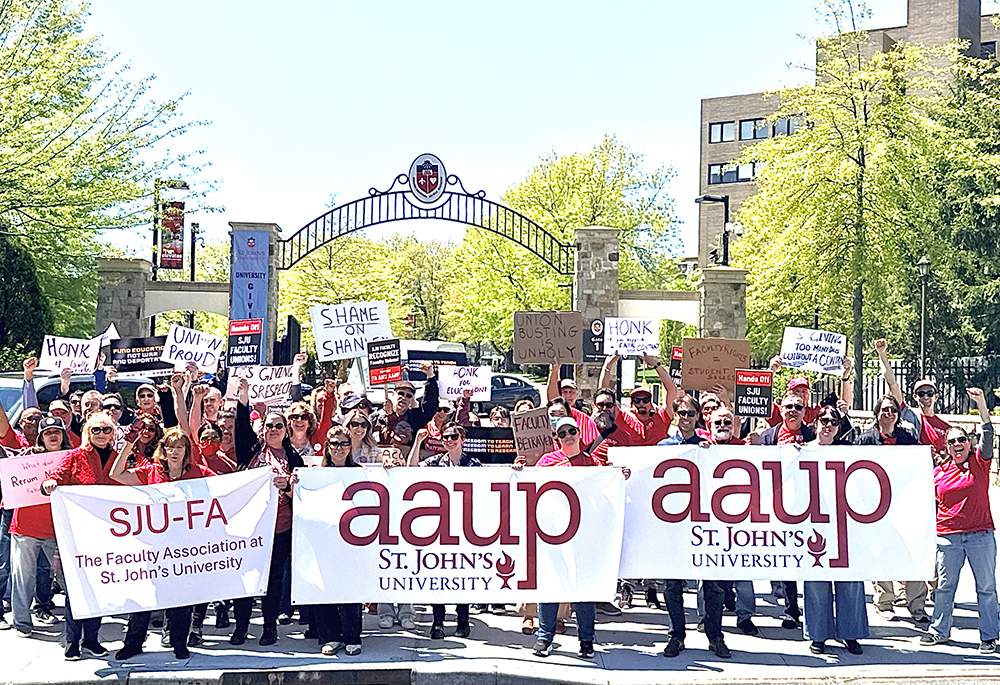
St. John's University faculty union members rally May 1 at the university gate to protest the administration's move to withdraw recognition of the faculty unions. (Courtesy of the St. John's University chapter of the American Association of University Professors)
Bell told NCR that the administration, led by Dominican Fr. Brian Shanley, is not only violating state labor law but also disrespecting the Catholic social teaching principle that workers have a right to organize.
"It's a really disastrous move, anti-union, anti-faculty, and anti-Catholic," Bell said. "This was an outrageous thing to do, and we're fighting it really hard."
Contacted by NCR, a spokesperson for St. John's University declined to comment, citing the pending litigation.
On Feb. 19, St. John's University notified employees that it would no longer recognize the unions. In an email to faculty members, university leaders said the decision to withdraw recognition of the unions had not been made "lightly or rashly," but that it was done to secure the university's long-term future.
"It was pretty shocking, and a little odd," Bell said. "The administration didn't give a particular reason besides that they needed more flexibility. There really was no legal argument made."
The unions and the university had been negotiating for about a year on a new contract to replace the collective bargaining agreement, which expired on June 30, 2025. The parties' last round of contract negotiations was in December.
In their Feb. 19 email, university leaders said there would be no further contract negotiations despite the unions' calls for the university to return to the bargaining table. Bell said she thought both sides were making "good progress" until the administration's announcement.
"Instead of going through the legal process to say, 'OK we're done with this bargaining round so here's your contract,' which they could have done, they just decided to union-bust instead," Bell said.
Union leaders had expressed concerns about the university's intentions in November, shortly after St. John's attorneys filed a response to an unfair labor practice complaint that the unions had brought against the university during contract negotiations.
Asserting its identity as a religious institution of higher education, attorneys for St. John's University argued that New York's Public Employment Relations Board lacked jurisdiction over the university on First Amendment grounds. The university's response further argued that the state board was "preempted" from asserting jurisdiction under the federal National Labor Relations Act.
Since the university's Feb. 19 announcement, union leaders have organized rallies on campus and at Madison Square Garden in Manhattan, gathering the support of elected officials and other labor unions in New York City. Bell said more than 3,000 people have signed a petition calling on the administration to reconsider its decision to stop recognizing the faculty unions.
According to the unions' unfair labor practice complaint, five faculty members were contacted by the university's chief of public safety in March and told that their activities, which included gathering petition signatures and distributing fliers, ran afoul of university policies regarding demonstrations.
"It's really an expansive definition of what constitutes a demonstration," Denny said.
Advertisement
When a group of faculty members delivered their petition to the university's board of governors on March 24, they received an email from the chief of public safety notifying them that they had violated multiple university policies that pertained to demonstrations and building access. The faculty members were also told that the public safety department had recorded them.
In addition, two faculty members were told that they were required to attend a meeting with the public safety department, and that if they did not, their campus access would be restricted, according to the unions' complaint.
Bell accused the administration at St. John's University of using surveillance and intimidation tactics to stifle union organizing on campus.
"It's an attempted chilling effect," she said. "Which is backfiring but also unconscionable and illegal."
"With the behavior that we've experienced from public safety, we're basically charging them with unlawful surveillance of union members engaged in protected union activity," said Denny, who added that the unions' fight appears to be the beginning of what could be a long struggle.
"If the university tries to get this matter into federal court, you could very well have a federal-state showdown as far as jurisdiction is concerned," he said. "Stay tuned."