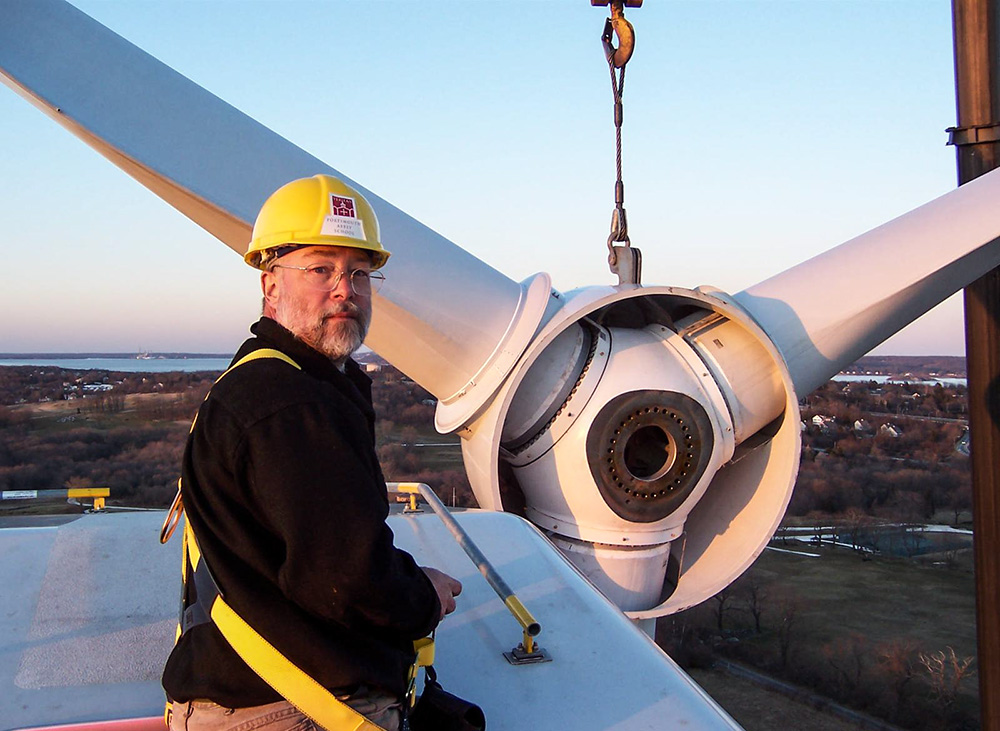
Benedictine Br. Joseph Byron, monk at Portsmouth Abbey and boarding school in Portsmouth, Rhode Island, stands on top of the abbey's wind turbine in March 2006. (Courtesy of Joseph Byron)

Join the Conversation
Send your thoughts to Letters to the Editor. Learn more
On a still, hot Sunday in August 2015, Benedictine Br. Joseph Byron climbed a wind turbine and fell asleep. He had gone there for his usual quiet time. Instead, he woke to a buzz.
A drone hovered above him.
Byron waved. The drone rocked back and forth, as if waving back. It flew off, then returned. The pilot, a visitor on the golf course next door, had sent the craft up for a close look at Rhode Island's first utility-scale wind turbine, one of the region's early projects, and found a Benedictine monk sunbathing on top.
"I heard this funny buzzing sound," Byron recalled. "Well, there was a drone over me."
The video went online and raced around the world. Millions watched it, and television shows and newspapers picked it up. Old college friends, who had lost track of Byron after he entered the monastery, called to say they had found him. Even the Vatican rang.
"People who had completely lost track of me here in the monastery, my colleagues from college said, 'Wait a minute, that's where he went!' " Byron said.
Years later, on a bright summer day, Byron sits in the Portsmouth Abbey cloister and tells the National Catholic Reporter the tale with a dry laugh. He has just come down from another climb. After years of tending the tower, he now makes the ascent without a harness. Beyond the stone walks and green court, the turbine towers above the monastery and its adjacent boarding school. The turbine is without its three blades, stripped for a deep overhaul after 20 years' work.
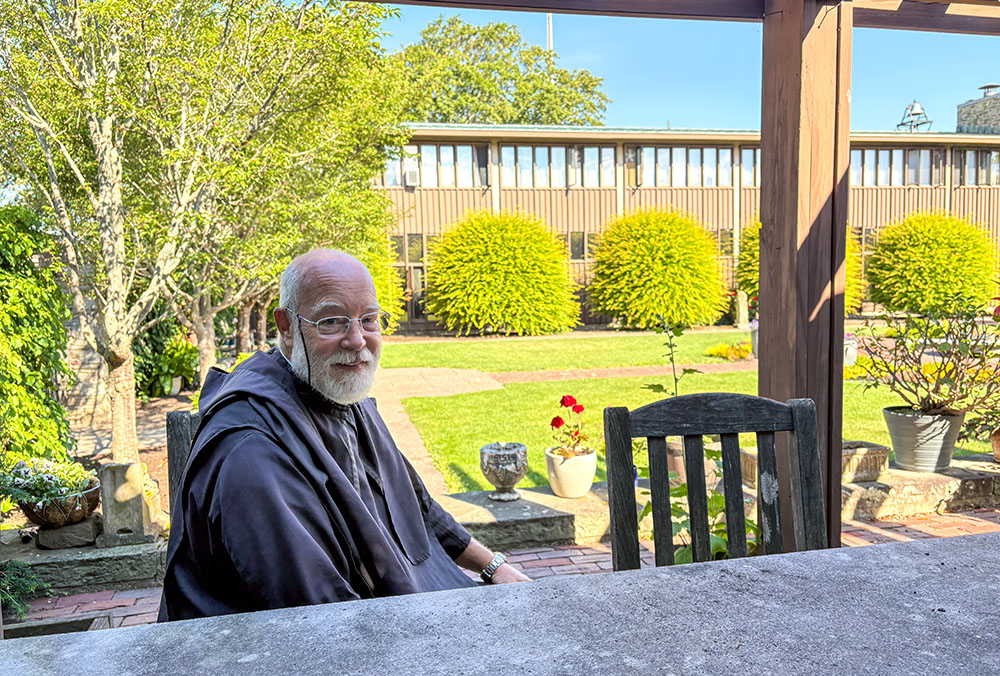
Benedictine Br. Joseph Byron, monk at Portsmouth Abbey and boarding school in Portsmouth, Rhode Island, sits in the monastery's cloister June 17, 2026. (NCR photo/Camillo Barone)
The odd fame of the drone clip hides a longer story: how a monk and his monastic and school communities brought a new kind of machine to Rhode Island and the wider region.
According to Politico, U.S. wind and solar generation rose 10% in the first half of 2026, surpassing both coal and nuclear power despite the Trump administration's efforts to curb renewable development. Federal data show wind and solar produced nearly 420 terawatt-hours of electricity, driven largely by rapid solar expansion, while coal output fell 10% and natural gas remained flat.
Low cost and speed of construction have helped the sector withstand policy setbacks, though the expiration of federal tax credits and rising electricity demand could slow growth after 2027.
Byron came to Portsmouth Abbey in 1981 to work at its boarding school. He became a Catholic in 1984, joined the monastery and took vows later in the decade. His care for the land grew, he said, from a childhood on an old farm in western Massachusetts and from life on the abbey's broad, windswept grounds by Narragansett Bay.
"My love was always this property, and trying to take care of it, maintain it and keep it well," Byron said.
Advertisement
The turbine plan grew out of smaller steps. The school had installed compact fluorescent bulbs, water-saving equipment and better windows. In 2005, a friend from a nearby university gave a talk on wind power and polled the school. The choice he posed was blunt: Would people rather see a nuclear power plant or a wind turbine on the grounds? Wind won.
At the time, the fight over the proposed Cape Wind project off Massachusetts filled the news. Byron and the school's operations director chose to test whether a single turbine could work on their own land. Byron's first task was to call the state energy office.
"They were delighted," he recalled, though it soon became plain that he knew little about the trade.
State experts taught the abbey how power produced behind its own meter could reduce the amount it bought from the grid. The goal was not to build the biggest tower possible, but to match the machine to the school's needs and the local wind. The abbey settled on a 660-kilowatt Vestas turbine.
Then came the harder work: winning trust.
Byron first made the case to his fellow monks. He then went door to door, spoke with neighbors and held public meetings. Experts answered questions about sound, ice, television signals and shadows. Photo mock-ups showed how the tower would look from nearby homes. At 241 feet from the ground to the tip of an upright blade, it would rise far above all else.
The project, Byron said, was a test of whether the school was willing to act on the environmental values it taught its students. "This is kind of a put-your-money-where-your-mouth-is kind of deal," he said.
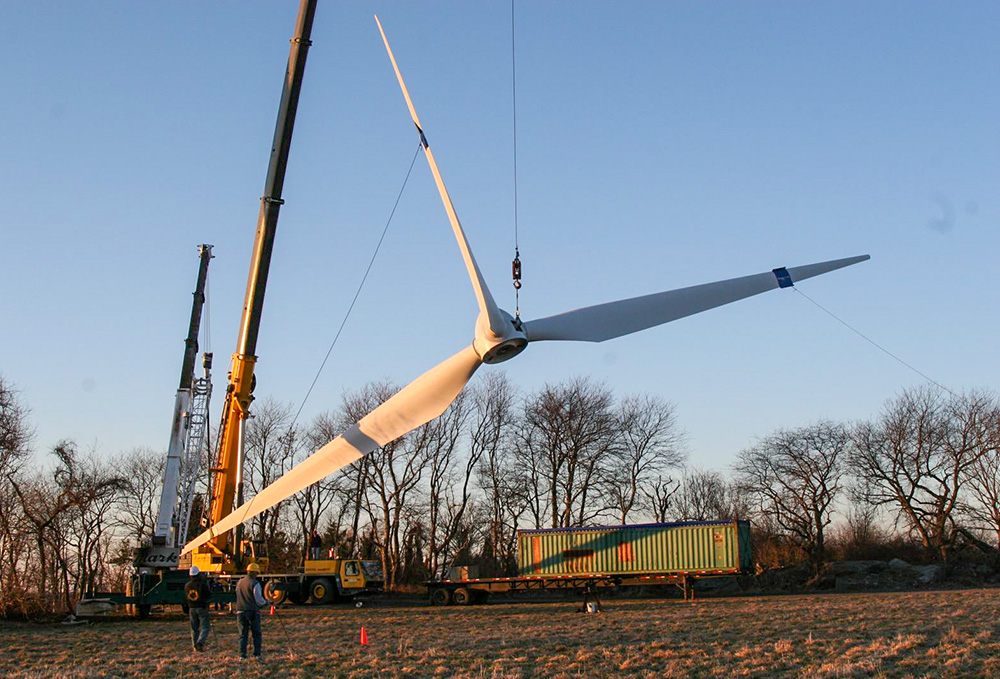
The blades of Portsmouth Abbey's wind turbine during the erection of the wind turbine in March 2006 (Courtesy of Joseph Byron)
The town had no rule written for such a structure. Officials granted a variance. The Rhode Island Renewable Energy Fund gave the project $450,000, and the monastery covered the rest. The full cost came to a little more than $1 million.
The parts crossed land and sea. The tower came by truck from Fargo, North Dakota. The blades were made in Denmark. The nacelle and generator came from Italy. The overseas parts met in Amsterdam, sailed to Brooklyn and then moved by road to Portsmouth. Once the loads reached the abbey in March 2006, crews raised the turbine in two days.
Byron soon walked the neighborhood again. Some residents said the machine was larger or louder than they had thought, while others saw a strobe-like flicker when the low sun passed behind the turning blades.
Byron had deliberately chosen a monastery room as close to the turbine as possible. "If it was a nuisance, then I was going to live with it," he said. At first, the sound woke him. After about two weeks, however, its silence became more noticeable than its turning.
"If it stopped, I would wake up and say, 'Why isn't it running?' " he said.
Even a neighbor who had strongly opposed the plan eventually told Byron it was not a bother. "I thought, 'Thanks be to God,' " Byron recalled.
The turbine also became a signpost for the school. Visitors parked to watch it. Families picnicked on the lawn. At meetings, other educators knew the Portsmouth headmaster as "the man from the school with the wind turbine."
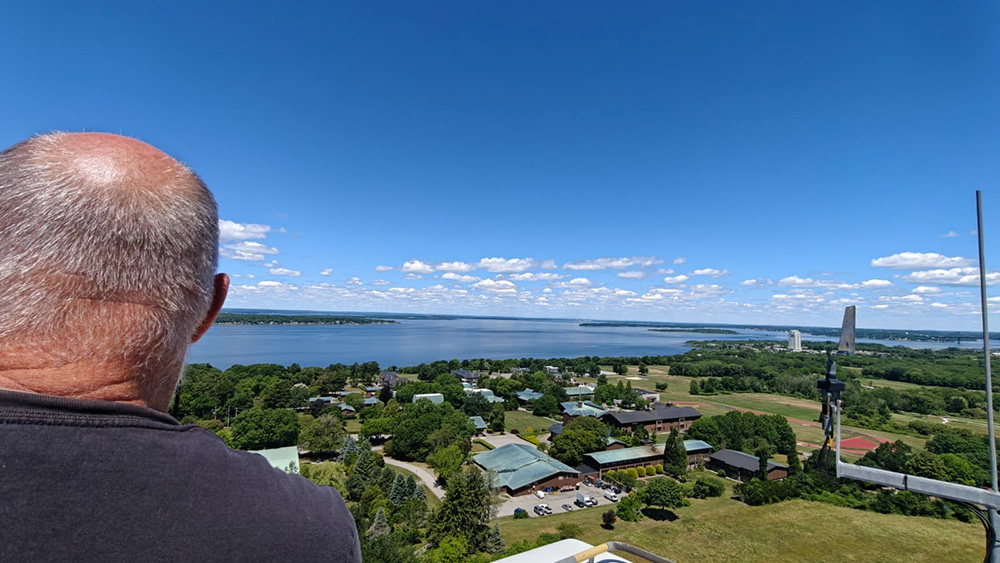
Benedictine Br. Joseph Byron admires the view from the top of Portsmouth Abbey's wind turbine in Aquidneck Island, Rhode Island, June 17, 2026. (Courtesy of Antony Parambi)
"It's been a huge boon to the school," Byron said.
The machine made about 1.1 million kilowatt-hours in an average year and met about 40% of the abbey and school's power use. It paid for itself in about three and a half years. Rather than take the savings back, the monastery put roughly $600,000 into a school fund for more environmental work, from new windows and lights to electric maintenance vehicles.
"We never took our money back," Byron said. "We just pumped it back into green projects for the school."
The turbine also became part of school life. Students climbed inside the tower with safety gear. Byron said he estimates that more than 800 people have reached the top.
"We've got to be the only school on the planet that would let kids climb this thing," he said, adding that "it's on everybody's bucket list" here.
Now age has caught up with the machine, and a service check found worn bearings where the blades meet the hub. The abbey chose a full rebuild, with work on the gearbox, generator bearings and other moving parts. The 77-foot blades, laid out below like white hulls, are being repaired and coated for another long run.
Byron said he hopes the blades will turn again by summer's end, serving the wind turbine for another 20 years. "They're beautiful things," Byron said. "They're like pieces of sculpture."
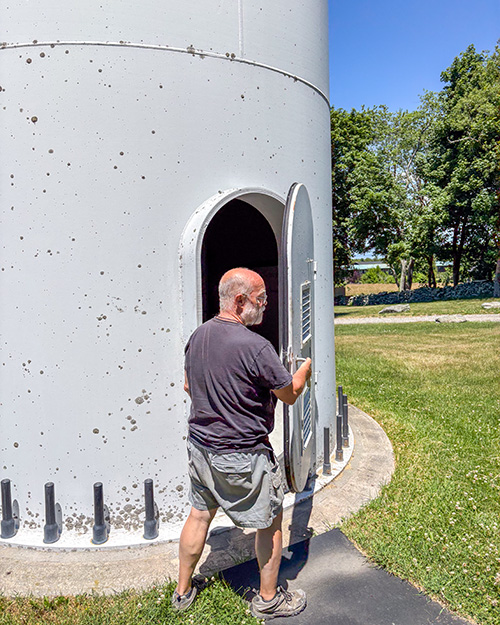
Benedictine Br. Joseph Byron walks inside the Portsmouth Abbey wind turbine June 17, 2026. (NCR photo/Camillo Barone)
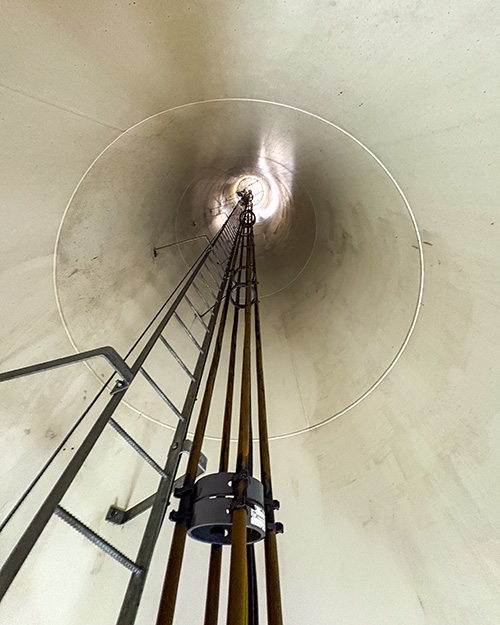
Inside the Portsmouth Abbey wind turbine, June 17, 2026 (NCR photo/Camillo Barone)
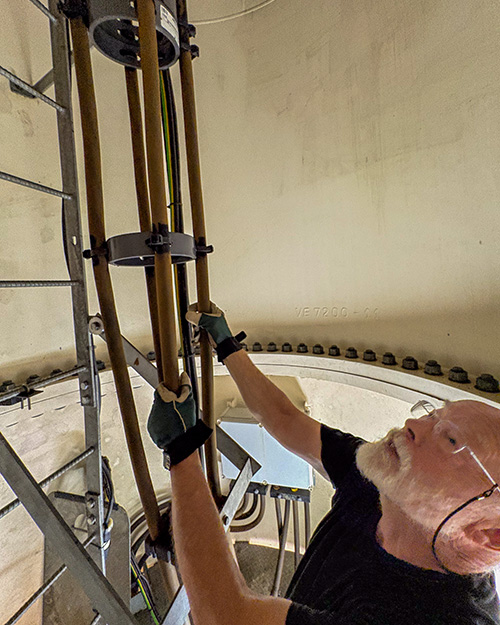
Benedictine Br. Joseph Byron climbs inside Portsmouth Abbey's wind turbine June 17, 2026. (NCR photo/Camillo Barone)
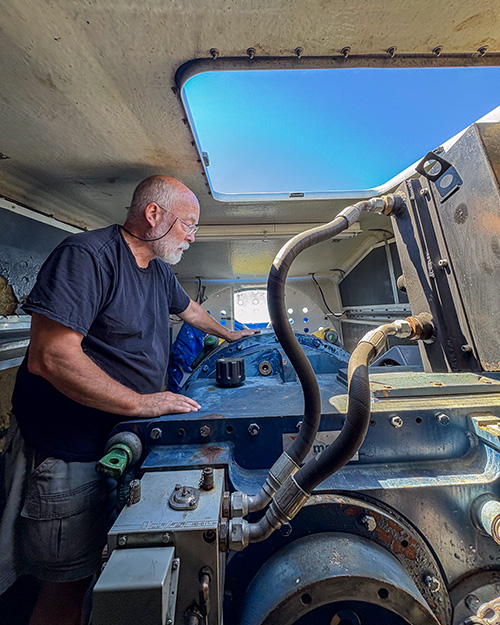
Benedictine Br. Joseph Byron inside the engine of Portsmouth Abbey's wind turbine June 17, 2026 (NCR photo/Camillo Barone)
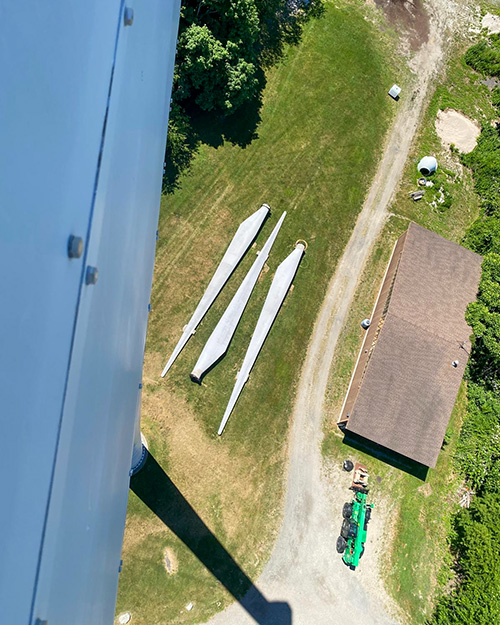
The blades for Portsmouth Abbey's wind turbine lie on the ground in 2026, waiting for repair after 20 years of function. (Courtesy of Joseph Byron)