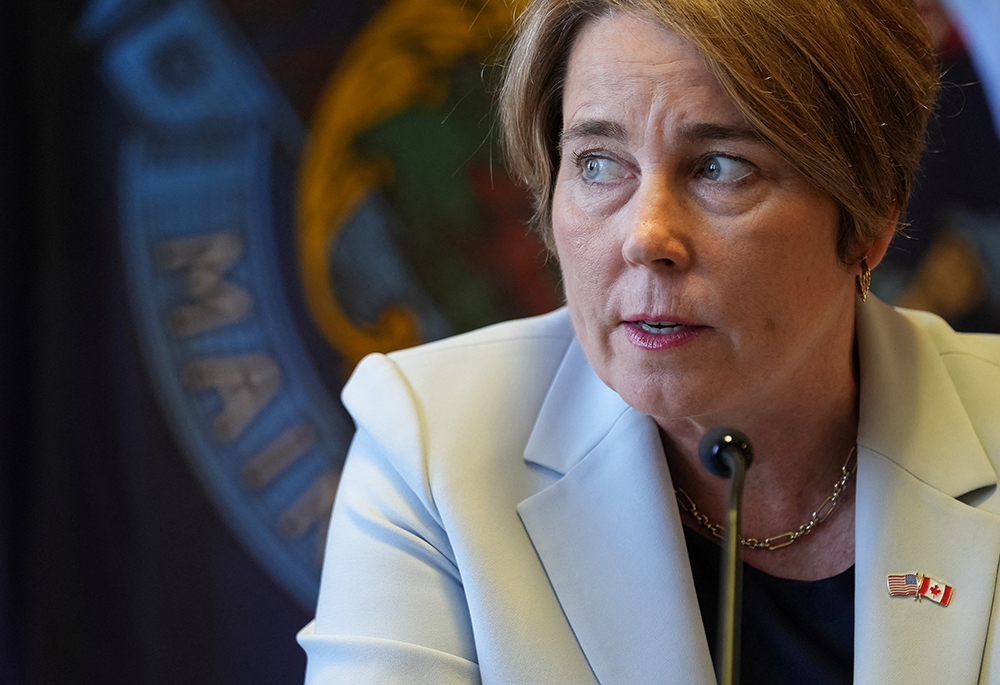
Massachusetts Gov. Maura Healey speaks during a Boston meeting of northeastern U.S. governors and Canadian premiers June 16, 2025. Healey signed the Prioritizing Patient Access to Care Act (House Bill 5595) into law on Aug. 10, 2026. (OSV News/Reuters/Sophie Park)

by Brian Fraga
Staff Reporter
Join the Conversation
Send your thoughts to Letters to the Editor. Learn more
Massachusetts' four Catholic bishops criticized Gov. Maura Healey's decision on Nov. 6 to use her executive authority to put into effect immediately a new state law that permits late-term abortions.
In using emergency powers to put the law into effect, Healey, a Democrat who is Catholic, blocked an attempt by antiabortion activists to suspend the measure until voters decide whether to repeal the law in a statewide referendum in 2028.
"The repeal campaign can continue its work, and Massachusetts voters will have their say. If they choose to repeal the law, we will respect their decision. But families should not have to go without the care they need while that process plays out," Healey said in a statement.
Healey also said she knew "some people" would disagree with her decision.
"I am Catholic, and my faith is an important part of who I am," Healey said. "It has shaped my understanding of service, responsibility and our obligation to care for others. My faith teaches me to meet people with compassion, respect their dignity, and approach suffering with humility.
"I am also Governor for people of every faith and belief," she added. "My responsibility is to ensure that every family can make deeply personal medical decisions according to their own circumstances, values and the guidance of their doctors."
Advertisement
Responding to Healey's statement, the state's Catholic bishops said in prepared remarks that they "respectfully and passionately disagree that abortion, the taking of human life, may be considered health care."
"We also disagree that there is an emergency requiring the further expansion of the existing and already radically permissive law," the bishops said.
The statement was signed by Boston Archbishop Richard Henning and Bishops Joseph McManus of Worcester, Edgar da Cunha of Fall River and William Byrne of Springfield.
State law previously allowed abortions at or after 24 weeks in Massachusetts only under specific circumstances, including to preserve a patient's life. The new law that Healey signed in August leaves the decision to end a pregnancy entirely to "the professional judgment of the physician."
The law was a flashpoint in the governor's race between Healey and her Republican challenger, Michael Minogue, a Catholic who described himself as pro-life though he said he would follow the law while not taking a stand on the repeal effort.
"I believe in the separation of church and state," Minogue said in one of the gubernatorial debates.
Massachusetts' pro-life community responded by organizing a campaign to gather signatures to place the law before the voters in 2028. The conservative organizations leading the repeal effort said in October that they gathered nearly 100,000 signatures, far surpassing the thresholds needed to place the item on the ballot and to suspend the law in the interim.
Myrna Maloney Flynn, president of Massachusetts Citizens for Life, one of the organizations that gathered signatures for the repeal effort, said in a statement that Healey's emergency action "reflects an utter disregard for the men and women she was elected to represent."
"Healey clearly demonstrates today how beholden she really is to the Massachusetts abortion lobby," Flynn said.
The Massachusetts bishops thanked the "coalition partners" and those who volunteered in the repeal effort. They also called upon state legislators and others "to reconsider the troubling state of our culture and its utilitarian and merciless approach to the elderly, the sick, the vulnerable, and the unborn."