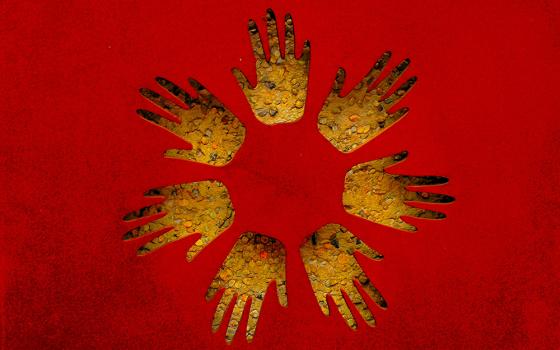
A mushroom cloud rises from a test blast at the Nevada Test Site on June 24, 1957. (U.S. Energy Department via AP, File)

Join the Conversation
Send your thoughts to Letters to the Editor. Learn more
The New York Times recently marked its 175th anniversary by publishing a list: "Ten days that changed the world." Lists like these are always useful in assessing how cultural elites confer significance and which blinders they bring to their work.
If you doubt the reach of the technocratic paradigm — against which several popes have warned us — consider that fully six of the days that changed the world began with a technological development. The first electric grid in 1882, the Haber-Bosch process which led to chemical fertilization in 1913, dropping the atomic bomb on Hiroshima in 1945, the 1960 approval of the birth control pill by the Federal Drug Administration, and the first internet message in 1969, all had social and political consequences, but were essentially technological developments.
These five "advances" all had morally ambivalent consequences, except perhaps the electric grid. We have come to learn that there are problems with chemical fertilizers but, as the Times argues, there is no denying that they played a large role in limiting worldwide famines. The atomic bomb killed fewer people than the fire bombings of Tokyo and Dresden, but is still a grisly act to have perpetrated. The birth control pill allowed women to plan pregnancies but also diminished the idea that life is a gift. The internet simultaneously connected us and alienated us one from another.
The sixth technological "advance" was not a technological advance but, instead, the application of a technological method to a profoundly evil objective: The Wannsee conference on Jan. 20, 1942 was when and where the Nazi regime decided to systematically exterminate the Jews of Europe by creating factories of death. Here there is no moral ambivalence.
This prominence of technology on the list is not surprising, or even wrong, but it is depressing. As I perused the list, I could not help but think of the great Swiss theologian Hans Urs von Balthasar trenchant critique of our modern, technocratic culture:
Whenever the relationship between nature and grace is severed … then the whole of worldly being falls under the dominion of "knowledge," and the springs and forces of love immanent in the world are overpowered and finally suffocated by science, technology and cybernetics. The result is a world without women, without children, without reverence for love in poverty and humiliation — a world in which power and the profit margin are the sole criteria, where the disinterested, the useless, the purposeless is despised, persecuted and in the end exterminated — a world in which art itself is forced to wear the make and features of technique.
Three items on the list were political revolutions: the ratification of the 15th Amendment in 1870, the Bolshevik putsch in 1917, and the 1978 economic reforms announced by Chinese leader Deng Xiaoping. It is difficult to argue with the Soviet Revolution being on the list: How many millions of people were killed, how many intellectually and spiritually maimed, by the avatars of communist revolution! I do not think Deng's economic reforms would have made my list.
Advertisement
The Times reveals that there was an interesting intellectual discussion about which of the post-Civil War amendments should be selected. Political writer John Ganz argued that the 14th Amendment, not the 15th, should make the list: "But the concept of citizenship that came out of the 14th Amendment is the one that's being struggled over today." There is a good case to be made for any of the Reconstruction amendments but one comment, from journalist Christopher Caldwell, caught my eye. "People all around the world today, when they try to manage minority rights, do it with these ideas. There's something about the American way of doing this. It has created a template for rights," he said.
Caldwell is right, but that template is not always precise. One of my closest Black gay friends once said to me: "It is the curse of being Black that I cannot hide my identity and it is the curse of being gay that I can." Different people, to say nothing of different individuals, achieve liberation by different means because they face different challenges.
Finally, there is the one item on the list that had an immediate effect on religion, the publication of Charles Darwin's On the Origin of Species in 1859. As historian Rick Perlstein states in the article, "Above all, Darwin's theory is an extratheological conception of what people are and what their place is in the universe. Nothing gets bigger than that when it comes to our own existential sense of ourselves." Extratheological and, consequently, impoverished.
Should there be an explicitly religious event on the list? Oct. 11, 1962 is the most obvious candidate. That is the day St. Pope John XXIII opened the Second Vatican Council, an event which is still being received by over a billion Catholics spread throughout the world.
I would be more inclined to nominate March 31, 1889, the day Mother Frances Xavier Cabrini arrived in the United States. Not only did she and her sisters become a model for countless other religiously motivated persons caring for the destitute, her work with migrants shone a light on an issue that continues to dominate our social, cultural and political landscape. She remains a saintly counterpoint to the countless nativists and bigots throughout the world who demonize migrants and cause them great suffering.
These top 10 lists are fun to engage, but they are also telling. The Times list tells us that the technocratic paradigm has been shaping us for a long, long time, and that its achievements are never without a dark side. Ours is now a secular culture, our horizon is terrestrial, our capacity for solipsism unbounded.
While reading the Times' list, perhaps mindful of the Thanksgiving holiday or the approach of Advent, my mind drifted to the lyrics of the second verse of the hymn "I Vow to Thee, My Country" written by Cecil Spring Rice:
And there's another country I've heard of long ago,
most dear to them that love her, most great to them that know;
we may not count her armies, we may not see her King;
her fortress is a faithful heart, her pride is suffering;
and soul by soul and silently her shining bounds increase,
and her ways are ways of gentleness and all her paths are peace.
Let's hope that 100 years from now, if the Times makes another list, it will have fewer technocratic and more humane achievements on its list.