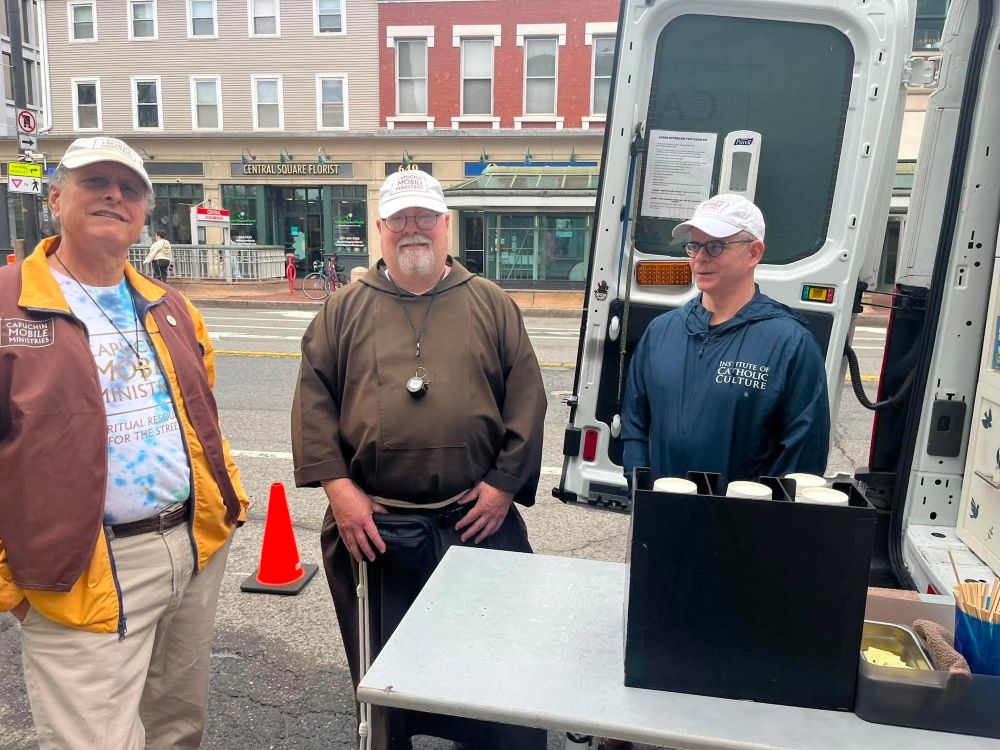
Lay chaplain Gary Riccio (left), Capuchin Franciscan Br. Paul Fesefeldt and a volunteer stand by the Capuchin Mobile Ministries van in Cambridge, Massachusetts, in mid-June. "It's like a mobile coffee hour," said Fesefeldt, founder and director of the ministry. (Greta Gaffin)
Capuchin Mobile Ministries not only offers spiritual care and food to unhoused people in the Boston area, but it also aims to provide something that can be particularly hard to find for those experiencing homelessness: relationships.
Three times a week, a van with a mix of a Capuchin Franciscan friar or two, lay chaplains and volunteers, travels to seven sites. For about 20 minutes at each site, volunteers give out coffee and sandwiches while the friars and lay chaplains talk to the people who come up to the van. "It's like a mobile coffee hour," said Br. Paul Fesefeldt, founder and director of the ministry.
The idea dates to 2019, when the Capuchin provincial asked Fesefeldt to start a food truck ministry. Fesefeldt, who previously served in other homeless ministries in Boston, spent six months talking to people. "The need was not a food truck," he said. "There's a lot of food in a big city. There are very few programs providing spiritual care to people on the street." On a food truck, the person giving out the food stands high above the people receiving it. With Capuchin Mobile Ministries, everyone stands at the same level.
The items on the van are intentionally simple: sandwiches, coffee, lemonade or hot chocolate, water, granola bars and socks. Fesefeldt tries hard to stay away from being a "van with stuff."
"The important thing is to move beyond the charity model to the justice model," he said. Restoring agency to people on the streets is important to him: The ministry does not go up to anyone and give them a sandwich. "A point of the van is spiritual care. It's to give people dignity and to move away from 'I have something and you will helplessly accept it,' " Fesefeldt said. People choose to come, or not. They also choose whether or not they want to have a conversation.
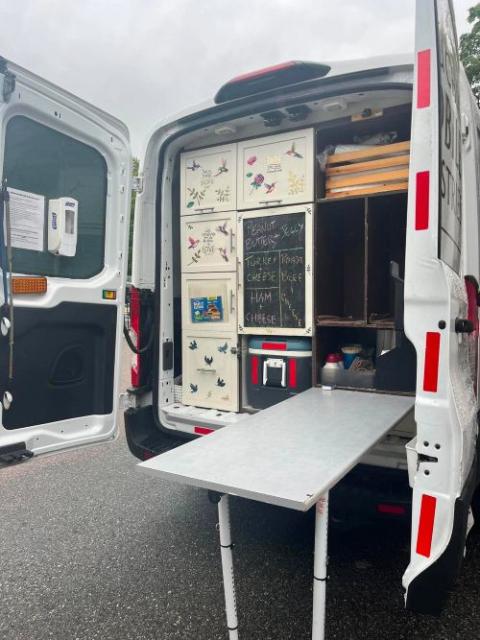
The Capuchin Mobile Ministries van visits seven sites three times a week in the Boston area. People can get a snack, a pair of socks or conversation. (Greta Gaffin)
People experiencing homelessness are poor in their lack of a place to live and in a lack of clothing, food and medical and dental care. But they also often suffer from relational poverty, because homelessness is an isolating experience. Capuchin Mobile Ministries gives homeless people a chance for an ordinary conversation about something like regional American pizza (on which Fesefeldt, as a New Yorker, holds a strong stance).
It also gives them a chance — if they want it — for a connection with the church. Fesefeldt hands out rosaries to those who ask, and he or one of the lay chaplains will pray for someone who wants prayer. But this is, like everything else, voluntary. The van features an image of St. Francis and Bible quotes, and Fesefeldt wears his brown habit. But they do not try to force religion on those who are disinterested. "We want to give people back their dignity, whether or not they believe the same thing we believe," he said.
It can be challenging. There is an immense amount of suffering and not much they can do about it. And they're going out, not having people come in. "You're in their living room," said Fesefeldt, in a way that isn't true in a shelter or soup kitchen setting. But that also means being able to reach people who don't want to go into one of the building-based services or ministries.
The people who came up to the van were young and old, white and Black. Some asked for food in the uneasy speech of a new English speaker; others spoke in a thick Boston accent. The presence of roast beef sandwiches, a novelty, was exciting. Some hoped for Fluffernutters, the New England specialty that combines peanut butter with marshmallow fluff, but not on this day in mid-June. And while the offerings are limited, there is also choice: white socks or black, strawberry or blueberry granola bars.
Advertisement
The fact that the van is there consistently at the same time is also important. "We're bringing constancy into their world. There's not a lot like that in the lives of these people," said Gary Riccio, one of the lay chaplains. People were happy to see the van and those on it. "You're the realest," said a man in Roxbury.
Fesefeldt and the lay chaplains greeted those they recognized by name. About half the people on a given trip will be familiar. Sometimes people might disappear for a few months and then reappear later. They might have been in jail, or rehab, or somewhere else. Some of the people are the formerly homeless who still go out onto the streets to talk to their friends.
Fesefeldt participates in a weekly meeting about homelessness with the mayor's office and with other nonprofits. He says the ministry has become seen as the "chaplains to the homeless." But sometimes there can be tension between a spiritual ministry and those with other focuses. "We don't have metrics," he said. "Public health — it's all about metrics." Even if they might count how many people they talk to, it's impossible to measure spiritual accompaniment.
The urge to give more to those who have very little is obvious, but they try not to. "It's a bit of a spiritual discipline," Fesefeldt said.