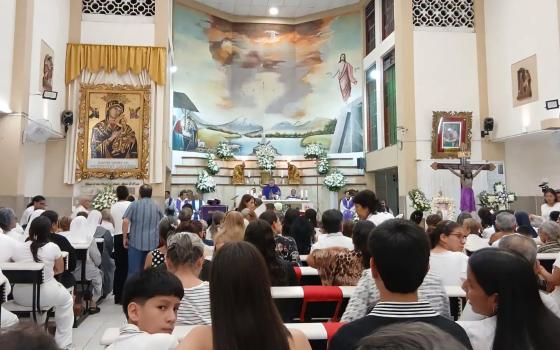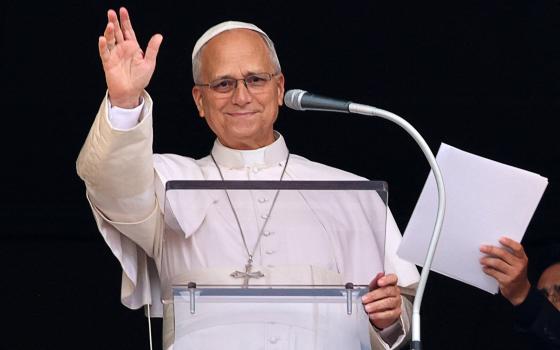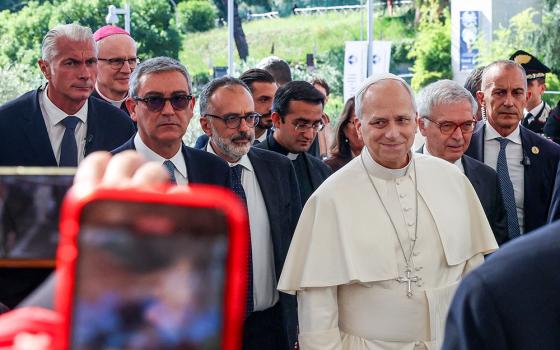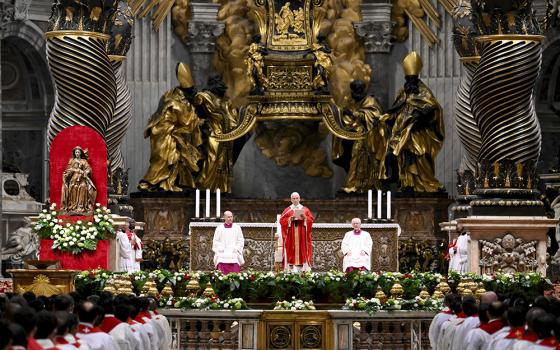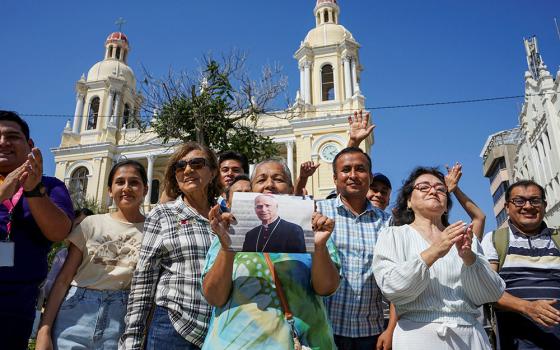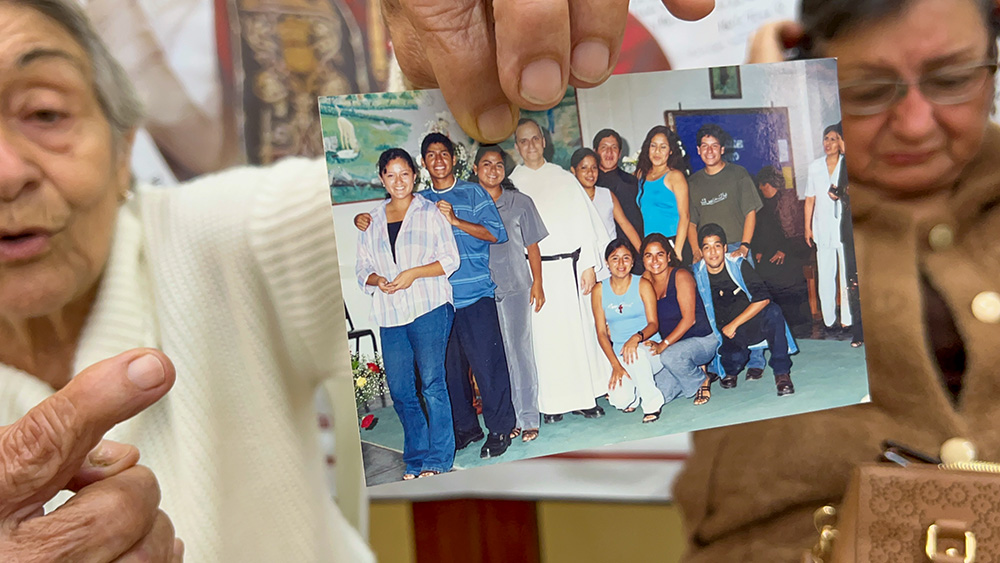
Socorro Cassaro holds up a picture of Augustinian Fr. Robert Prevost with a group of young people at Our Lady of Montserrat Parish in Trujillo, Peru. Prevost, the future Pope Leo XIV, served as parochial administrator of the parish from 1992 to 1999. (NCR photo/Justin McLellan)

Join the Conversation
Send your thoughts to Letters to the Editor. Learn more
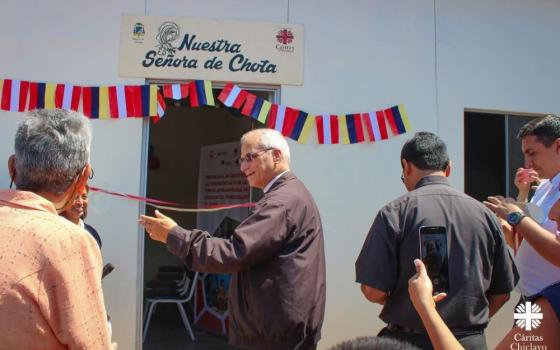
Long before he was the successor of St. Peter, Pope Leo XIV had a different name to the faithful of St. Joseph the Worker Parish in Chulucanas.
"We called him Father Robertito, because we were very close to him," Elena Lozada Seminario told the National Catholic Reporter inside the church where a then-30-year-old Fr. Robert Prevost once served in northern Peru in 1985. "He was always visiting the communities, going to the countryside. People loved him because he was so simple, so humble."
As a young missionary and priest of only three years, Prevost was sent to Chulucanas where he spent just one year before moving on to minister for over a decade in the coastal city of Trujillo, but his time there left an indelible mark on the future pope's vision of the church.
The pastoral model he encountered — rooted in synodal governance, lay leadership and social mission — shaped his later ministry in Trujillo and, decades later, guided his approach as bishop of Chiclayo, a city just four hours south of where he first arrived in the country.
Vision of church steeped in Vatican II
The pastoral framework Prevost immersed himself in Chulucanas was up and running by the time he got there as a young Augustinian in 1985, but its roots can be clearly traced back to the 1962-65 Second Vatican Council and the Latin American bishops' assemblies that followed it.
In 1962, Pope John XXIII called on the church in the United States to send 10% of its clergy on mission to Latin America.
Though that figure was never realized, several religious congregations took that message in stride. The Midwest Province of the Augustinians was one of them; in 1963 the first U.S. Augustinians arrived in Peru and the prelature of Chulucanas was formed the following year.
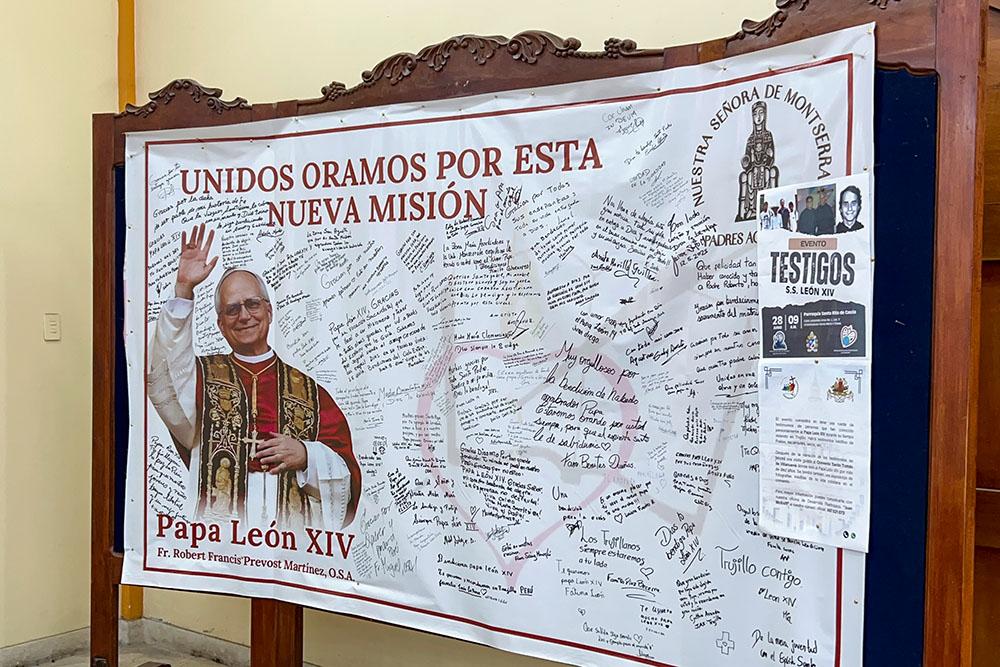
A banner signed by the community of Our Lady of Montserrat Parish in Trujillo, Peru, sends best wishes for Pope Leo XIV, who served as parochial administrator of the parish from 1992 to 1999. (NCR photo/Justin McLellan)
John McNabb, an Augustinian from Beloit, Wisconsin, became prelate of Chulucanas in 1964, the head of the church's jurisdiction, which was not yet a diocese. When McNabb arrived in Peru, the other U.S. Augustinians already working in the country told him that leading Chulucanas was "impossible," he recalled in his memoir. "There's no way we can begin to evangelize that large a territory. We don't think we should take the prelature as it is planned," they told him.
McNabb, however, pressed ahead, and as the head of the church in Chuclucanas he attended as a voting member the Second Vatican Council's third and fourth sessions, which dealt with church's structure, the role of bishops and the laity, missions and priestly formation.
That started McNabb's decadeslong reflection on how to best organize the mission in Peru that would materialize in the model encountered and embraced by Prevost.
In 1968, Latin American bishops met in Medellín, Colombia, to discuss implementing Vatican II, which had concluded three years prior. A key outcome of this meeting was the recommendation to promote the formation of ecclesial base communities — small, locally led Christian communities — as the "first and fundamental nucleus" of the church. The meeting said the formation of leaders for these communities, which could be clerics, religious or laypeople, should be a "priority concern for parish priests and bishops."
Advertisement
Following that assembly, the Augustinians implemented a formation program for lay leaders in the prelature. At the time, it was estimated that some 300,000 people lived in the church's jurisdiction, 15% of whom lived in urban provincial capitals and 85% in rural areas.
In a history of the Augustinian Order in the region, Augustinian Fr. Avencio Villarejo recalled how in the mid-'60s, the rugged terrain, "almost entirely devoid of roads, clearly indicated the difficulties that the Augustinians would encounter in the spiritual administration of so many souls, who can only be reached through arduous and lengthy journeys on the backs of animals and on dizzying trails."
Nine years after the Medellín meeting, McNabb attended another assembly of Latin American bishops in Puebla, Mexico, which was opened by Pope John Paul II. McNabb recounts in his memoir how the pope referred to the ecclesial base communities that were being developed throughout the continent as "a special source of hope for the church in Latin America."
At that point, McNabb was discerning the implementation of a parish renewal project to be adopted by the prelature, titled the "New Image of Parish."
The Movement for a Better World, a Catholic initiative dedicated to church renewal that began in 1952, developed the project following Vatican II. The parish renewal project would become integral to McNabb's legacy in the diocese and an essential part of Prevost's vision of the church.
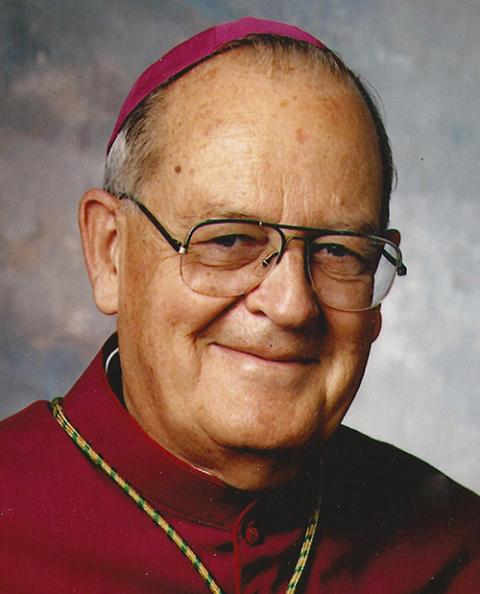
Bishop John McNabb in an undated photo (CNS/Courtesy of the Augustinians of the Midwest)
The project sought to include all baptized persons in the life of the parish. Practically, that meant dividing each parish into zones, in which laypeople were elected to fulfill ministries within their zones, such as secretary, messenger, or coordinator for liturgy, catechesis, social services or young adult activities.
McNabb wrote that the pope's praise of the ecclesial base communities during the meeting in Puebla in 1977 "gave the plan a very positive recommendation and helped to assure us that the direction of our pastoral program was not only approved and necessary, but also that it was probably the most concrete way to accomplish the many suggestions we had heard about in Puebla."
With a 10-year implementation timeline, Prevost would arrive in Chulucanas right as the "New Image of Parish" plan was reaching its full potential. The model, implemented by the Augustinians who preceded him, became integral to the future pope's pastoral DNA, informing his view of church, the laity, the role of the priests and bishops, and how they all interact with one another to live as church.
'Father Robertito' and the spirit of Chulucanas
The faithful at St. Joseph the Worker Parish in Chulucanas recall a young Augustinian Fr. Robert Prevost pushing McNabb around Chulucanas in a wheelchair, helping balance him while walking and assisting him in keeping track of taking his medication.
"Pastorally, [Prevost] was forged here in Chulucanas," Lozada, the parishioner, told NCR. "We had a bishop, Msgr. Juan [McNabb], who was a missionary 100%, he worked a lot. He made our little parish into a huge diocese with the help of the Augustinians, who did a lot of work and were formed here."
A young canon lawyer who had only been a priest for three years, Prevost was sent to Peru after spending four years in Rome and earning his licentiate in canon law. In Chulucanas, he acted as chancellor to assist McNabb, then 60 years old, and to prepare the documentation to convert the prelature into a diocese.
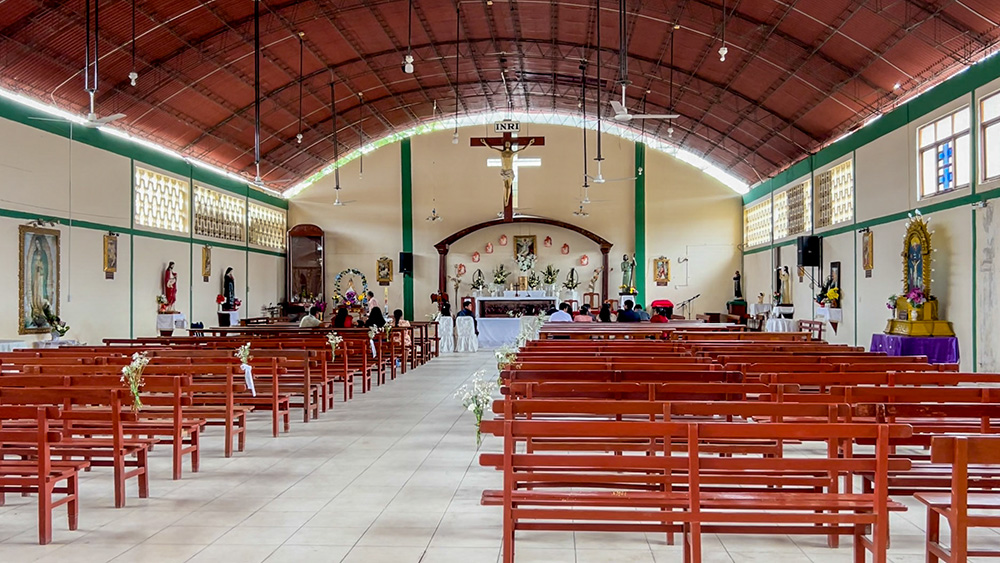
St. Joseph the Worker Parish in Chulucanas, Peru, was one of the churches where a young Augustinian Fr. Robert Prevost served as a missionary upon arriving in Peru in 1985. (NCR photo/Justin McLellan)
Beginning in late 1983, just over a year before Prevost's arrival, the region of Chulucanas was hit by serious floods that worsened the area's already poor economy. McNabb recalled rescue missions led by religious sisters, priests and seminarians riding out on pickup trucks belonging to parishes to pull people out of waist-deep water and housing them in Augustinian convents and rectories.
Pope Leo recalled that extreme poverty in an interview for his biography published in Peru.
"There was a part of me that looked around and said, 'Lord, where have you brought me?' " he said.
Although his objective there was largely administrative, the parishioners who saw him at work remember him as a pastor.
Lozada recalled Prevost spending time forming young people and training them to be altar servers. Those who lived close by would come to the parish for their formation, but Prevost "would go and visit the villages where priests wouldn't reach because it was difficult, but he would go once or twice a week."
Luis Chiroque Farán was just 13 when the future pope taught him how to be an altar server. He said he and the other young people Prevost worked with were happy to have a young priest around.
"To see a priest in jeans, in a polo shirt, with a cap on, that he would walk with and meet with the young people, it was very striking," he said. "He had a spirit of great openness toward young people."
The Chulucanas in which Prevost found himself was "a very small town, very poor, the houses were made of sticks and straws," said Lola Chávez Hernández, another parishioner of St. Joseph the Worker. Yet Prevost "stood alongside the poor, the most simple, the most humble. That's where he was, and he also learned from his predecessors, from those whose authority he was under, like Msgr. Juan [McNabb] and other priests who had been here. So he came here with that conviction to serve the poor."
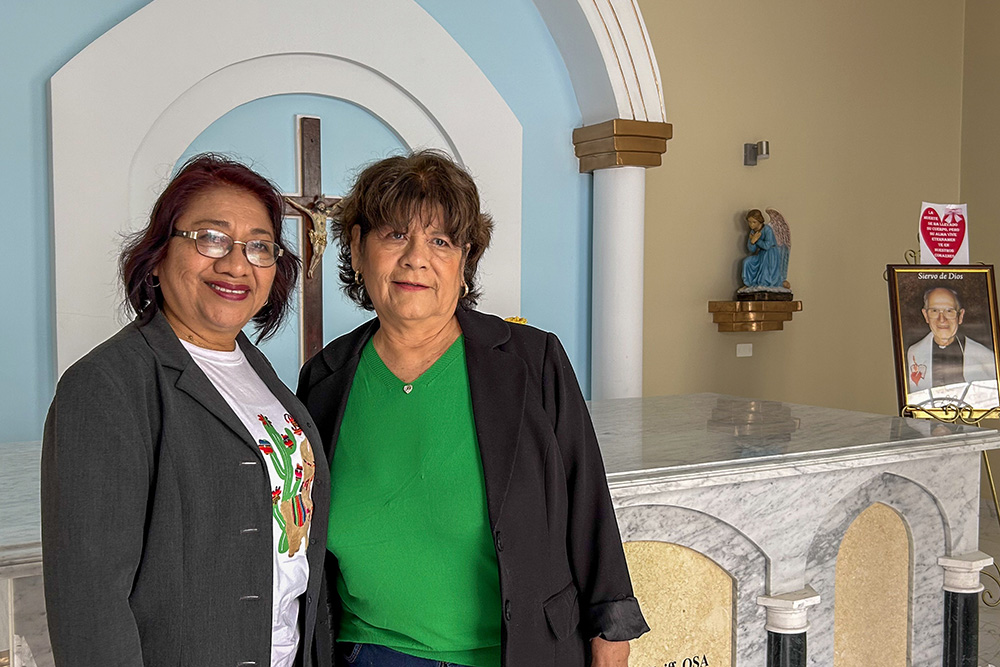
Lola Chávez, left, and Elena Lozada Seminario stand for a photo in front of the tomb of Augustinian Bishop John McKniff of Chulucanas, Peru, at St. Joseph the Worker Parish. (NCR photo/Justin McLellan)
Victor Chiroque, another parishioner, said that Prevost, like the other Augustinians in the prelature, was committed to the pastoral plan implemented by McNabb.
"All of the priests were very involved in the pastoral plan, and he was one of them," Chiroque said. "He was young, so he would go out — not just here in Chulucanas, but to all of the villages to visit, which at that time was not easy."
As pope, Leo said in his biography that McNabb "was in many ways a very prophetic bishop" for instituting a pastoral plan that envisioned a parish as "the experience of the church at the local level and the building of an authentic community where people get to know each other, help each other, and support each other."
"All the things we are hearing today with the talk about synodality, we were already doing in Chulucanas in the 1980s, moving forward, so it was all very natural for me," he said, referring to the term for creating a more listening and participatory church coined by Pope Francis.
The future pope would only spend one year in Chulucanas before returning to the United States, yet his time there would instill in him a participatory image of the church that he worked to implement time and again throughout his ecclesial career.
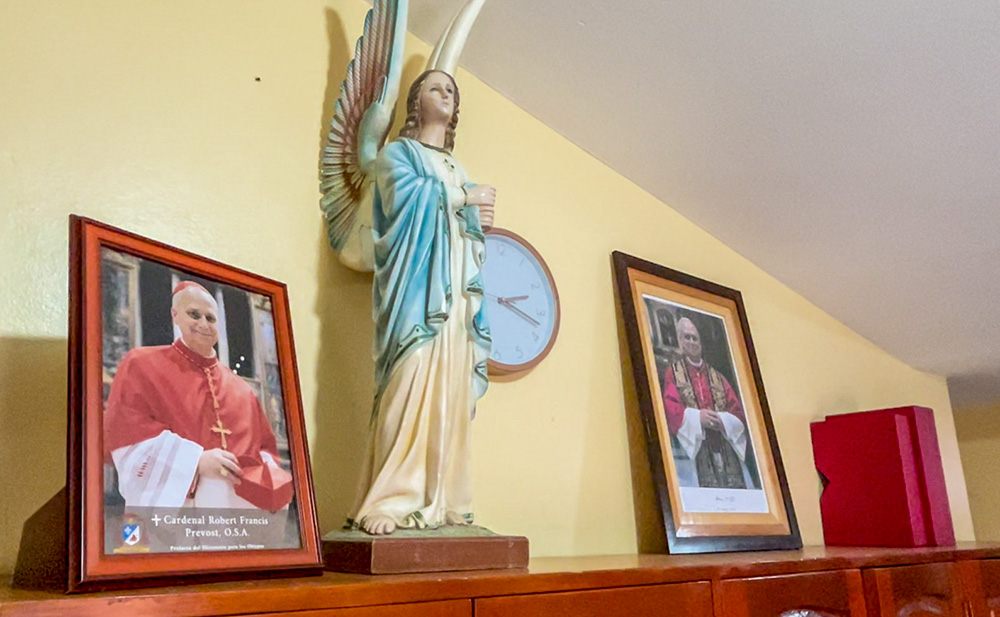
Pictures of Robert Prevost as a cardinal and as Pope Leo XIV adorn the sacristy in Our Lady of Montserrat Parish in Trujillo, Peru. (NCR photo/Justin McLellan)
Turning parishioners into partners
Víctor Saldaña Ortíz had a problem. In the early 1980s, he began living in the Monserrate neighborhood of Trujillo, the Peruvian coastal city some 220 miles south of Chulucanas.
The neighborhood didn't have any parish of its own and the community was divided as people visited different parishes for Mass each Sunday.
In 1989, Saldaña and other neighbors successfully lobbied the Redemptorist religious order to celebrate a Sunday Mass for the neighborhood. Despite the 6:30 am Mass time, the people showed up, and more and more began flocking to it.
Yet in 1992 the Redemptorists could no longer provide the community with a regular Mass. The faithful in Monserrate met with the archbishop of Trujillo, who recommended that they contact another religious order, the Augustinians, who were still relatively new to the area and could have the bandwidth to support the parish.
Saldaña and other neighbors recall going to the Augustinian formation house in Trujillo to request their support. There, a young seminarian opened the door for them and another group of young Augustinians soon followed them into the house to eat lunch.
Socorro Cassaro, a member of the neighborhood group, told one of the Augustinians that they were told to speak with Fr. Robert Prevost, the prior of the community. Dressed in a polo shirt, jeans and sneakers just like the seminarians, the Augustinian responded with a smile, "I'm him."
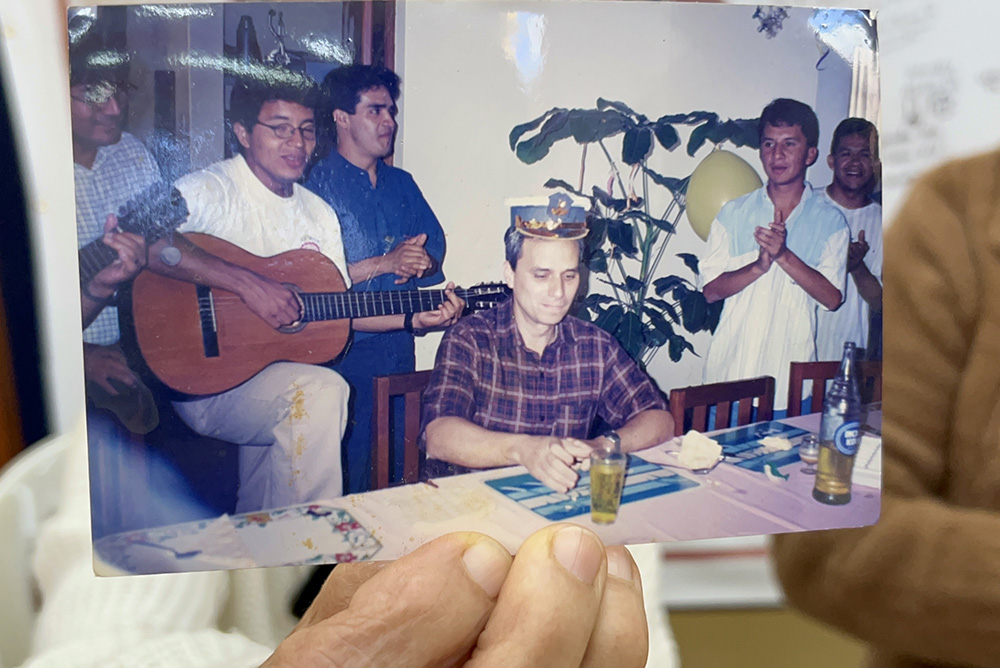
Socorro Cassaro holds up a picture of Augustinian Fr. Robert Prevost with a group of young people at Our Lady of Montserrat Parish in Trujillo, Peru. Prevost, the future Pope Leo XIV, served as parochial administrator of the parish from 1992 to 1999. (NCR photo/Justin McLellan)
After his yearlong stint in Chulucanas, Prevost had returned to the Chicago area to act as mission and vocations director for the Midwest Augustinians. In 1988, he then returned to Peru, this time to Trujillo, which had a population of just under 700,000 at the time.
For 11 years in Trujillo, Prevost was the formation master at the Augustinian formation house. He was in charge of pastoral care at another poor parish, and, from 1992 onward, he was parish administrator at Our Lady of Montserrat Parish.
After thinking on the community's request, Prevost agreed to entrust the pastoral care for the community of the Monserrate neighborhood to the Augustinians, on one condition: to push back the 6:30 am Mass time.
"How am I going to get there at 6 am?" Saldaña recalled Prevost telling them. "I'm just opening my eyes then."
While the parish community was vibrant, there was still no church building. Masses in that first year that Prevost was involved were celebrated in the streets or in different parks. Families would bring their own chairs, and at the end of Mass each week they would communicate where Mass would be held the following week.
Once the Augustinians took over the parish, Prevost and the other organizations began implementing the model of parish he had learned in Chulucanas, and the new Parish of Our Lady of Montserrat was divided into 16 zones.
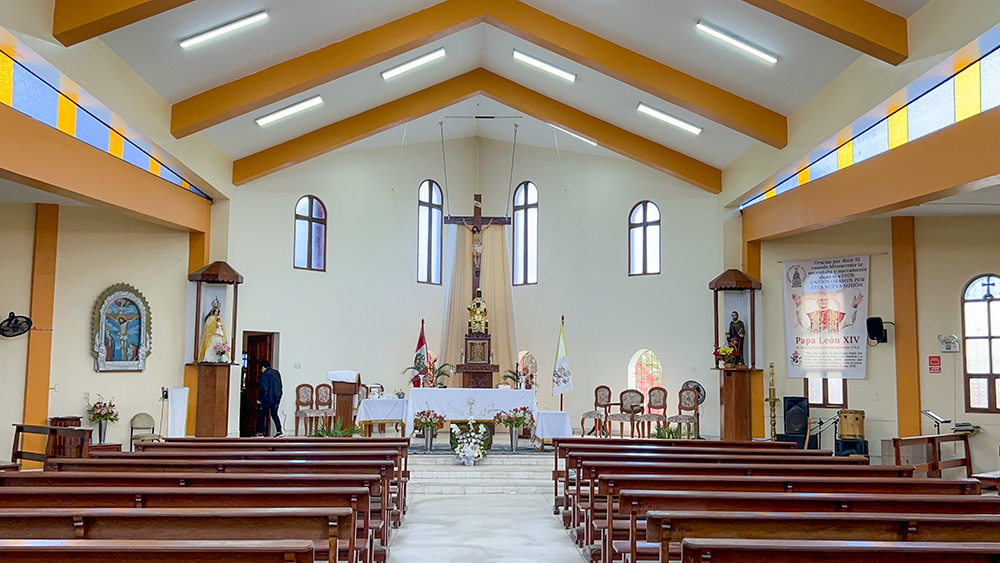
Our Lady of Montserrat Parish is where Fr. Robert Prevost served as parochial administrator for some seven years in Trujillo, Peru. (NCR photo/Justin McLellan)
"In each area we knocked on doors, set an appointment for a certain time. The families would come out to a park and meet, Father Robert would also come, and young people would play songs so that everyone would come out," explained Alicia Chang Sánchez, a parishioner. "There, a leadership group was appointed, a representative body so that they could work more directly with the parish, and really that's how everyone in Montserrat knows each other, because of that work."
Elsa Ocampo recalled how it was initially a challenge for the community to adjust to the New Image of Parish plan.
"We were accustomed to another, more traditional way of leading where the priest led everything and gave orders and that's what was done," she said. "But with [the Augustinians] we began to work as a team."
Each zone of Montserrat Parish hosted its own fiesta de fraternidad, or "fraternity party" each month consisting first of a liturgy, followed by an assembly and then sharing conversation over coffee, tea and snacks. Those gatherings, Ocampo said, "helped to create bonds of friendship between the people who make up a parish community."
When someone fell sick, and couldn't afford medicine or the fare for a taxi to take them to work, "we would all collaborate, we'd put something together and give it to them," she added. When someone died, the liturgical coordinator would organize people to gather at the home of the deceased for a prayer.
"From those acts, people feel involved and committed to the work of each zone," Ocampo said. Each zone has a patron saint, typically marked by a statue of the saint within that neighborhood, and on their feast day the entirety of the parish community would come over to their zone to celebrate it with them.
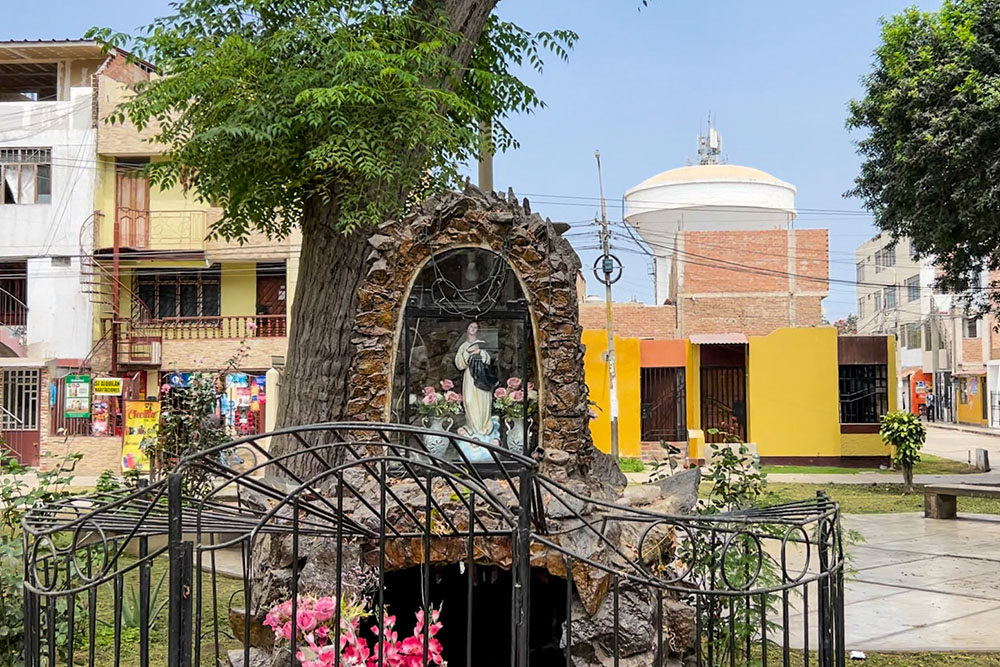
A statue depicting the Immaculate Conception marks the "Inmaculada" neighborhood of Our Lady of Montserrat Parish in Trujillo, Peru. (NCR photo/Justin McLellan)
The parish's monthly gatherings, its grassroots decision-making and its network of mutual aid gave ordinary Catholics a sense that they were the church and not merely its audience.
Even decades later, the parishioners who built Monserrate remember Prevost not only for the structures he helped shape but for his presence among them. "He was very gentle in how he said things," Cassaro recalled. "I never saw him upset. He always did things with much calm, with much peace. He was always open to making friends."
They remember him in their homes, sitting at kitchen tables, sipping lemongrass tea, listening to concerns about parish life. "He wasn't the kind of priest who stayed in the church," she said. "He was like a member of the family."
For them, his leadership wasn't about authority but about accompaniment, drawing people in and letting them take ownership of their faith.
In time, the system he implemented became a defining part of Our Lady of Montserrat's identity. Those who founded the parish now talk about how their children are involved in many of the roles they previously held.
"Many young people who came to the church back when he was the parish priest, they have come back since our Pope Leo XIV was elected," said Ocampo. "Everyone is happy that someone who was so close to us is now leading the universal church."
The National Catholic Reporter's Rome Bureau is made possible in part by the generosity of Joan and Bob McGrath.