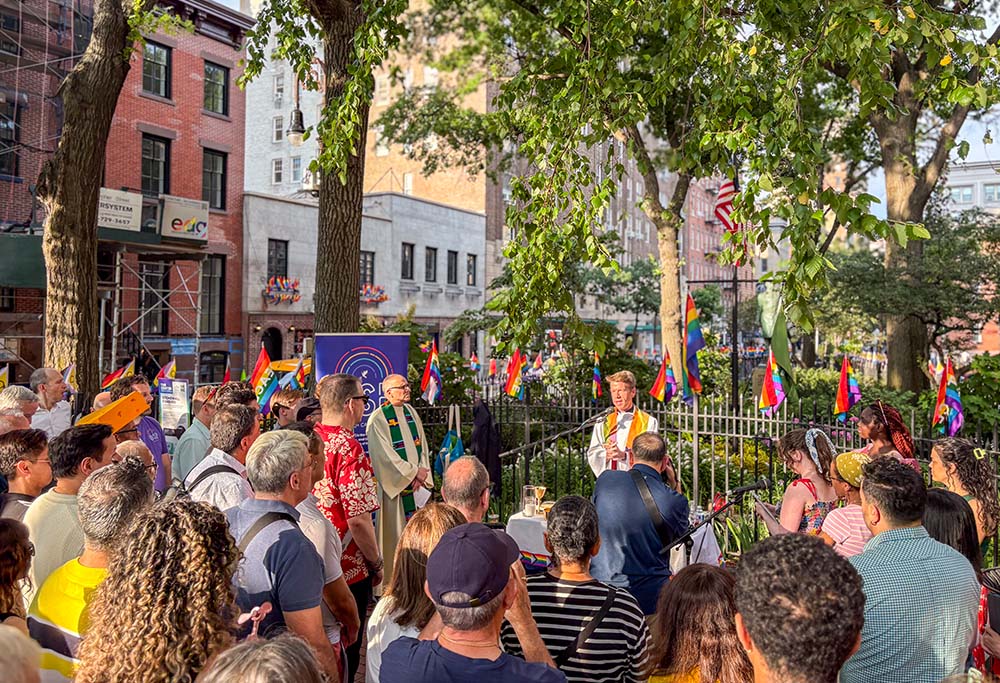
Worshippers pray at a Pride Mass organized by Out at St. Paul's, the LGBTQ+ ministry of St. Paul the Apostle in Manhattan, at the Stonewall National Monument in Christopher Park in New York, steps away from the Stonewall Inn, June 25, 2026. (NCR photo/Camillo Barone)

Join the Conversation
Send your thoughts to Letters to the Editor. Learn more
Surrounded by rainbow flags and packed shoulder to shoulder with more than 150 worshippers, Christopher Park in New York's Greenwich Village became an open-air sanctuary at the start of New York's Pride weekend. Catholics, allies and visitors gathered for the 2026 Annual Pride Mass on June 25 at the Stonewall National Monument, steps away from the Stonewall Inn, where the modern LGBTQ+ rights movement traces its origins to the June 1969 uprising.
Organized annually by Out at St. Paul, the LGBTQ+ ministry of St. Paul the Apostle in Manhattan, and set against the backdrop of one of the country's most significant civil rights landmarks, participants celebrated the Eucharist while affirming the ministry's three pillars of spirituality, community and service.
The small park, transformed by dozens of rainbow flags encircling the gathering, offered a visible sign of both remembrance and hope. As tourists paused to observe and neighborhood sounds drifted into the celebration, the Mass unfolded as an expression of faith rooted in a place synonymous with the struggle for dignity and equal rights.
Presiding over the liturgy, Paulist Fr. Chris Lawton, associate pastor at St. Paul the Apostle, said holding the celebration at Stonewall reflects Jesus' own way of ministering.
"If we are a church that reflects that Jesus who goes out to encounter all those who might receive this message of extraordinary love, then of course, praise God, we celebrate the sacraments here in our church," he told NCR before the Mass. "And we also go out regularly to be present to others, especially those who may not enter the doors of a church."
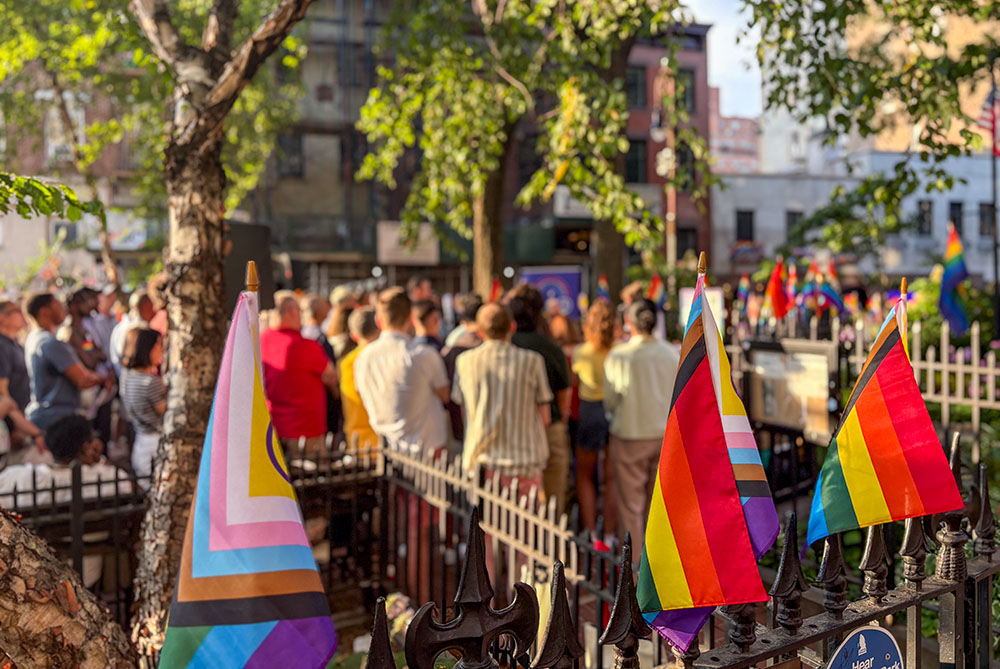
About 150 worshippers gathered at the Stonewall National Monument in Christopher Park in New York for an open-air Mass on June 25, 2026, steps away from the Stonewall Inn. (NCR photo/Camillo Barone)
The Mass was held amid a national decline in support for same-sex marriage and other LGBTQ+ rights, with 65% of Americans saying in a Gallup poll that they support marriage rights, down from a high of 71% in 2022. The drop is largely due to decreased support from Republicans and independents.
Still, some church leaders have continued to offer encouraging words for LGBTQ+ Catholics, including Washington, D.C., Cardinal Robert McElroy, who earlier this month celebrated Mass at Georgetown University for a gathering hosted by the LGBTQ Catholic group Outreach.
Drawing on memories from his childhood in Wisconsin during his homily, Lawton recounted how two openly gay business owners quietly transformed his hometown despite living in an era when many people refused to acknowledge their relationship. Their perseverance, he said, became part of the foundation upon which later generations built.
He connected that personal story with the significance of the Stonewall National Monument.
"This evening we stand on a monument, established because others came before us believing that civil rights for all of us was worth standing up for," he preached, "worth risking their well-being for the conviction that we are a greater nation when we honor those rights and our rich diversity."
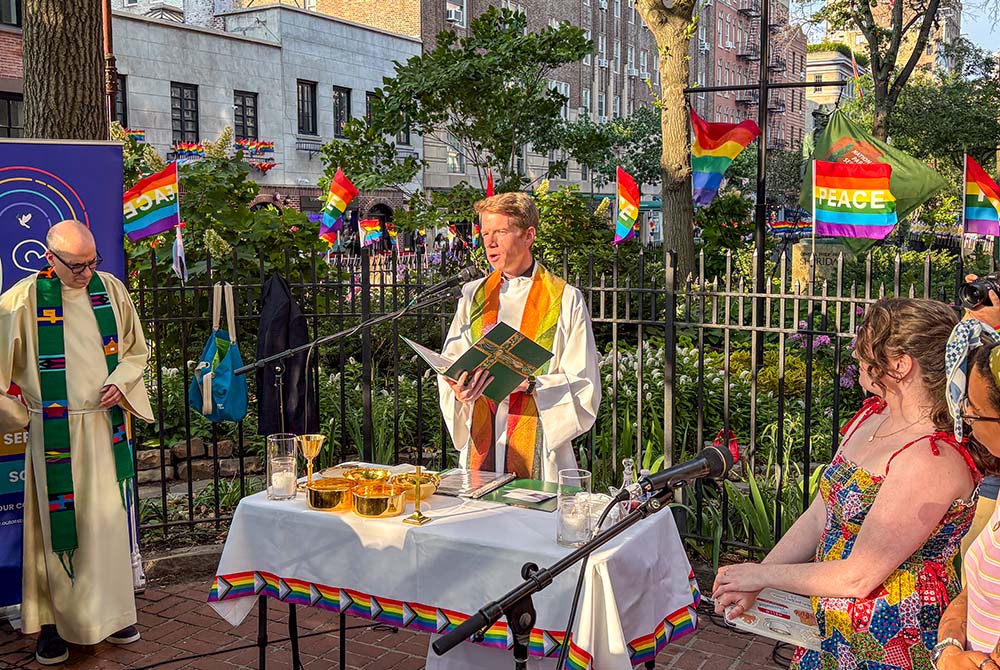
Paulist Fr. Chris Lawton, associate pastor at St. Paul the Apostle in New York, presides over a Pride Mass at the Stonewall National Monument in Christopher Park in New York June 25, 2026. (NCR photo/Camillo Barone)
He extended that reflection to the Catholic Church itself, arguing that generations of LGBTQ+ Catholics have quietly helped build parish life despite experiencing exclusion.
"Our church has been built on rock," he said. "Built on the faith so many people who believed in God's extraordinary love, and from that faith, helped build up this church even as they were marginalized. This includes, for centuries, LGBTQ Catholics."
Lawton also acknowledged the pain many LGBTQ Catholics have experienced within the church.
"To all those who have suffered because of our church, please hear this: First, I'm sorry. I am sorry for the times that the church has not recognized the presence of God in you, and for the times it has implicitly encouraged others to do the same."
He offered particular recognition to transgender Catholics, saying, "I want to apologize to our transgender siblings, who continue to face unique injustice in this church, and at this time in the life of our country as well."
He also thanked LGBTQ Catholics "whose faith in God and knowledge of their own belovedness has led them to extraordinary service, even amidst that adversity."
"Thank you for your witness. Your joy. Your creativity," he added.
Throughout the liturgy, prayers expanded that vision beyond the LGBTQ community, including petitions for care of creation, racial justice, migrants, women, people experiencing poverty, peace, and a church that grows in unity, humility and inclusion, while especially remembering transgender and nonbinary people.
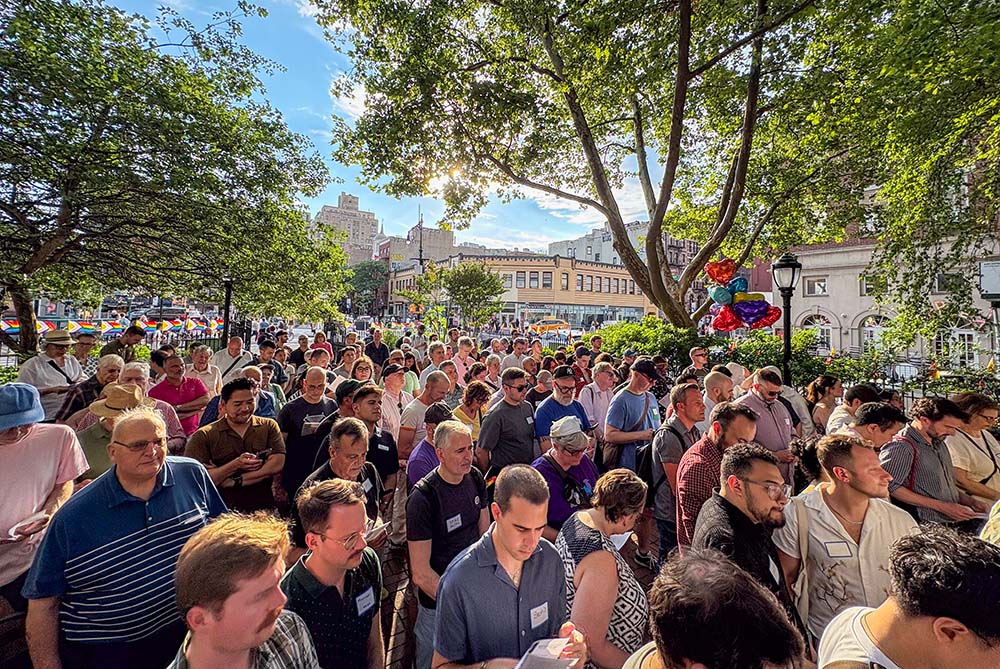
A crowd of about 150 worshippers and visitors stand at the Stonewall National Monument in Christopher Park in New York during an open-air Mass on June 25, 2026, steps away from the Stonewall Inn. (NCR photo/Camillo Barone)
Among those helping organize the celebration was Ben Kulos, 42, a New York-based assistant principal and member of the leadership team of Out at St. Paul.
"It is really important to be here to bear witness to LGBT Catholics and our presence in this city and in the church, especially in this time in our country's history and the discourse that is happening," Kulos said.
He said his message to Catholics who may feel isolated was simple: "You belong, and don't let anyone else tell you otherwise."
For many participants, the celebration reflected deeply personal journeys of faith.
Issy Bilek, 30, a New York-based union organizer and parishioner at St. Paul the Apostle, was baptized during the parish's Easter Vigil in April after completing the Order of Christian Initiation of Adults process. The parish welcomed one of the largest classes of new Catholics in the New York Archdiocese, an experience many parish leaders attributed in part to its culture of welcome and social justice.
"I'm a member of St. Paul the Apostle Congregation. I'm gay and I'm trans, and so I feel like this overlapped with my personal interests and obligations as a member of the community," Bilek said.
Advertisement
Asked what message they hoped others would hear, Bilek said, "Spirituality is a part of your sexuality and your identity, in the same way that anything else is."
Bilek's decision to enter the Catholic Church reflected that conviction.
"I really wanted to pursue my Catholic and spiritual journey at the same time that I was pursuing my gender identity, because I felt like the two would help guide each other. I didn't think that they would be in conflict," they said.
Among those seated quietly before the liturgy began was Marcus Paul, a 77-year-old New Orleans native who now lives in New York.
Asked why he attended, Paul expressed his support for LGBTQ inclusion in the church.
"The reason is that the formation of one's sexual identity has nothing to do with society," he said. "We are all God's children, so anyone who wants to come and participates in that relationship is entitled. Their sexuality has absolutely nothing to do with it."
Lawton closed his homily by describing the church's growing welcome for LGBTQ+ Catholics as something already in motion.
"There is in this church a force of welcome, and of inclusion, and integration, and of celebration of diverse gifts that is alive, propelling us forward, making us more reflective of Jesus Christ," he said."The train has left the station. And we are going somewhere."