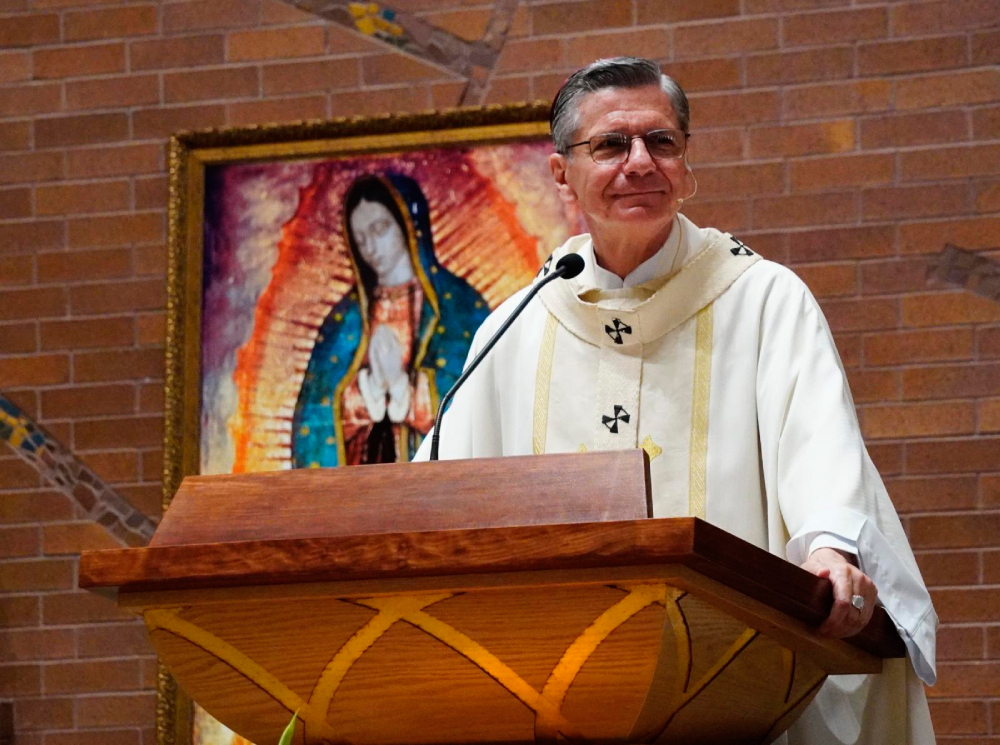
Archbishop Gustavo García-Siller of San Antonio, is pictured in a June 8, 2024, photo. (OSV News/Courtesy of Archdiocese of San Antonio/Veronica Markland)

by Brian Fraga
Staff Reporter
Join the Conversation
Send your thoughts to Letters to the Editor. Learn more
Catholic bishops in Texas and Michigan released new public statements this week defending the dignity of migrants and calling for comprehensive immigration reform amid recent enforcement actions by federal immigration agents.
Bishop Robert Gruss of Saginaw, Michigan, said Aug. 1 that it was "necessary" for him to respond to news reports that U.S. Immigration and Customs Enforcement officers arrested nine migrant workers while they were installing cable in Saginaw in late July. The arrests sparked local protests.
"It is understandable to remove immigrants who have caused harm to society by participating in criminal activity. But is it fair to remove those who are and have been contributing to society in a positive way, often times for many years?" Gruss said in his prepared statement.
On Aug. 3, San Antonio Archbishop Gustavo García-Siller issued a new pastoral letter, titled "We Will Come to You: United in Solidarity with Our Brothers and Sisters in Migration," offering a pastoral roadmap grounded in human dignity and the Gospel call to welcome the stranger.
"Families we know by name are now afraid to come to the sacraments. Like the Good Samaritan who drew near to the wounded, we cannot walk past them," wrote García-Siller, who released his letter on the 100th anniversary of San Antonio's elevation to a metropolitan archdiocese.
"I write to console the suffering, to awaken the indifferent, and to confront injustice with the courage the Gospel demands," García-Siller wrote in a press release.
Advertisement
The bishops' remarks are the latest in a series of statements that Catholic prelates across the country have released over the past year expressing solidarity with beleaguered immigrant communities that have found themselves in the crosshairs of the Trump administration's immigration crackdown.
In November 2025, the U.S. Conference of Catholic Bishops approved a special pastoral message on immigration that condemned the indiscriminate mass deportation of people. Gruss referenced that statement in his remarks this week that called for the legal rights of migrants to be respected.
"The deportation of people without cause, the detention of immigrants without meaningful legal representation, without access to family or a supportive community, and without basic human needs being met, and the forced separation of immigrant families and incarceration of children do not represent a just and civil society," Gruss said.
Every human person, migrant or otherwise, Gruss said, must have their constitutional rights respected, including the rights to due process, protection against discrimination and protection from unreasonable search and seizure.
"Disregard for this should never be normalized in our society," said Gruss, who added that the legitimate role of civil authorities to implement the law in a humane manner, respecting the fundamental human rights, is part of a just society, "but must always include due process."
"The power of the state must always be exercised within the limits of moral law," said Gruss, who called on Congress to "remove the politics, do its work, and take the bold steps necessary to pass comprehensive immigration reform."
"Our system has been broken for more than 40 years, and our government leaders do not seem to want to try and fix the problem. Herein, lies the problem," Gruss said.
In the San Antonio Archdiocese, García-Siller said he wrote his pastoral letter, which reflects on the prevailing climate of immigration enforcement, in a spirit of love, "grounded not in ideology but in walking with you."
"Our immigration system has failed the people it was meant to serve, and a misleading public narrative has done much to sustain that failure," García-Siller wrote as he referenced statistics from the Cato Institute indicating that 73% of people in immigration detention have no prior criminal conviction.
"Research shows mass deportation would subtract more than $1 trillion from the economy, while a pathway to citizenship for these families would generate $1.7 trillion in growth. They do not weaken the nation but rather sustain it," García-Siller wrote.
The letter is organized around four pillars that emphasize the human dignity of every person, encountering Christ in welcoming the migrant, the importance of parishes and families accompanying migrants, including the detained, and appealing to civic leaders on "the non-negotiable principles" of dignity, family unity and due process.
Parishes, Catholic schools and campus ministries in the San Antonio Archdiocese will receive a reflection guide and liturgical resources, with an emphasis on World Day of Migrants and Refugees, which will be observed on Sept. 27.
García-Siller noted that immigrant detention and deportation at a large scale are not new in United States history.
"What distinguishes the present hour is not enforcement at scale alone, but a convergence of structural and legal tactics whose relative novelty calls for the careful and well-formed moral discernment of every Catholic conscience," García-Siller wrote.
The church acknowledges the legitimate authority of law enforcement to enforce immigration laws, García-Siller said, but he added that "all laws must remain at the service of human dignity. When the enforcement of law violates human dignity, they betray the very justice they claim to defend."