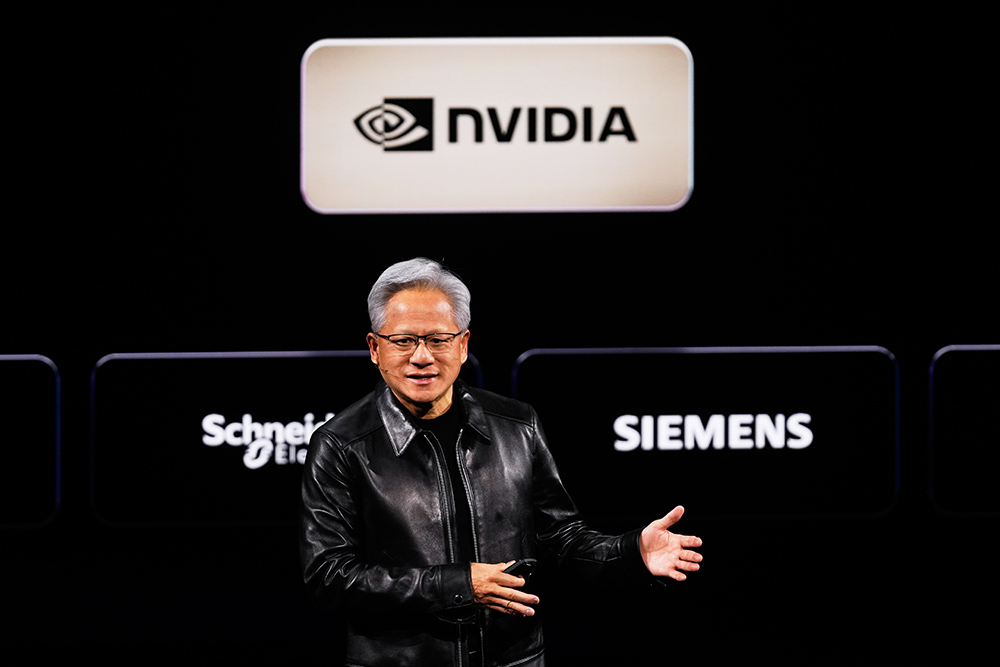
Nvidia CEO Jensen Huang delivers his keynote at the company's GTC event in Berlin, Germany on Oct. 21, 2026. (AP Photo/Markus Schreiber)

by Daniel P. Horan
Join the Conversation
Send your thoughts to Letters to the Editor. Learn more
Two millennia before the advent of computers or the internet or the micro-processing chip company Nvidia, Jesus offered a prescient warning that speaks directly to our historical moment: "You cannot serve both God and mammon" (Matt 6:24 and Luke 16:13). Mammon, a term that comes from the Aramaic for "riches" or "profit," may not be common in our modern vocabulary, but what it points to can be found in nearly every headline over the last few weeks. And it is clear that Jesus' admonition has not been heeded by corporate boards, political leaders and ordinary investors alike.
What we have seen unfold with the multiple scandals involving Jensen Huang, the founder and leader of the tech firm Nvidia, can rightly be described as unprecedented and bears the markers of a true story seemingly too implausible even for Hollywood.
First, news reports uncovered that Huang was having an extramarital affair with a woman believed by U.S. intelligence officials to be a Chinese spy. Then, it surfaced that Huang allegedly also had an affair not only with an Nvidia employee who was his direct report, but apparently also admitted to having other affairs when questioned by the Nvidia board of directors Sunday. Huang resigned from his leadership post on Nov. 12 at Nvidia, and President Donald Trump began calling for Huang's reinstatement. And, as The New York Times reported this week, Trump appeared to have ratcheted up that pressure over the weekend and effectively compelled the Nvidia board to overturn its once stalwart position that it "does not intend to reinstate Jenson as C.E.O."
This brings us to the present moment when Huang has been returned to his previous leadership positions at the company and on the board, in what reports described as "a rare reversal in corporate America over less than a week."
Trump's unusual and, frankly, unethical intervention in the internal affairs of a corporation appears to have been primarily motivated by his fears of the Nvidia tumult's effects on the stock market, which appeared to enter into a correction last week. On Monday (Nov. 23), the market opened with force, with several indexes climbing by more than 4% or 5%. Nvidia stock alone surged by 31% on Monday, a seeming affirmation by investors of the board's decision after Trump put his thumbs on the scale.
Although, as of this writing on Tuesday (Nov. 24) the value of Nvidia stock and market indexes are both sliding back some, the weeklong rollercoaster and chief-executive reinstatement appears to have been a success for those allied with Huang and Trump.
I, however, remain very concerned.
The turn of events this past week may rightly be called a "win," certainly for Huang and vicariously for Trump, but also by those who hold stock in Nvidia (which is, minimally, nearly everybody with some kind of retirement account). But these ostensible short-term gains have been made without consideration of the long-term consequences.
Setting aside the Christian teachings on morality and relating to material wealth for the moment, there are business, social and political implications to consider that make this whiplash turnabout dangerous.
Advertisement
On the business side of things, despite many of the Nvidia employees cheering Huang on as he returned to the company headquarters on Nov. 23 (you can watch the video here), Huang has lost one of the most valuable assets any leader can have: trust. Although the Nvidia board chair released a statement after Huang's return stating "We have every confidence in Jensen," I do not believe that for a second. If that were truly the case, and not merely the result of presidential interference and bullying, then the board would never have asked for Huang's resignation in the first place.
Not only is it likely that the board, to whom Huang answers, has lost trust in him, but I suspect many of the employees at Nvidia also have reason not to trust him. He has been lying to his family, to his employees, to his shareholders, to his board and to the world and the lack of faith that rightly engenders doesn't just disappear overnight. I would not be surprised if in the medium and long-term many of those Nvidia employees that can work elsewhere, will work elsewhere. The instability of this episode, occasioned by the foolish placement of nearly all corporate stakes on one deeply flawed person, is not likely to sit well on those who have their own professional interest in mind.
Instead, it would have made more sense to endure the short-term pain resulting from the Huang-inflicted turmoil and let the board and senior leadership at Nvidia learn from their mistakes and build a leadership structure and strategic plan that could weather the long haul without tying everything to just one man. A company valued at $3 trillion ought to be more careful than that.
The social implications are also significant. What does this episode in corporate America teach young people and aspiring business owners today? The stock market does not generally care about the moral character of business elites provided they continue to grow profits and return value to investors.
But to reward people who have acted in bad faith, who have repeatedly lied, who have admitted to violating their company's ethical guidelines, and who have been accused of having a yearslong sexual affair with an alleged foreign spy, to name just a few public transgressions, sends a troubling signal to the world. It suggests that if you build an incredibly valuable company, you can do whatever you want with impunity. It also says that this is how we do things in America. And I, for one, do not approve.
This brings me to the political implications. I am shocked by the effectiveness of Trump's bullying the Nvidia board of directors, particularly given his deeply weakened position after the midterm election rebuke he suffered. It is not surprising that a man known for decades to be a serial cheater, a bad business leader, and a liar would rally to the aid of someone accused of many of the same misdeeds. But what worries me is the message this sends about Trump's intentions for the remainder of this two-year-long lame duck era.
On Nov. 24, New York Times reporter Jonathan Swan noted in an episode of "The Daily" that "I haven't seen Trump this excited, almost giddy, since after winning the 2024 election. It appeared and advisers said that he saw this as the ultimate power move." Perhaps Trump has come to terms with his declining influence over American politics, including within his own political party, and so will now seek to exert his influence in the business sector alongside obsessing about his White House renovation projects. This could have far-reaching and negative consequences if, on a whim, Trump gets it in his head to start pressuring other corporate boards or business leaders to bend to his will and personal interests.
But, returning to Jesus' admonition, let's not forget about the moral implications here. Our business leaders and politicians do not need to be moral exemplars or canonized saints (although it would be nice if some were). Instead, they need to be minimally ethically upstanding people. The business, social and political stakes are too high for anything less than that, and that is not to say anything about the spiritual stakes on the line. I don't know what the future holds for Nvidia or Huang, but I do know that Jesus has made clear to all parties that the consequences are dire for those who choose money over morality.