


A crucifix hangs before a mural depicting the Resurrection in the sanctuary at St. Timothy Parish in Mesa, Arizona, in this undated file photo. (OSV News/Catholic Sun/J.D. Long-Garcia)

by Mary M. McGlone
Join the Conversation
Send your thoughts to Letters to the Editor. Learn more
In the mid-1960s, that world-upending era of counterculture, new frontiers and devastating assassinations, Burt Bacharach cowrote the surprisingly popular song "Alfie." The song began, "What's it all about, Alfie?" It raised the existential question that lurked beneath many of the events of the epoch: "Is it just for the moment we live?"
This melancholy question continues to haunt our own era, marked as it is by more screens than encounters, flagrant consumption of people and goods and, for many, the loss of religious or even relational mooring. The readings of the Easter season offer us a vision of Christianity's countercultural response to the question.
Today's Liturgy of the Word draws us to the long view. We hear about Christ, the Alpha and Omega, about heaven opened up and Jesus' expression of his deepest desire, his reason for doing what he did.
In the Gospel, we find ourselves again at table with Jesus as he voices a prayer summarizing the hopes for which he had given his life from the day he started to preach. However much he intuited about his coming passion and death, he had no doubt that his mission would continue, therefore he prayed for all those who would believe in him in the future.
With no idea of what that future would look like, he prayed that they would feel what he always had: "May they all be one as you are in me and I in you. May they so revel in our glory that the world will know that you sent me (John 17:21-23)." Indeed, soon after his ascension, his disciples began to replicate his mission of love and enjoy the freedom he had in the Spirit.
Stephen, filled with the Holy Spirit, gives us our first illustration of this freedom. When the community began to experience jealousy and ethnic division, the apostles appointed Stephen, a "Greek" Jew, along with others to ensure that the goods of the community were shared with impartiality. (Yes, even the primitive Christian community needed to strive for diversity, equity and inclusion.) Stephen, along with other deacons and deaconesses, accepted responsibility for seeing to the well-being of the poor and marginalized (Acts 6:1-7).
Advertisement
Stephen, like Jesus, carried out his mission so well that he threatened religious leaders who lied about him as they had about Jesus. When he preached an eloquent recap of human resistance to salvation that ended with Jesus' passion, Stephen struck a raw nerve. So they lashed out. Luke paints a verbal graphic picture of their frenzy as they covered their ears and rushed to drive him out of the city for a stoning. (Just picture it!)
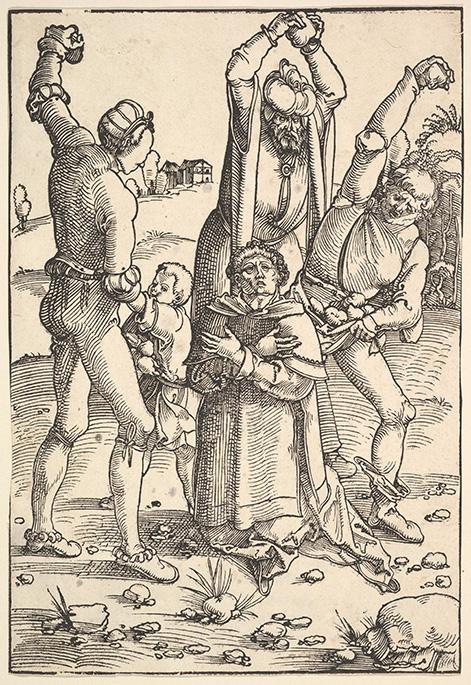
"Martyrdom of St. Stephen," a 16th-century woodcut print by Hans Baldung, called Hans Baldung Grien (Metropolitan Museum of Art)
The key to the story is not the stoning, but Stephen's experience. Although trapped by a furious and vicious posse, he seemed to hardly notice them. Instead, he saw the heavens opening and Christ at God's right hand. He saw eternity, not an end; providence, not death. He envisioned what the author of Revelation heard in the message from the open heavens: Christ, the Alpha and Omega, moving creation toward fulfillment in God.
All three of these readings respond to the Alfie question: What's it all about?
It's all about John's description of creation's destiny in God. It's about the freedom from death and fear that allowed Stephen to appreciate his stoning in a way his persecutors couldn't imagine. It's all about realizing that the heavens are open and God's love permeates all of creation.
Someone wrote the book of Revelation to give hope, to assure people that God was not dead, nor blind or deaf. It describes what Stephen saw: the work of God begun in creation and revealed in Christ as a work in progress that will be continually opposed and never overcome. Describing Christ as the Alpha and Omega, the truly human one who bids us come, proclaims again that God desires our flourishing in the love that expresses God's union with all creation.
And so, as we come to the end of our Easter season, we can ask, "What have we learned? How have we changed? Has our faith in the resurrection of Christ given us courage and freed us from fear? Does the Resurrection give us a vision of the future that grounds us in the meaning of the present? Have we grasped more of the Gospel's alternative to our societies' distorted values?"
If this season has moved us more deeply toward grasping the meaning of our lives, that is grace. If our contemplation of the resurrection has strengthened our awareness of Christ dwelling among us and our part in his mission, that is grace. If we have become freer because we believe in God's future, that is grace. If we know how much more we need, that is our preparation to be filled with the Spirit at Pentecost.
<div style="text-align: center;"><div style="max-width: 400px; margin: 0 auto;"><a href="https://www.ncronline.org/vatican/francis-comic-strip/francis-comic-str… style="max-width: 100%;" src="https://www.ncronline.org/files/st

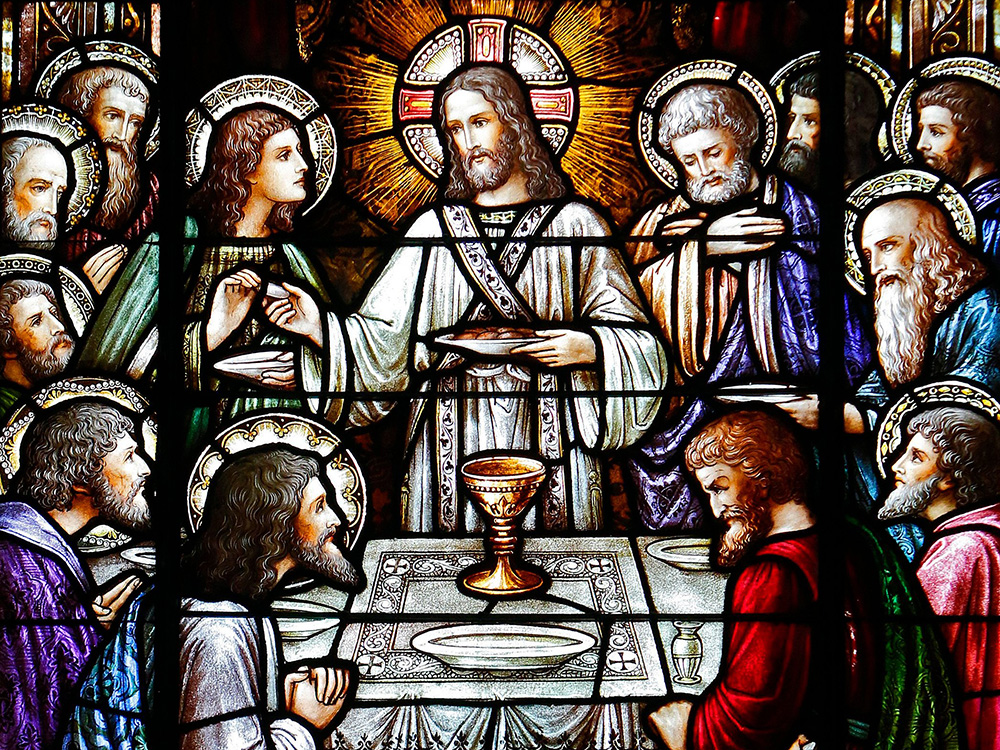
Jesus and his apostles at the Last Supper, depicted in a stained glass window at St. Aloysius Church in Great Neck, New York, in this undated file photo. Today's Gospel comes from Jesus' last discourse, John's record of Jesus' long dinner conversation on the night of his betrayal. (OSV News/Gregory A. Shemitz)
by Mary M. McGlone
Join the Conversation
Send your thoughts to Letters to the Editor. Learn more
"I've thought about it, and I'm right." That's the line the mother of one of our sisters used whenever necessary. While we might think it's pretty bold, most of us would have to admit that we often share that often overly confident opinion. Strong conviction is not a bad thing, provided we abandon illusions of infallibility. Another expression of the potential problem is what New York Times columnist David Brooks described as a crisis of serious thinking. Among other things, he warned that our nation is losing the "ability to reason," asking, "What happens when people lose the ability to … render good judgments?" In a way, he's saying that we're losing the ability to "think about it," even while we remain convinced that we're right.
The Sixth Sunday of Easter invites us to think hard and invite the Holy Spirit to draw us beyond any narrowness and the fear of change that makes us cling to the familiar. (Note the first-person plural there!) Today's Gospel comes from Jesus' last discourse, John's record of Jesus' long dinner conversation on the night of his betrayal. John's Chapter 14 repeatedly affirms Jesus' promise that the Spirit will remain with the disciples (us). In Verses 15-16, Jesus says, "I will ask the Father who will give you another Advocate to be with you always." Today's Gospel reiterates his promise, saying that the Holy Spirit, "will teach you everything and remind you of all that I have told you."
Learning from the Spirit underlies our story from Acts. As the Christian community grew, polarization began to fester among them. More Gentiles than Jews were choosing to follow Christ, and that caused some of the original group to worry that newcomers would dilute the true faith. To prevent that, they insisted that everyone entering the church should follow the traditions of pious Judaism, including the requirement that the men must be circumcised. The people promoting this position were arguing on behalf of their very identity: Christ was born a Jew and died a Jew. So too should be his followers.
As Luke indicates, "this caused no little dissension" or, more plainly, they nearly came to blows over it. Speaking up for the Gentiles, Peter declared, "God who knows the heart, bore witness by granting [the Gentiles] the Holy Spirit just as he did us." Peter insisted that there was no need for Gentiles to become Jews, only to live as people permeated by God's Spirit.
What did they do? They followed the synodal path. After discussing the issue, the community in Antioch sent Paul and Barnabas, the "son of encouragement," and some others to meet with the community in Jerusalem and proclaim all that God was working among the Gentiles (Acts 15:12). They carried a letter from the whole community that explained their discernment. After listening to one another and invoking the Holy Spirit, they boldly pronounced, "It is the decision of the Holy Spirit and of us" not to place undue burdens on the Gentiles.
Advertisement
German theologian Karl Rahner taught that this decision counted as one of the three most important moments in the history of the church. (The other two, he said, were the Incarnation and Vatican II.) With this decision, the community opened itself to be a gathering of all people. Without it, Christianity probably would have remained a small sect within the Jewish community. (For Rahner, Vatican II ratified this decision by gathering bishops native to all the continents, thereby definitively opening the church to the diversity of cultures and viewpoints that would give it a future.)
And today? We live in a time of unprecedented polarization in society and even in the church. Too many of us maintain a spirit of, "I've thought about it, and I'm right." The danger with this is that we leave little room for the Spirit. We don't approach others with the kind of prayerful, open hearts that allow us to comprehend various sides of an issue and discover new, community-building resolutions. What the disciples came to was not, "I've thought about it …" but the humble and faith-filled ability to announce boldly, "It is the decision of the Holy Spirit and of us …"
Following what Vatican II started, Pope Francis led the church into this era of synodality — gathering the widest possible diversity of Catholics of different ages, opinions and backgrounds to listen attentively for what the Holy Spirit wishes to do among us. There is no doubt that the Spirit can inspire us, as long as we remember that inspiration is not a direct line from heaven, but communal discernment even though it may entail no little dissension on the way to creative solutions.
Today's liturgy asks us one stark question, "Do you have the humility and courage to allow the Spirit to permeate you, moving you beyond your cherished convictions into a genuinely new era?"
<div style="margin-bottom: 10px; padding-bottom: 10px; border-bottom: 1px dotted #ccc;" class="full_width_image"><img style="width: 624px; max-width: 100%;" src="https://www.ncronline.org/files/styles/email_newsletter_full_width/publ… style="font-size: 19px; font-family: 'Georgia', serif;"&

<h2><a style="color: #04619d; text-decoration: none;" href="https://www.ncronline.org/opinion/will-pope-leo-xiv-make-call-women-dea… Pope Leo XIV make the call on women deacons?</a></h2><div style="font-weight: bold; font-size: 15px; font-family: Arial, sans-serif;" class="byline">by Phyllis Zagano, Religion News Service</div><div style="font-size: 19px; font-family: 'Georgia', serif;"><p>A
<div style="text-align: center;"><div style="margin-bottom: 10px; padding-bottom: 10px; border-bottom: 1px dotted #ccc;" class="full_width_image"><img style="width: 624px; max-width: 100%;" src="https://www.ncronline.org/files/styles/email_newsletter_full_width/publ… style="color: #04619d; text-decoration: none;" href="

<h2><a style="color: #04619d; text-decoration: none;" href="https://www.ncronline.org/opinion/lessons-leo-xiv-his-predecessor-leo-x… for Leo XIV from his predecessor Leo XIII</a></h2><div style="font-weight: bold; font-size: 15px; font-family: Arial, sans-serif;" class="byline">by Michael Sean Winters</div><div style="font-size: 19px; font-family: 'Georgia', serif;"><p>We now know why Pop