

<div style="text-align: center;"><div style="max-width: 400px; margin: 0 auto;"><a href="https://www.ncronline.org/vatican/francis-comic-strip/francis-comic-str… style="max-width: 100%;" src="https://www.ncronline.org/files/styles/email_newslett

<div style="margin-bottom: 10px; padding-bottom: 10px; border-bottom: 1px dotted #ccc;" class="full_width_image"><img style="width: 624px; max-width: 100%;" src="https://www.ncronline.org/files/styles/email_newsletter_full_width/publ… style="font-size: 19px; font-family: &

<div style="text-align: center;"><div style="margin-bottom: 10px; padding-bottom: 10px; border-bottom: 1px dotted #ccc;" class="full_width_image"><img style="width: 624px; max-width: 100%;" src="https://www.ncronline.org/files/styles/email_newsletter_full_width/publ… style="color: #04619d; text-decoration: none;" href="

<div style="text-align: center;"><div style="margin-bottom: 10px; padding-bottom: 10px; border-bottom: 1px dotted #ccc;" class="full_width_image"><img style="width: 624px; max-width: 100%;" src="https://www.ncronline.org/files/styles/email_newsletter_full_width/publ… style="color: #04619d; text-decoration: none;" href=&q


(Unsplash/Samuel Martins)

by Mary M. McGlone
Join the Conversation
Send your thoughts to Letters to the Editor. Learn more
The Wisdom author says, I prayed and wisdom came to me. Watch out! Prayer is dangerous. Remember Sirach's warning: "If you wish to serve the Lord, prepare yourself for an ordeal" (Sirach 2:1).
If you want a sense of the danger of prayer, just listen to Jeremiah: "You seduced me Lord, and I let myself be seduced" (Jeremiah 20:7). Unfortunately, the point of prayer is neither to give God a wish list or assure ourselves a place in heaven. Prayer opens us to the Reigning of God and our part in it.
Take today's Gospel, where a wealthy fellow asks Jesus for assurance that he can earn eternal life. Poor guy, he naively approaches Jesus from an unconscious position of supremacy. His privilege taught him to believe that he can do anything. So, he comes to Jesus and asks, "What is it that I have to do to inherit eternal life?" (Apparently, his upbringing didn't teach him that an inheritance is unearned.) He's among those who fool themselves into thinking they deserve all the goods that come to them.
In response, Jesus reminds him of some of the commandments — interestingly, not the ones that speak of relationship with God, just the ones that deal directly with human relationships. The fella knows he has that down pat. He replies, "Oh, I've observed all of those since my youth!" Saying that reveals that he sees human relationships as rule-bound: Avoid certain bad actions and all will be well. He's been careful to succeed at not doing certain things.
Then Jesus ups the ante. "How about going beyond the restrictions? How about being godly by giving yourself completely for others?" Ooph! That took it a bit too far! It was as if Jesus had punched him in the stomach. He must have felt like a kid presenting a good report card whose mom says that grades don't say a thing about what kind of person he is or should become. Being proud of getting all As might be his way of putting down the rest of the class.
The trouble was that the rich guy measured himself by his performance on a severely limited scale. What did he feel like when Jesus looked at him with love? When Jesus gazed at all his loving potential rather than his goods and legalistic accomplishments?
Prayer is very dangerous — it undermines every sort of complacency.
The Letter to the Hebrews describes what happened to the fellow. Jesus, the Word of God incarnate, spoke more sharply than a two-edged sword. Jesus beheld the man's whole and deepest self. Jesus gazed on all he was and all he could become. Jesus invited him to accept and love himself not for what he owned or had accomplished but for the love he could give and receive. In Jeremiah's terms, Jesus tried to seduce him. He did not let himself be seduced.
When Jesus told his disciples how hard it is to be part of the Reigning of God, he explained that it's more costly for those who have much — be it money, prestige, education, etc. Those kinds of wealth are seductive enough to enslave us. They can cushion us from sincere, vulnerable prayer. They can hook us into the delusion that we are self-sufficient and might be worthy of even more.
What then? The Book of Wisdom shows us the way. "I prayed and prudence was given to me." In other words, "Prayer led me to discern the meaning of life, it freed me from the snares of silver, health and beauty. It left me vulnerable enough for God to permeate my very being and accomplish what is impossible for human beings."
Advertisement
When Peter said, "What about us? We've given up everything to follow you!" Jesus responded in a terribly godly way. He told Peter that he would receive more than he expected in ways that he would never imagine — things impossible for human beings.
What does this say to us, people invited into the radical life of synodality while living in the midst of deep divisions? What does Christ call us to pray for and to give away? Synodality tells us that we can't answer these questions alone. Prayer opens us to God, but it doesn’t give us direct and infallible inspiration. Prayer offers us the prudence to discern how God is working among us, and to know that we need all those hundreds of mothers, fathers, sisters and brothers to recognize the promise and the demands of the Reigning of God in our midst.
Prayer is dangerous — it undermines every sort of complacency. But for those who allow themselves to be seduced by a loving God, it offers more than can be imagined — and yes, ordeals that, like the cross, usher us into what only God can give.
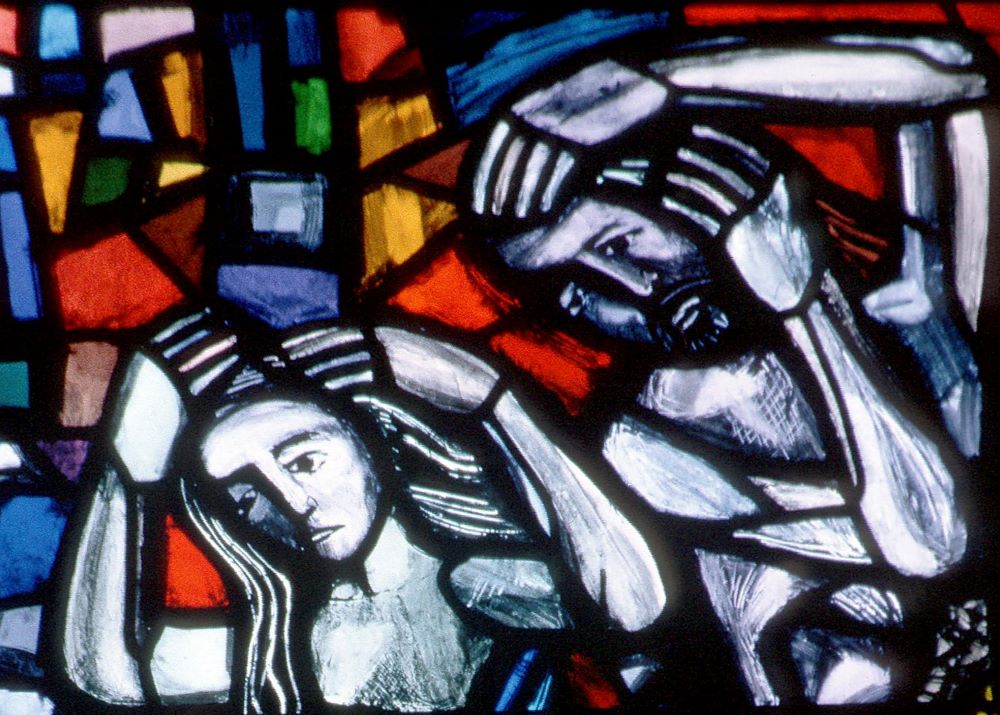
Adam and Eve are depicted in a stained-glass window at St. Nicolas Church in Feldkirch, Austria, on Aug. 2, 2004. (CNS photo/Crosiers)
by Mary M. McGlone
Join the Conversation
Send your thoughts to Letters to the Editor. Learn more
Do you remember René Descartes? ("I think, therefore I am.") Well, one day Descartes walked into a bar. (Original opening, no?) The bartender looked at him and asked, "Would you like a beer?" Descartes replied, "I think not." Then he disappeared.
As we know, Descartes died (1650), but his ideas haven't disappeared. Today we can argue that Descartes' brilliant thinking undergirds much of modernity's individualism, an approach to life that, according to Pope Francis, can tear the world apart and fosters division. Individualism can grow like cancer and metastasize into nationalism, sexism, homo and xenophobia, etc. But Descartes' theory had a fatal fallacy: He didn't understand that he wouldn't have known what "I" meant if his grandmother had not held him on her lap and said, "I am mémé you are René." Genesis 2 explains this with a theological myth.
Genesis weaves a tale about how God formed an adamah, an earthy creature who reflected God's own Self. God watched the adamah, then, for the first time ever, God said, "It is not good." What was wrong? Adamah was all alone. So, God fashioned all sorts of living creatures to accompany our mythical mudman ancestor. None of them the fellow's need. Finally, God said, "If this poor little creature is to become like us, he needs another who is very similar, yet distinct from himself." Voila! Eve.
When adamah and the woman saw each other, they could not only call one another by name, but they could grow, drawing one another forth through mutual relationship. In this relationship, Eve and Adam initiated our limitless trajectory of growth in humanity, our capacity to be images of the triune, all-relational God. Their relationship served as their first catechism, leading them through the first steps toward a relationship with God whose love called them to life. This ushers us into today's Gospel.
Every experience of love incarnates God with us.
A group of Jesus' antagonists asked him to legislate about the relationship between a wife and husband. Could a man just dump his wife like a pair of worn-out shoes? Jesus replied that legislating about relationships reveals hardness of heart; laws circumscribe what is meant to grow freely. Because all people are made for each other, ignoring or treating another as disposable denigrates both sides. The offended suffers an injury to her/his humanity — and the one dismissing constricts his/her world and humanity by rejecting, rejects the growth offered through relationship.
The letter to the Hebrews sheds a bright light on the sacramental character of relationships. Hebrews, like Philippians 2:6-8, tells us that Christ was made lower than the angels and tasted death. In other words, in the Incarnation, Christ entered into the closest possible solidarity with humanity, sharing our experience, even to death. Why? So that we who share his same origin in God might share his glory. That glory? Relationships of union among God and neighbor that can grow infinitely.
Forgetting that Jesus declared that legislation about relationships reflects hardness of heart (closedness to God), we often interpret today's Gospel as a decree about marriage. But no, these readings reach beyond the single subject of marriage to help us consider the reality that every relationship draws us deeper into divine life.
The biblical myth of Adam and Eve reveals that we human beings are made for one another. Adam had the power to name everything around him, but, until Eve came along, he labeled things that could not name him back, creatures who could not draw him forth in the equality and mutuality that express the deepest dimensions of our humanity. Only together could Eve and Adam become human images of the triune God.
Advertisement
Adam and Eve might be the perfect patron saints for this moment when our church is moving into the second session of the synod on synodality, or, we could say, the synod on becoming more together. The synod, building on and deepening the inspiration of Vatican II, reminds us that in the most profound sense, we are called to live as a church. This means that, rather than think of the church as an institution, we are beginning to realize that it is an experience of togetherness, of being called by God to be and do something together that nobody, not even small groups, can accomplish alone.
From this insight, we realize that every relationship (friendship, marriage, parenting, pastoring, teaching, companioning, serving and being served, etc.) offers us and our world mini experiences of what Jesus called the Reigning of God. Every experience of love incarnates God with us.
Descartes was indeed mistaken. We don't just think that we exist, we know that we become who we are through loving relationships. We know that loving continually makes us more than we were before. As an African saying puts it, "I am because we are."
<h2><a style="color: #04619d; text-decoration: none;" href="https://www.ncronline.org/opinion/ncr-voices/archbishop-di-noias-new-bo… Di Noia's new book examines the ecclesial vocation of theology</a></h2><div style="font-weight: bold; font-size: 15px; font-family: Arial, sans-serif;" class="byline">by Michael Sean Winters</div><div style="font-size: 19px; font-family:
Secondary 550 Ad
David Danks is a professor of data science, philosophy and policy at the University of California San Diego.