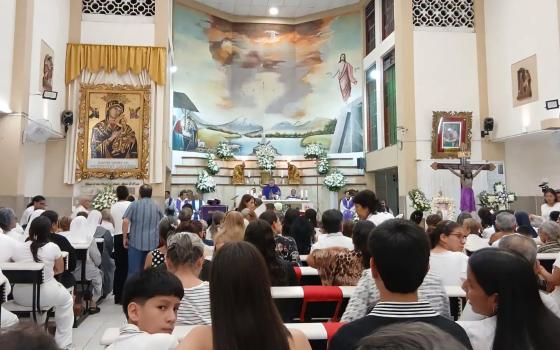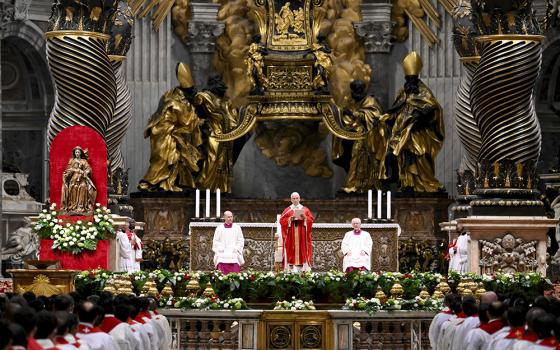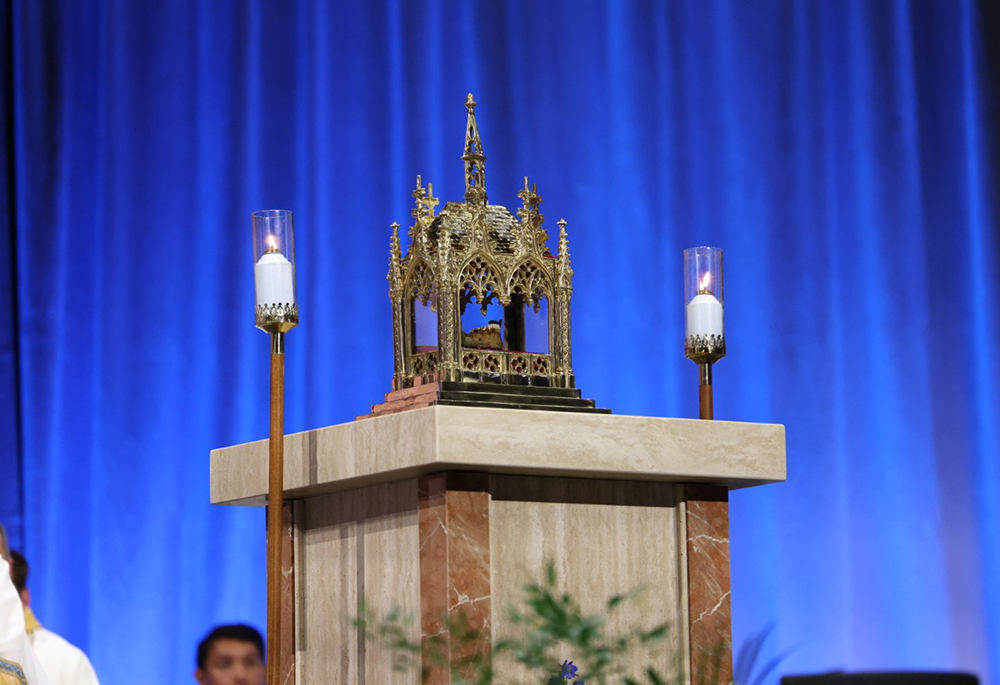
A major relic of Blessed Fulton J. Sheen is displayed at his beatification Mass Sept. 24, 2026, at The Dome at America's Center in St. Louis. (OSV News/Margaret Murray)

by Brian Fraga
Staff Reporter
Join the Conversation
Send your thoughts to Letters to the Editor. Learn more
Morbid.
Powerful.
Creepy.
Those were just some of the comments that acquaintances and friends shared to a picture I recently posted on Facebook of Blessed Fulton J. Sheen's mandible — his lower jawbone — which is now kept in a gilded reliquary.
In case you missed it, the first-class relic of the famous Catholic media evangelist was presented during his beatification Mass on Sept. 24 in St. Louis. Teenager James Fulton Engstrom, the recipient of a 2010 miracle attributed to Sheen's intercession, presented the reliquary.
As images of Sheen's jawbone, complete with dental work completed during his lifetime, have spread on social media, reactions have been strong and swift.
Many Catholics have taken the opportunity to defend the church's ancient tradition of venerating saints' relics, and commented on the symbolism that the jawbone will be venerated given that Sheen was a gifted communicator.
Others have questioned whether it is a ghoulish practice that requires a rethinking.
"I know there are Catholics who love first-class relics and I'm OK with that. But it's not for me. I find this very gruesome," Theresa Maccarone of Rochester, New York, told National Catholic Reporter.
Jose Galindo, from Wisconsin, told NCR that he has never been a fan of the idea of keeping someone's bodily remains as relics.
"Saints, or in this case, a blessed holy man are best remembered for their works and I would rather think of them alive in paradise where they accept our veneration," Galindo said.
Advertisement
By contrast, Mark Shea, a Catholic writer, posted on Facebook that "we moderns" are squeamish about an ancient Catholic practice, rooted in the Incarnation, that recognizes that God's sanctifying grace works through physical matter.
"I love the Catholic communion because it casually but firmly rubs our noses in forms of incarnational spirituality and the insistence of the sacredness of the body that date right back to the Resurrection of Jesus' body and the veneration Christians afforded their dead from the get go," Shea wrote.
Meanwhile, Joanne McPortland, of Glendale, California, said she is "normally fine" with relics, noting that in most cases, there is "a cushion of time" between when the saints lived and today.
"A piece of someone I saw in life, with obvious signs of dentistry, is challenging in ways I didn't expect," McPortland said.
I related most to McPortland's position. I have venerated bone fragments of saints in my own personal spiritual life, but for the most part those were saints who lived hundreds of years ago, in cultural and historical contexts very different from our own.
Seeing an entire mandible of someone who was still alive when I was a toddler was a bit jarring, even more so given that we can still watch reruns of Sheen speaking during his popular television show from the 1950s.
Mathew Schmalz, a religious studies professor at the College of the Holy Cross in Worcester, Massachusetts, told NCR in an email that the different takes on Sheen's relic demonstrates a clash between contemporary American sensibilities and traditional Catholic ways of understanding the body and its relationship to sanctity.
"Death has always been associated with impurity, but the body of the saint transforms our understanding of death by providing a place of contact with the divine," said Schmalz, who added that is "striking" that Sheen — who died at age 84 in 1979 — is someone that Catholics and many others were familiar with in life.
"Because of this it's jarring," Schmalz said, "but it calls us to reflect on the broader trajectory of human life that extends beyond death."