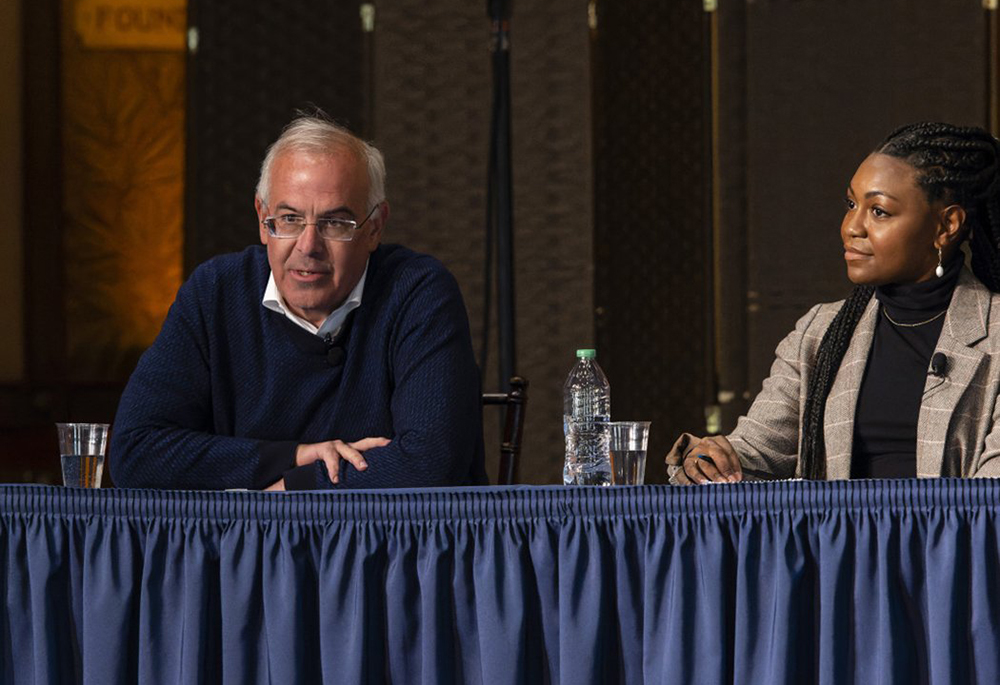
David Brooks, speaks during a March 28, 2022, panel discussion on "'So What Did I Miss?' A Look Back, A Look Around, A Look Ahead After Two Years of COVID." The discussion was sponsored by Georgetown University's Initiative on Catholic Social Thought and Public Life. (CNS/Courtesy of Georgetown University/Art Pittman)

Join the Conversation
Send your thoughts to Letters to the Editor. Learn more
David Brooks is leaving The New York Times. It took me some time to fully appreciate his writing. And this isn't a rhetorical flourish — it's a genuine confession.
For years, I read him — when I read him at all — through a narrowing lens. He struck me as too conservative, too comfortable with inherited assumptions and too quick to interpret American life from within the guardrails of respectability. In those years, I was less inclined to linger with a writer I assumed I already understood. I thought I knew where he would land — and where he would not dare to go.
That judgment, I've learned, was incomplete.
My reassessment didn't arrive all at once. It came in fragments: a column shared by a friend that I found myself nodding along with; a book someone I trusted described as formative; a conversation that lingered longer than expected. By early 2024, I remember forwarding one of Brooks' essays and asking — more honestly than rhetorically — am I changing, or is he, or is the world? The question mattered because it signaled something deeper — a loosening of certainty, an openness to being surprised.
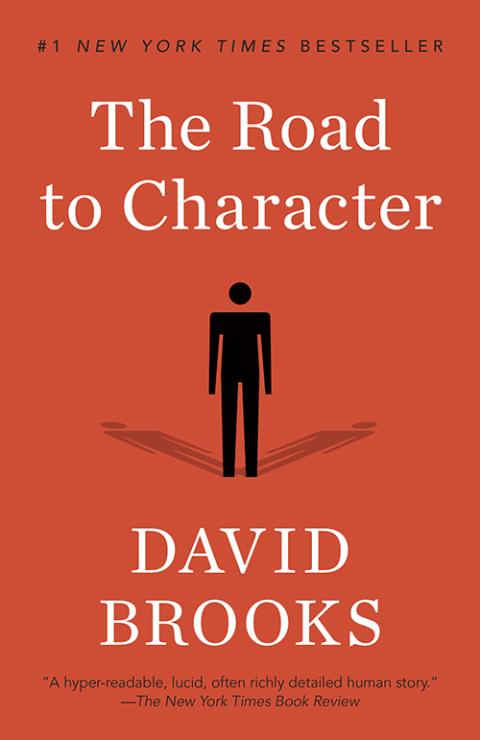
Book cover to The Road to Character (penguinrandomhouse.com)
Books played no small role in that shift. The Road to Character stayed with me. I read it, recommended it, and talked about it with friends and family. I remember asking a friend about a discussion she led on the book after she noted — quite fairly — that it was "not everyone's cup of tea." That observation didn't diminish the book for me — it confirmed something essential about it. Brooks was writing against the grain of a culture trained to prize resume virtues over eulogy virtues, speed over formation and success over meaning. That kind of writing will always meet resistance.
I'd heard similar things years earlier. As far back as 2016, a friend wrote to say how much the book meant to them, describing Brooks — without irony — as a "strong mentor." At the time, I might have raised an eyebrow. Now I understand what he meant. Brooks was not offering instruction so much as accompaniment, an invitation to take the inner life seriously.
The same was true of How to Know a Person: The Art of Seeing Others Deeply and Being Deeply Seen, which I recommended alongside The Road to Character in 2024. In an era defined by loneliness and misrecognition, Brooks has persistently argued that seeing one another clearly — and kindly — is not a soft virtue but a moral discipline. That insight alone sets him apart from the usual ideological categories.
His columns followed a similar arc. My interest in his political analysis goes back further than I sometimes remember. In 2008, during the Clinton-Obama primary season, I told my colleague, Tom Roberts, that I liked a Brooks column — no small admission at the time. Years later, in 2022, I shared one of his pieces with NCR board colleagues, describing it as "enlightening and wise." Those moments mattered precisely because they interrupted my own habits of dismissal.
By 2025, his writing had become more openly introspective. When a friend praised a column in which Brooks wrote about what he called "spiritual warfare" — a phrase that can easily curdle in the wrong hands — I responded simply: Right on. Others were less charitable. One Atlantic piece circulated among friends drew criticism for being "insufficiently groveling." Brooks has never satisfied those who demand ritualized denunciation or total ideological conformity. He shouldn't.
Advertisement
Nor is he beyond critique. I've read thoughtful challenges to his economic and political analysis, including arguments — echoed by voices like Robert Reich — that his framing can underestimate structural injustice or misread power. Those critiques deserve serious engagement. Brooks himself has acknowledged blind spots and course corrections over time. What I respect is that he has remained teachable, willing to revise and sit with complexity rather than retreat into slogans.
There is also a professional dimension to this appreciation. While working on Beacon of Justice, Community, and Hope: How NCR has sustained independent journalism from Vatican II to Pope Francis, a history of the National Catholic Reporter, Brooks' name surfaced on a list of potential "A-list" endorsers — an acknowledgment, even across differences, of his moral seriousness and cultural reach. That felt right to me. NCR has always valued writers who resist easy binaries and insist that faith, ethics and public life belong in the same conversation.
Which is why his departure from The New York Times, after more than two decades, feels genuinely significant. I am sad to see that chapter close. But I am encouraged — deeply so — that he is moving to The Atlantic as a staff writer, with space to write longer, think more deeply and explore the moral and spiritual questions that have increasingly defined his work. This feels less like an exit than a homecoming.
It took me time to see what was there in David Brooks' writing. I had to set aside my own reflexes, my own labels, my own impatience. I'm glad I did. In a public square dominated by outrage, performance and certainty, his insistence on character, humility and moral formation has been a quiet gift. I trust that wherever he writes next, he will continue doing what he has done at his best: examining the human condition with honesty, lifting spirits without sentimentality and reminding us — again and again — that who we become matters at least as much as what we argue.