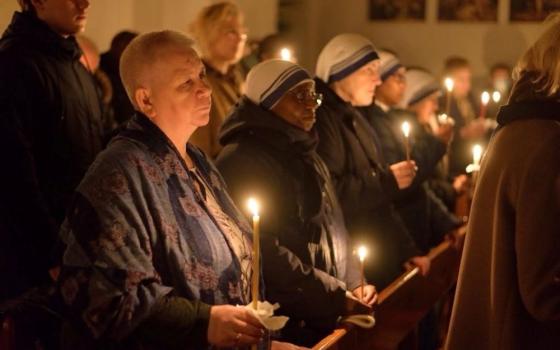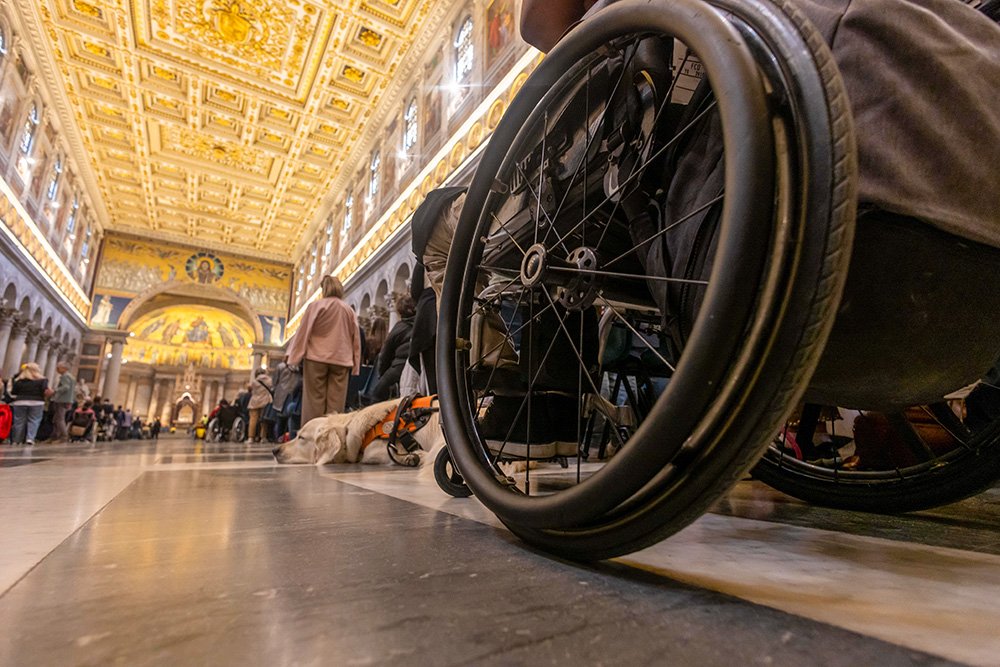
A wheelchair and a guide dog can be seen during Mass as part of the Jubilee of People with Disabilities at St. Paul Outside the Walls in Rome April 28, 2025. (CNS/Pablo Esparza)

by Emma Cieslik
Join the Conversation
Send your thoughts to Letters to the Editor. Learn more
During Disability Pride Month this July, there has never been a more important time to discuss how disabled people's rights are under attack — from access to services in community, to marriage, to vital, life-saving healthcare. Especially with the Department of Justice's latest memo arguing for states' rights to lessen restrictions on institutionalizing people with disabilities, the Trump administration is pushing to infantilize, remedicalize and marginalize disabled people in ways that remove their agency and bodily autonomy.
As Catholics, we have an ethical and spiritual imperative to recognize human dignity and fight for the rights of disabled people. Catholic disability theologians argue today that this is not part of a novel Catholic disability theology but continues a long-standing Catholic tradition of resisting eugenics.
Mary Jo Iozzio, professor of moral theology at Boston College, specializes in disability theology: a branch of liberation theology that explores the intersection of faith, social teaching, and the lived experiences of people with physical, intellectual and psychological disabilities. For Iozzio, disability theology is the "recognition of the imago Dei standing before us, and our job is to learn how to love one another," she told me over Zoom.
Her argument draws directly from Pope John Paul II's "theology of the body," where the pope argued that all of us are created in God's image and are thus images of God bodily as well as spiritually.
Because we are made in the image of God, disabled people have — like all of us — inherent human dignity that must be honored, recognized and protected. "It's God's law," Iozzio explained, and Catholics "need to help other people recognize the full dignity, the full humanity" of disabled people.
"Each one of us is a miracle," Iozzio continued, "and we have to do something with that. We have to not only give thanks to God for the lives that we have," but appreciate what everyone brings to our communities.
Her argument reflects Pope Francis' "magisterum of fragility," where he argued that the lived experiences of disabled people not only enrich all of us but also call us all to reject social expectations of bodily perfection that deny that disabled people are made in God's image.
Advertisement
In fact, as disabled theologian Nancy Eiesland argued in her foundational text The Disabled God — believed to be one that established the field of disability theology — Jesus' resurrected body, covered in scars and nail holes, is inherently disabled.
Eiesland and disability theologians like John Swinton argue that disabled people are a reflection of a resurrected Jesus, and the resurrected Jesus is himself disabled. Therefore, efforts to fix or heal disabled people deny their, and his, humanity — and also play into a harmful savior complex by assuming that able-bodiedness is the ideal. Fixing and curing disability, instead of combating the beliefs that disabled people are somehow lesser or need fixing, connects with the eugenics movement and its early Catholic opposition.
Originating in the United Kingdom and spreading to the United States and Europe in the late 19th and early 20th centuries, the eugenics movement advocates for the public and political purification of the human population by forcibly regulating the reproduction of people with "favorable" or "unfavorable" genes.
The latter included not just people of color but also disabled people. Since eugenicists began calling for the forced sterilization of disabled people, theologians like 20th-century Catholic priest Msgr. Charles Bruehl considered these policies "a drastic curtailment of his [a person's] natural rights."
In many ways, Catholic theologians opposing forced sterilization and denying disabled people's rights to marriage are the ancestors of modern disability theology, as Catholic theologian Sharon Leon details in her 2013 book An Image of God: The Catholic Struggle With Eugenics.
Like these early thinkers, Iozzio has revolutionized the field of disability theology by calling for justice for disabled people. In her thesis, published as Disability Ethics and Preferential Justice: A Catholic Perspective, she outlines how Catholic social teaching implores Catholics to fight for the rights of all people. As she described it, "Preferential justice is a dedication to those for whom justice has been denied."
She stands as a key leader in disability theology alongside disabled Catholic theologian David Gayes. Gayes also cites Eiesland's work, along with that of the Rev. Lamar Hardwick, Rabbi Julia Watts Belser and Amy Kenny as foundational to the field and his own studies. Gayes affirms, like Iozzio, that "there is a spiritual imperative for Catholics to advocate with disabled people, as with all groups pushed to society's margins."
"We must invite disabled people to be part of our individual communities, making space for disabled Catholics to share and lead," he told me. "We can also call our legislators to oppose the potential reversal of the Olmstead decision [by the U.S. Supreme Court in 1999], which enables disabled people to live in their homes and communities rather than institutions."
During this Disability Pride Month, here's hoping that this is not justice denied but rather delayed, that Catholics will understand the importance of fighting for disabled people's rights and affirming their human dignity. According to the Centers for Disease Control and Prevention, more than 61 million adults (one out of every four people in the U.S.) live with a disability. Disability remains the largest marginalized community and one that anyone can become part of at any time of their life, especially as they age.
Here's hoping that one day we as a society will recognize this dignity and will realize justice deconstructs ableism, or discrimination against millions of Americans.
As the current administration reinvigorates the very eugenics movement that Bruehl and other Catholic theologians fought in the early 20th century, we as Catholics stand not only on the shoulders of theological giants who have long opposed restricting disabled people's rights, but on the shoulders of modern disability theologians like Iozzio who light the way for restorative, preferential justice.