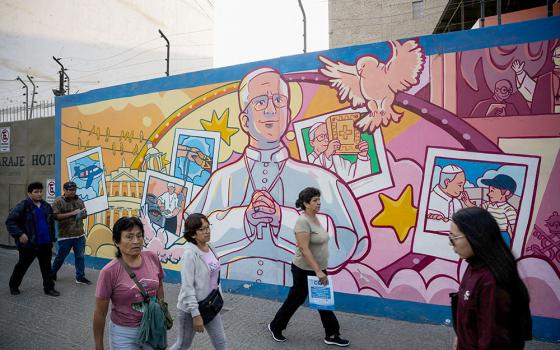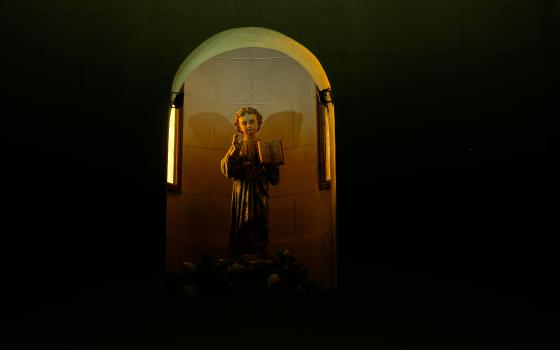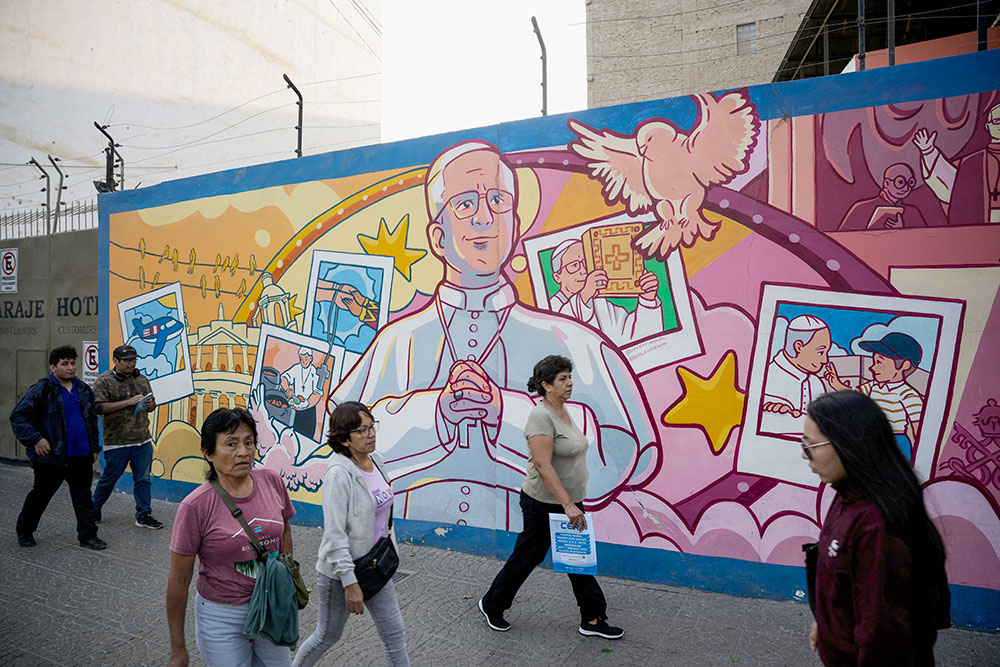
People walk past a mural dedicated to Pope Leo XIV in Chiclayo, Peru, Sept. 2, 2026, ahead of his scheduled November visit to Peru. (OSV News/Reuters/Angela Ponce)

Join the Conversation
Send your thoughts to Letters to the Editor. Learn more
After weeks in which Pope Leo XIV's Latin America trip hung in the balance of his doctors' recommendations, the Vatican confirmed Oct. 26 that his visit to Uruguay, Argentina and Peru "will proceed according to the programme previously published."
Less than a month after undergoing surgery that removed a malignant tumor from his right lung, the pope will embark on a 11-day journey involving a dozen flights and a whirlwind agenda across three countries.
"I am looking forward to returning to the continent where I've experienced so many moments of my life," the pope said in a Vatican statement released ahead of the trip. "May this journey be an occasion for us to open our hearts to one another, strengthen our communion as brothers and sisters, and renew our commitment to proclaiming the Gospel with joy."
Though American by birth, Latin America is where the future pope spent more than two decades as a missionary priest and bishop, acquired Peruvian citizenship and developed much of the pastoral outlook he has since carried into the papacy.
His homecoming in Peru and to the city of Chiclayo in particular, has been highly anticipated since he name-dropped his former diocese from the balcony of St. Peter's Square in his first address as pope.
After an early-morning takeoff from Rome, Leo will land in Uruguay on the afternoon of Nov. 6 and spend fewer than 48 hours in one of Latin America's most secularized countries. Roughly one-third of Uruguayans identify as Catholic, and the country's church operates on a considerably smaller scale than in many of its neighbors.
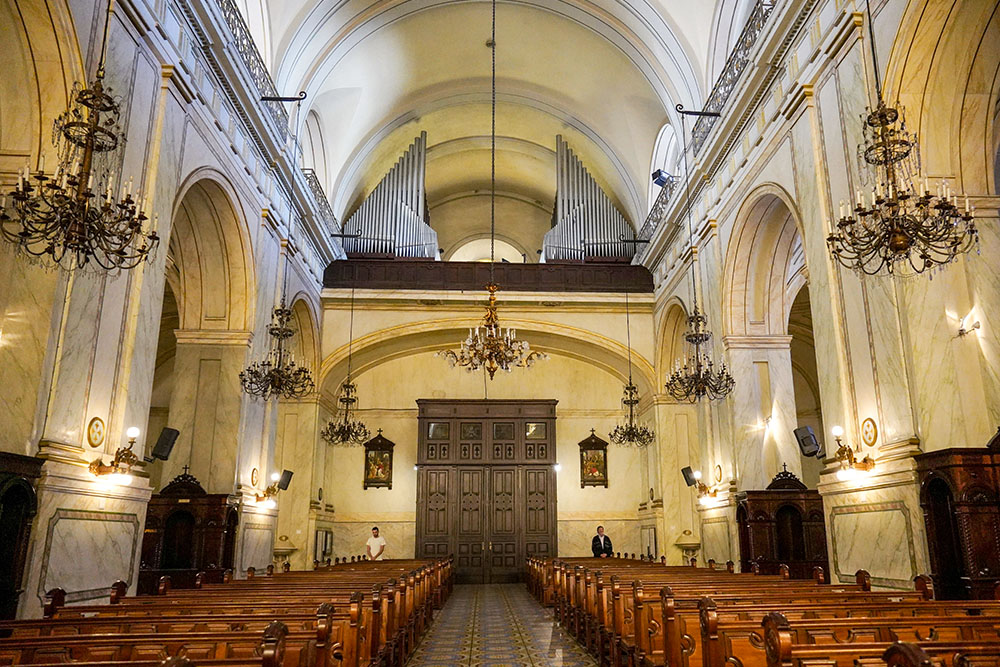
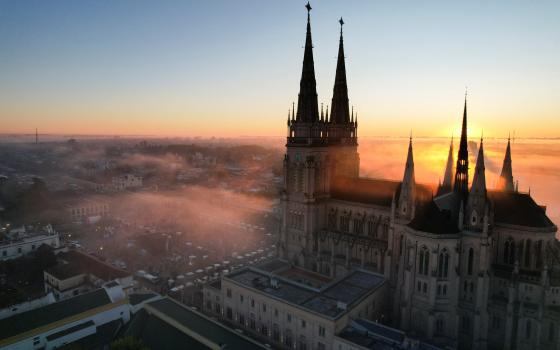
A file photo shows the interior of the Cathedral of Montevideo in Uruguay. (OSV News/Reuters/Mariana Greif)
The pope will celebrate Mass, meet with a local community engaged in social outreach and visit the Catholic University of Uruguay.
"Our church is poor and small, but free and beautiful," Cardinal Daniel Sturla of Montevideo said at a recent conference hosted by Aid to the Church in Need International ahead of the visit. "Being a priest here is a service offered with modesty. There is no prestige attached, which leaves the priest free to lead a normal life and be devoted to his tasks."
The opening leg of the pope's trip may therefore be relatively subdued compared with what follows, though in secularized France Leo showed that he can still draw large crowds and intense fervor even in a country that seems to have shaken off its Catholic roots.
From Uruguay, the pope will travel to Buenos Aires, a city that gave the Catholic Church a pope in 2013 but has not received one since St. John Paul II visited Argentina in 1987.
Pope Francis, a native porteño from the Argentine capital, never returned to his home country during his 12-year pontificate. Though he repeatedly expressed a desire to visit, Francis also seemed wary of being drawn into Argentina's fiercely polarized politics, where both supporters and opponents repeatedly sought to claim him as their own.
Many Argentine Catholics nevertheless longed for a homecoming that never came. Ahead of Leo's visit, Archbishop Jorge García Cuerva of Buenos Aires warned against treating the new pope as a stand-in for the old one.
"The successor of Peter is coming, not the successor of Francis," he told Argentine daily Clarín.
But Leo may want to imitate his predecessor when it comes to meeting with Argentine President Javier Milei. Francis ultimately developed unexpectedly warm relations with the right-wing populist despite his repeated attacks on the pope during his presidential campaign.
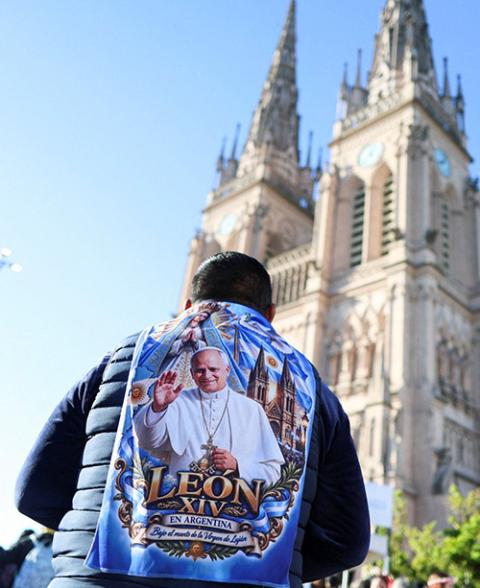
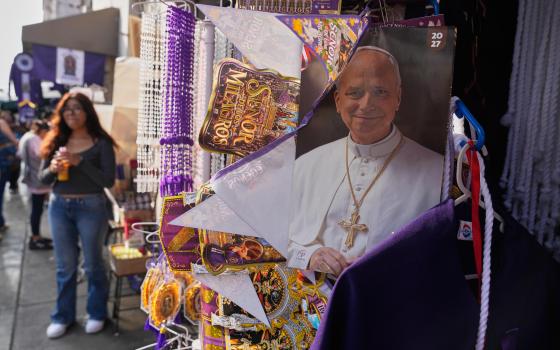
A pilgrim wearing an image of Pope Leo XIV is seen outside the Basilica of Lujan in Argentina on the outskirts of Buenos Aires, Oct. 4 2026. (OSV News/Reuters/Antonio Becerra Pegoraro)
Milei, who has cozied up to U.S. President Donald Trump, has since become a target of criticism from Argentina's bishops over austerity measures that have slashed social spending.
The two leaders also diverge sharply over another issue Leo has made central to his pontificate: artificial intelligence.
While Leo has called for greater regulation of emerging technologies to safeguard human dignity, Milei has sought to attract AI investment by pledging that Argentina will not preemptively regulate the technology in ways that could hinder innovation. Peter Thiel, the PayPal and Palantir co-founder who has publicly criticized the pope's approach to AI, bought a mansion in Argentina earlier this year.
The enthusiasm of Argentine Catholics who have waited 39 years for a papal visit, set against the clear differences between Leo's and Milei's political visions, could make the pope's three days there among the most closely watched of the trip.
Leo is expected to draw the crowds, but what he chooses to tell them remains to be seen.
Yet the emotional and ecclesial centerpiece of the journey comes with Leo's homecoming to Peru. The pope has made no secret of his affinity for the Peru leg of his trip, dedicating six of his 11 days of travel to the Andean nation.
On Nov. 11, Leo will arrive in Peru, where the U.S.-born pope spent more than two decades as a missionary priest and bishop and where he remains, to many Peruvians, one of their own.
Though the Peru that Leo will encounter as pope is markedly different from the country Robert Prevost first knew, some of its political tensions will feel familiar.
As a formation director in Trujillo during the 1990s, Prevost marched in support of human rights and gathered signatures backing the United Nations' Universal Declaration of Human Rights.
The president at the time was Alberto Fujimori, whose increasingly authoritarian rule gave rise to the political movement known as Fujimorismo.
Now, when Leo returns to his adopted country as pope, Alberto Fujimori's daughter, Keiko Fujimori, will receive him as president.
Though not a carbon copy of her father, Fujimori campaigned on restoring order after a decade of extraordinary political instability that produced eight presidents and 21 prime ministers.
But only months after her inauguration in July, Fujimori's approval rating has already fallen sharply, dropping from more than 40% to 28.3% in October amid concerns over the economy and public security, according to a Bloomberg poll.
A successful papal visit, however, could offer her government a rare moment of national unity.
"The figure of the pope is very important in Peru's religious life, and his mere presence alongside a government would almost certainly foster a climate of peace, which is exactly what [Fujimori] needs right now," said Kurth Mendoza Gutiérrez, a professor of communications at the University of San Martín de Porres in Lima and former head of communications for the Peruvian bishops' conference.
Advertisement
In Lima, Leo will participate in a "Meeting on the Challenges and Hopes for the Future of the Peruvian People" in the capital's central square outside the cathedral, giving him a prominent platform to address the country's political and social crises to an audience that extends beyond government officials.
Leo also returns to a Peruvian church whose internal divisions he knows intimately.
As bishop of Chiclayo, Prevost was generally associated with the more progressive wing of a sharply divided hierarchy, while earning respect across ideological lines as an effective administrator. His emphasis on the poor, migrants and communities on the margins placed his ministry within a Peruvian church deeply marked by liberation theology, the theological current born in Peru that sought to place the experience of the poor at the center of Christian reflection. Liberation theology was, for decades, the subject of intense debate within the global church, with crackdowns from Rome on priests and theologians.
The challenge for Leo will then be how he can capitalize as pope to sell his pastoral message to a divided episcopate.
"In Peru, as in all of Latin America, there is a sector of the church that is very critical of the Catholic Church of Francis. ... This pope [Leo] has a lot of that [vision] as well, the option for the poor, concern over the power of large private companies," said Eduardo Dargent, a political scientist at the Pontifical Catholic University of Peru. "The Peruvian pope is the one in charge right now, he's very beloved and respected, and what you'll probably see is this sense of harmony and gratitude, even though there may still be some lingering resentment and probably criticism as well."
Prevost also gained some enemies in Peru due to his role in suppressing the Catholic movement Sodalitium Christianae Vitae, which was immensely powerful in church circles but was found to have perpetuated widespread spiritual, and in some cases sexual, abuse among its members. Leo will meet with victims of abuse during his trip to Latin America, just as he did when visiting Spain and France, the Vatican said, though where the meetings will be held and how many will take place was not announced.
In Peru, Leo's trip will also be deeply personal. In Chiclayo, the diocese he led from 2014 to 2023, his schedule includes dinner with its priests and encounters with clergy, seminarians, pastoral councils and the local Catholic university. He will also visit a shrine dedicated to St. Turibius of Mogrovejo to close a jubilee year honoring the Spanish missionary bishop who became one of Peru's most important saints.
As pope, Leo wrote about his devotion to St. Turibius in a September letter to Latin American bishops, praising the saint's willingness to travel through his vast diocese to encounter and understand its people. "Certain aspects of a diocese are hard to grasp from behind a desk," he wrote.
Just like the Spanish saint, Leo will also do his fair share of travel throughout Peru.
After traveling to Lima and Chiclayo, he will head to Cusco in the Andes before flying east to Pucallpa, on the edge of the Amazon rainforest, for a meeting with missionaries and representatives of Amazonian peoples.
Leo's predecessor made the Amazon a central concern of his pontificate, convening a Vatican synod on the region in 2019 and repeatedly linking the defense of Indigenous peoples with the protection of the environment.
The entire trip, however, will also be a highly visible test of Leo himself. His doctors recently recommended that he cancel a day trip to Assisi, Italy, by helicopter to give his body more time to recover from surgery. In Latin America, there will be little room for rest between a dozen flights, days of public events spanning more than 12 hours and, in Cusco, an ascent to more than 11,000 feet above sea level.
For the 71-year-old pope who has proven indefatigable on his international trips, a return to the continent that defined his priestly ministry could hardly offer a more emphatic return to the papal office.
The National Catholic Reporter's Rome Bureau is made possible in part by the generosity of Joan and Bob McGrath.