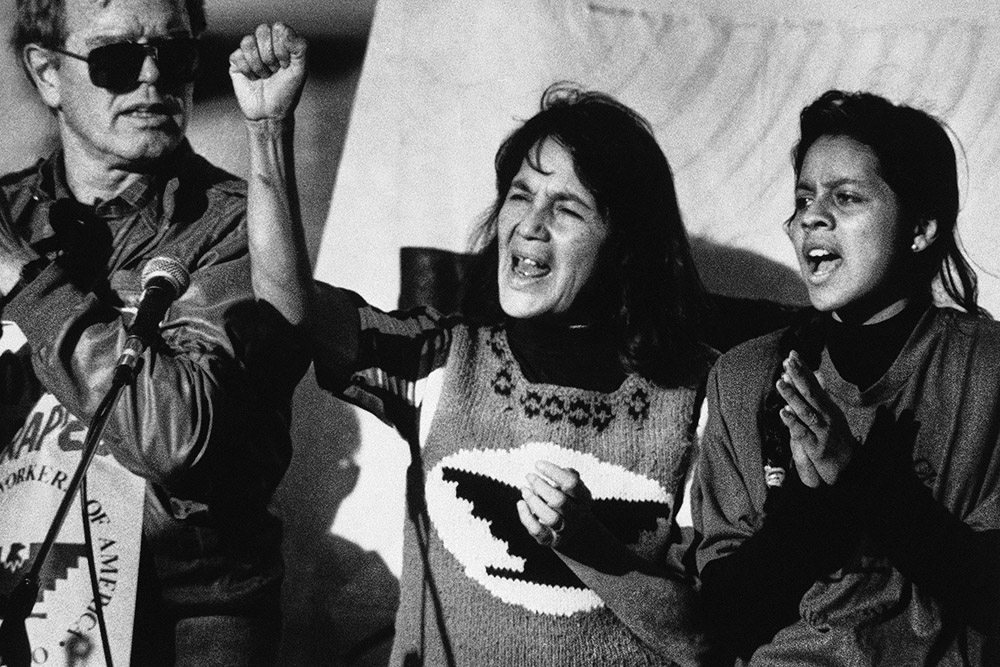
United Farm Workers leader Dolores Huerta, center, leads a rally in San Francisco's Mission District on Nov. 19, 1988, along with Howard Wallace, left, president of the San Francisco chapter of the UFW, and Maria Elena Chavez, right, the daughter of César Chavez. (AP/Court Mast, File)

by Kat Armas
Join the Conversation
Send your thoughts to Letters to the Editor. Learn more
The recent reporting by The New York Times on sexual abuse allegations against César Chavez has shaken long-standing narratives about one of the most respected figures in the farmworkers' movement. For many, the revelations are not only devastating, but also disorienting — prompting a deeper reckoning about moral authority, about power, and about the stories we accept as truth.
They also force us to confront the often-hidden labor and sacrifices made by women within these movements: the organizers, caregivers and community builders whose contributions have historically been minimized, and whose emotional and social burdens have been absorbed into the background. Figures like Dolores Huerta, whose tireless work helped build the United Farm Workers and sustain its fight for justice, remind us that the movement's victories are shaped by collective stories, just as much by those remembered as by those forgotten.
In Greek, apokalypsis means an uncovering. What we are witnessing now is precisely that: an unveiling of what has always been present but carefully obscured. The abuse of power, the silencing of women, the ways institutions and movements protect their own at the expense of the vulnerable — these are not new realities. In this case, only newly revealed ones.
As Jesus said, what is hidden will be made known. This moment feels like that kind of revelation. It is an invitation to tell the truth, and to resist the temptation to protect legacies at the expense of people.
To revisit Chavez's legacy, then, is not only to reassess a man, but to recognize how narratives themselves are formed; how power, proximity and even empire — the systems of power and domination that structure social and political life — shape which voices are amplified, and which are silenced. Women's stories are not simply side notes; they are essential to understanding the full human cost of social justice work, and the deeper truths that often remain just outside the official record.
There is a story I return to often. When Chavez was just a young boy living on his family's small farm in the North Gila Valley near Yuma, Arizona, a priest tried to deny him his first Communion. The Chavez family lived far from the city, making it difficult to attend formal classes, and without institutional instruction, the priest insisted, Chavez couldn't participate in the sacrament.
But his mother, Juana, refused to accept this. She told the priest to ask César and his sister Rita any question about their faith — she was confident their grandmother, affectionately called Mama Tella, had already taught them what mattered most.
To the priest's surprise, they answered every question. What they demonstrated was not simply memorization but formation — a faith shaped long before any institutional validation, nurtured through stories, rituals and the gentle authority of a grandmother whose knowledge carried no official recognition. Ultimately, the priest had no basis to deny them. They received Communion the following day.
I first encountered Mama Tella while studying nonviolent resistance movements in seminary in Southern California. Something in her story felt familiar before I could explain why, less like learning and more like remembering. That moment became a turning point — the start of what I later called an abuelita theology, a framework that would shape my first book, Abuelita Faith. At its core is a question that refuses to let me go: What if the greatest theologians the world has ever known are those the world wouldn't consider theologians at all?
Women's stories are not simply side notes; they are essential to understanding the full human cost of social justice work, and the deeper truths that often remain just outside the official record.
What if the stories that carry the deepest truth are the very ones empire has trained us not to see?
Abuelita theology begins with the conviction that God is revealed not only in formal doctrine but also in the lived experiences of women whose wisdom is rarely written down. It pays attention to the kitchens, the living rooms, the stories told over simmering pots — insisting that theology is not only something we study, but something we inherit. It draws our attention to the voices of women — especially Latinas — whose lives have always carried both the weight of survival and the imagination of something more.
To speak of an abuelita theology, then, is to recognize that while empire and patriarchy have long dismissed these voices as secondary or insignificant, they have never been silent. They have been telling a different story all along — one that refuses erasure, one that remembers what power forgets, and one that, if we are willing to listen, begins to reshape how we understand faith, history and truth itself.
It is within that persistence that a hidden history of labor, care and courage comes into view — one the recent revelations from The New York Times about Chavez now force us to confront. These accounts are not simply an interruption of the narrative; they reveal the parts of it we were never taught to see.
Advertisement
They expose how empire operates not as an abstraction, but as a force that shapes whose voices are believed, whose suffering is sanctified, and whose legacy endures — often elevating men as moral authorities while obscuring the women whose labor sustains. Patriarchy then baptizes that distortion, teaching women to absorb harm as if it were holy, to carry the moral weight of others' failures while remaining unseen.
Huerta did not arrive at organizing by chance. Her story begins with her mother, Alicia Fernández, a working-class woman who, after years of grueling labor, opened a small hotel and restaurant that regularly offered free lodging to migrant workers and their families. This was Huerta's formation. Long before she stood beside Chavez, she founded the Stockton chapter of the Community Service Organization, registering Latino voters, leading citizenship classes and advocating for dignity in her community.
And yet, as we now reckon more honestly with that history, we must also hold the harder truth that proximity to movement leadership did not shield women from harm. Huerta herself has spoken about the personal costs she bore — realities that complicate any singular, heroic narrative and call us to listen more carefully to the stories that were never centered.
Across the country, Black women were doing the same work of sustaining movements that would later be attributed to singular names. During the Montgomery bus boycott, it was the organizing labor of women like Jo Ann Robinson and the Women's Political Council that made collective resistance possible. Even Rosa Parks' refusal did not emerge in isolation but from a network of women who had already been preparing the ground. These stories, strategies and courage circulated long before the moment history chose to record.
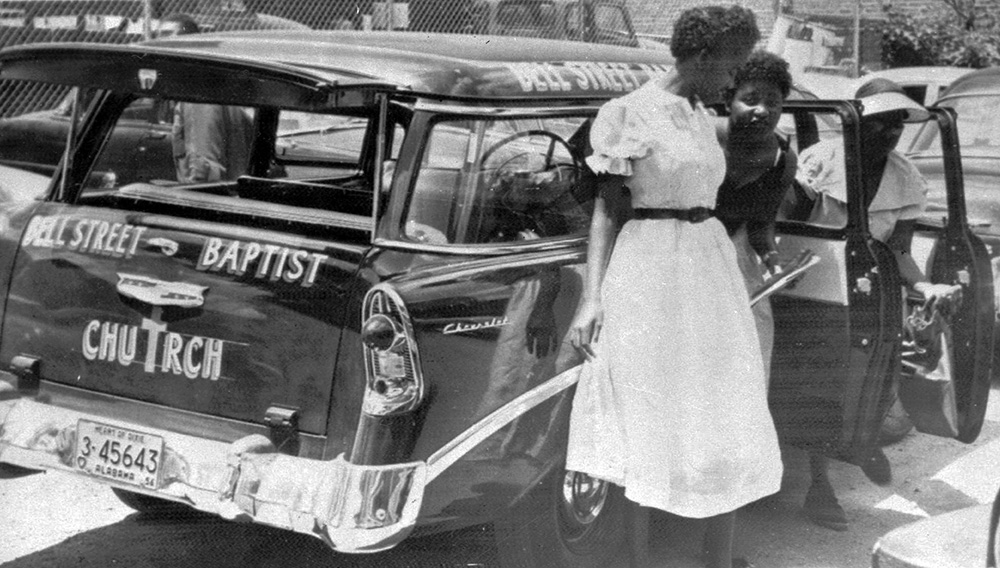
Women alight from a church-operated station wagon May 31, 1956, in Montgomery, Ala. The vehicle was used to provide transportation for African Americans boycotting segregated city buses. (AP)
In Cuba, where my own story begins, women also carried movements from within the intimate spaces of home and the Catholic Church. Under the dictatorship of Fulgencio Batista in the 1950s, women organized through phone chains, neighborhood networks, and acts of everyday resistance that rarely made headlines but proved essential in undermining the regime. They turned domestic spaces into sites of political imagination, sustaining resistance in ways that empire could neither fully see nor easily control — shaping a counter-story beneath the surface of official power.
I carry their memory in my body. As a Cuban American who later moved to Los Angeles, I felt an instinctual connection to the farmworkers movement. It was not only in the language or the shared histories of displacement, but in the recognition of women like my own family, whose labor, faith and defiance made survival possible.
The fields of California and the streets of Little Havana are not the same, but the spirit that animates resistance often is. It is the same breath, the same insistence on dignity, the same refusal to disappear. And perhaps most importantly, the same inheritance of story carried across generations, waiting to be told more fully.
In her first interview after the article was released, Huerta sat with Maria Hinojosa for Latino USA. She said that the abuse she endured was "worth it" — for the movement, for the millions of people who benefited from it. "It was my cross to bear," she said. And this is exactly what patriarchy does: It teaches women that they must suffer in silence for the so-called collective good. How often have we seen this — the cross used to sanctify abuse or demand the silence of the vulnerable?
I am not critiquing Huerta here. In fact, her sentiment feels familiar; I was raised by abuelitas who held the same beliefs. What I am critiquing is a theology that has been too often weaponized against women. A theology that convinces women it is their job — or even their calling — to carry the weight of men's sins, even when those sins are directed at them.
This is the same theology that highlights Mary's self-sacrifice instead of her bold, revelatory song of resistance. Christ's cross, by contrast, was not an endorsement of suffering for suffering's sake. It was a confrontation with empire, an exposure of its violence, and an invitation to stand in solidarity with those crushed under it.
If we take that invitation seriously, then, it demands that we transform the histories we preserve. So perhaps the way forward is not to search for better heroes, but to tell better stories. Stories that refuse the myths of empire and the distortions of patriarchy. Stories that center the women who have always carried the movement, not as footnotes, but as protagonists. Stories that sound, at last, like the Gospel we claim to believe.