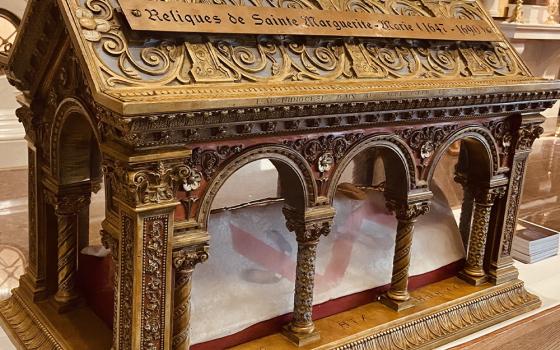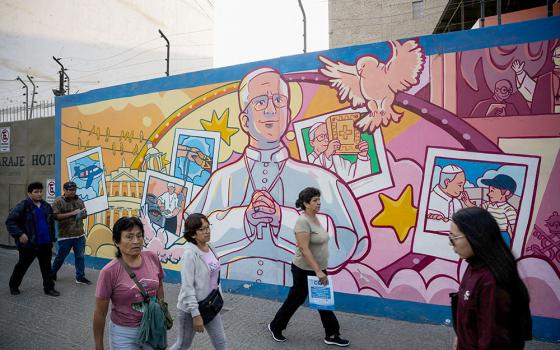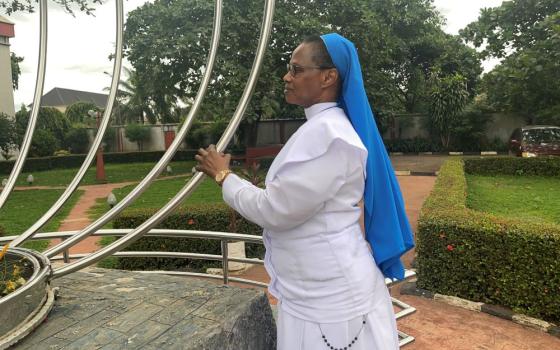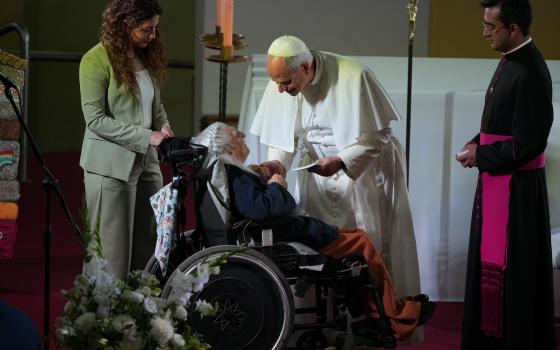
A World Mission Rosary, seen in a file photo, is identified by the color-coded decades that represent the five mission territories of Africa, Oceania, Europe, the Americas and Asia. The rosary was designed by Fulton J. Sheen, who served as national director of the Pontifical Mission Societies. (OSV News/Margaret Murray)

by Clarence Devadass
Join the Conversation
Send your thoughts to Letters to the Editor. Learn more
The parting words of Jesus to his disciples were clear: "Go and make disciples of all nations" (Matthew 28:19). These words are not simply a final instruction given before the Ascension. They reveal something fundamental about the very nature of the church. The church exists for mission. She is, by her very nature, missionary.
For centuries, the church has taken this missionary mandate seriously. Missionaries have left their homes, crossed oceans, entered unfamiliar cultures and travelled to the remotest parts of the world to proclaim the Gospel. They established communities, schools, hospitals and institutions, but above all, they sought to make Jesus Christ known and loved. The church exists ad gentes, sent to the nations.
For many of us, this mission is not simply a matter of history; it is deeply personal. If those missionaries had not come, if they had not crossed oceans and borders, I might never have come to know Jesus Christ.
Pope Francis often reminded the church that we are called to be "missionary disciples." We are not disciples who simply receive the faith for ourselves. To encounter Christ is also to be sent. Yet being sent on mission does not look exactly the same everywhere. Mission is lived out in particular places, among particular peoples and within particular histories.
From continent to continent, from era to era and from context to context, the way the church carries out her mission may look very different. What remains unchanged is its fundamental essence: to proclaim Jesus Christ and to bear witness to the Gospel.
The proclamation of the Gospel, however, can take different forms. There are moments when proclamation can be direct and explicit. There are other situations where proclamation may be more indirect, expressed through witness, service, dialogue, solidarity and the patient building of relationships. The Gospel is proclaimed not only by what we say, but also by how we live.
This is where we sometimes encounter difficulties. We can fall into the temptation of defining mission and proclamation according to only one particular context and then assuming that what works there must necessarily be the model for the whole church. But the church is universal.
We profess the church is "one, holy, catholic and apostolic." Her catholicity means universality. Yet her universality does not mean uniformity. In fact, the universality of the church is reflected precisely in the rich diversity of cultures, peoples, histories and circumstances in which the one Gospel is lived and proclaimed.
I live in a context where Christians are a minority. This is the reality of many parts of Asia. Here, proclamation cannot simply be separated from dialogue and peaceful coexistence. The Christian community lives alongside people of different religions, cultures and worldviews. We share neighborhoods, schools, workplaces, markets and even family relationships.
Dialogue, therefore, is not something that has suddenly become fashionable. It is not a novelty introduced by recent theological developments. In many parts of Asia, dialogue and peaceful coexistence are not merely options. They are part of everyday life, and sometimes modes of survival. One cannot simply proclaim the Gospel without also learning how to listen and aspire for peaceful coexistence.
For the church in Asia, mission and proclamation necessarily involves dialogue with cultures, dialogue with religions and dialogue with the poor and marginalized. It involves listening before speaking, understanding before judging and building relationships before expecting others to understand our faith.
This does not mean that the church abandons proclamation. Dialogue is not a substitute for evangelization. Nor does dialogue mean that Christians cease to believe in the uniqueness of Jesus Christ. Rather, dialogue can itself become a way of bearing witness to Christ. The manner in which Christians listen, respect, serve, live and accompany others are part of the proclamation of the Gospel.
Advertisement
The question, therefore, is not whether the Christians must explicitly proclaim Christ. The question is how we can proclaim and live in peaceful harmony with one another within a particular context.
A missionary approach that is appropriate in one part of the world may not be appropriate in another. The church in a society where Christians form an overwhelming majority in the past or present will naturally experience mission differently from a church that lives as a small minority among people of other religions. A church shaped by centuries of Christian culture will approach mission differently from a church that has only recently encountered Christianity.
This is why we must resist the temptation to reduce mission and proclamation to a single model. The danger arises when one particular experience of proclamation becomes the standard against which all other experiences are judged.
The church does not exist in an abstract world. She exists in real places, among real people, with real histories and concrete circumstances. The church proclaims Christ not only through words, but through her presence in the world and through her service to humanity.
Perhaps, then, one of the great challenges facing the universal church today is learning to recognize that there can be different ways of being missionary and at the same time, remaining faithful to the same Gospel.
The church must proclaim Jesus Christ. But she must also discern how that proclamation can be received, understood and lived within each particular context. The missionary church must therefore be both faithful and attentive: faithful to Christ and attentive to the people and circumstances to whom she is sent.
Asia has much to contribute to this conversation. As Christians who have lived for generations alongside people of different religions and cultures, dialogue is not a theological luxury. It is part of the ordinary experience of being Christian. It teaches us patience, humility, listening and the importance of "being bridges" and "building bridges" of human fraternity.
The temptation to universalize one particular pastoral experience must be resisted. We cannot assume that because something worked in one cultural or ecclesial context, it must automatically become the template for another. Context matters. History matters. Culture matters. People matter. The lived experience of Christians matters.
We are one church, but we are a church that lives in many contexts. We are one in faith, one in Christ and one in our missionary calling, but the expression of that mission and proclamation will necessarily take different forms.
The missionary church is not a church with one accent, one cultural expression or one pastoral formula. She is a church capable of proclaiming the same Christ in many modalities, languages, cultures and circumstances.
The question, therefore, is not whether the church should be missionary. She must be. The question is whether we are humble enough to recognize that mission and proclamation can take different forms while remaining faithful to Christ. We need the wisdom to know when to speak boldly, when to remain silent, and when to whisper softly. For the Gospel is not proclaimed only by the volume of our voice, but also by the quality of our witness: "Go and make disciples of all nations."