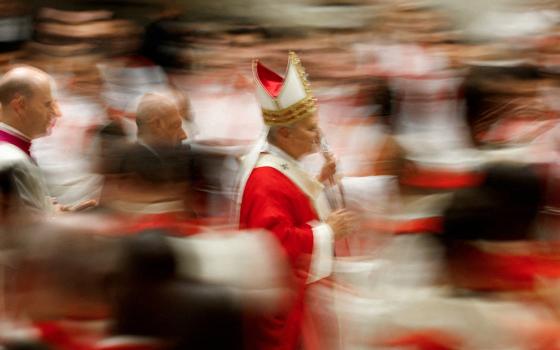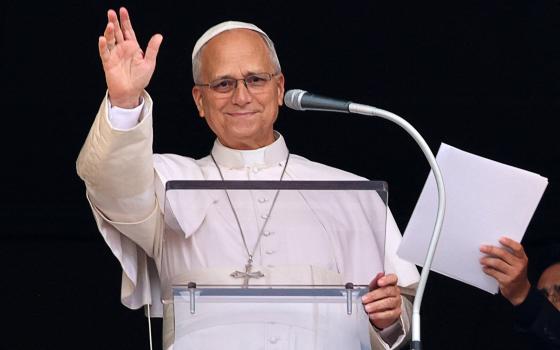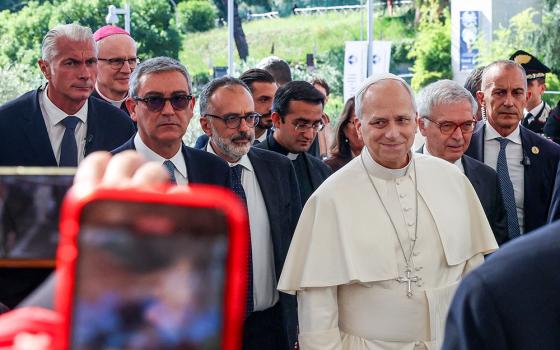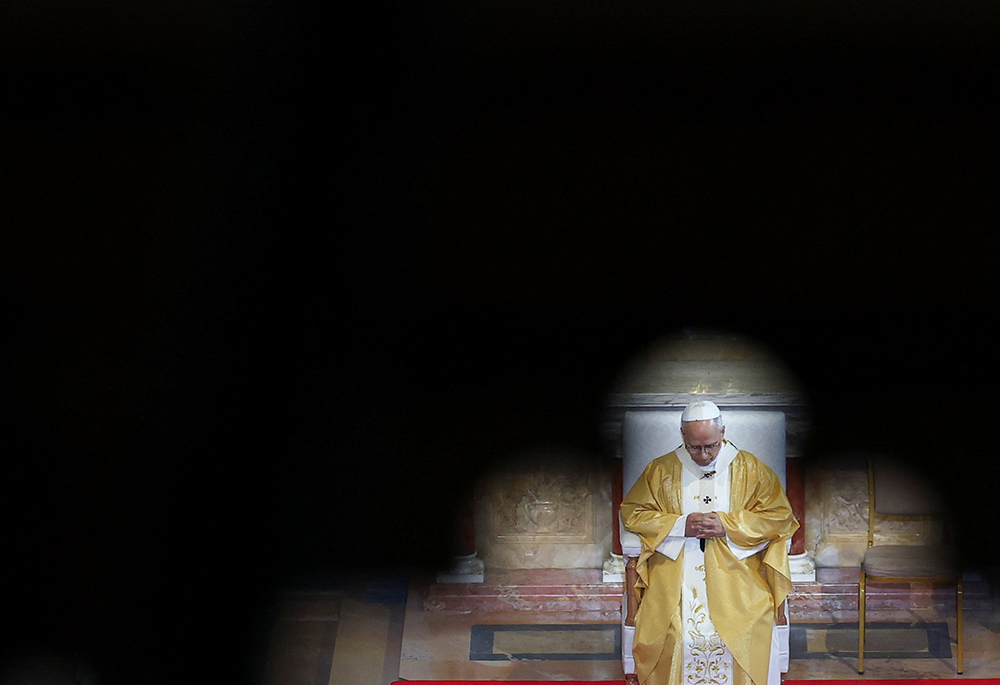
Pope Leo XIV celebrates Mass at the Basilica of St. Augustine in Annaba, Algeria, April 14, 2026. (OSV News/Reuters/Guglielmo Mangiapane)

by Kathleen Sprows Cummings
Join the Conversation
Send your thoughts to Letters to the Editor. Learn more
President Donald Trump's attempt to strong-arm Pope Leo XIV via a Truth Social diatribe echoes a pattern seen across global history. Emperors, monarchs and despots have long threatened popes — and often failed — to bend them to their will. In an American context, however, Trump's invective does represent a historic reversal. For most of this country's history, Americans viewed the pope as a war-mongering, money-grubbing, anti-democratic menace who harbored imperial designs on the White House. Today, that menace is in the White House, and the pope is the one defending American ideals of liberty and human dignity. It's especially ironic that the current pontiff is a U.S. citizen — and that his namesake, Pope Leo XIII (who was pontiff from 1878-1903), was the reigning pope during a particularly high point of anti-papal and anti-Catholic sentiment in America.
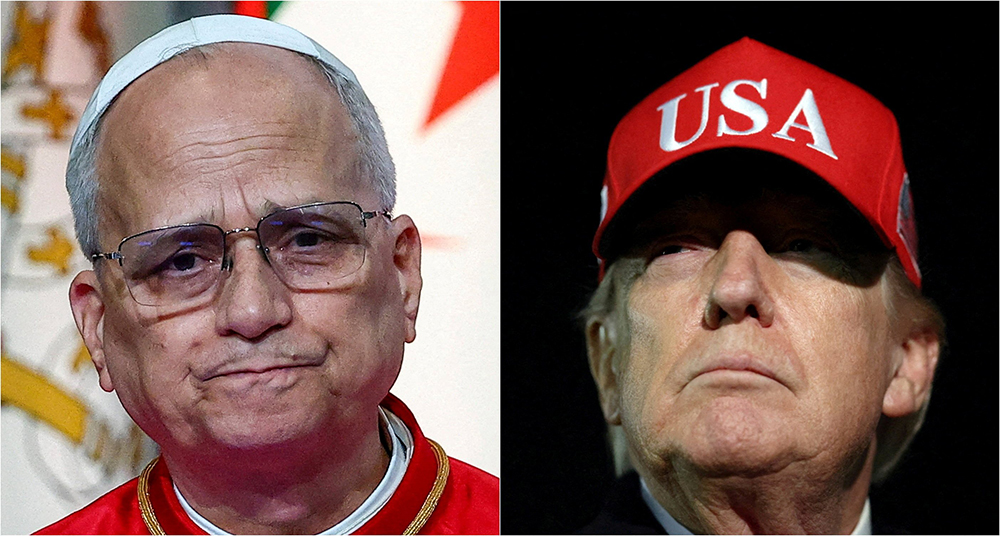
A combination picture shows Pope Leo XIV addressing Algeria's political leaders at the cultural center of the Great Mosque of Algiers in April 13, 2026, where he criticized violations of international law by "neocolonial" world powers, in the Mohammadia of Algiers, Algeria, April 13, 2026, and U.S. President Donald Trump after disembarking Air Force One at Joint Base Andrews in Maryland, April 12, 2026. (OSV News/Guglielmo Mangiapane/Reuters/Kevin Lamarque)
If you had entered "American pope" into a Google Image search before May 8, 2025, one of the top hits would have been a cartoon under that title that appeared in 1894. Published in Puck Magazine, a widely circulated satirical magazine of the late 19th century, it featured a rendering of Archbishop Francesco Satolli, who had been designated the first official Vatican representative to the United States a year before. Satolli's appointment heartened U.S. Catholics, who yearned for a closer connection between their country and their church. But it horrified many U.S. Protestants, who believed any such alliance would undermine Americans' commitment to democracy and religious freedom. The Puck cartoon illustrated those fears. Perched on top of a giant dome that resembled St. Peter's Basilica in Rome but was branded "American headquarters," Satolli cast a dark shadow over a crudely drawn U.S. map.
Instead of matching Satolli's own countenance, the shadow evoked that of Leo XIII. Readers of Puck would have instantly recognized the caricature of Leo, who had often been depicted in its pages pursuing his two favorite endeavors: stealing money and stealing U.S. elections. "At it Again," declared a November 1885 cartoon that pictured Leo inside a ballot box, stretching out his arms to tear down the establishment clause of the U.S. Constitution, which prohibits the establishment of a national religion.
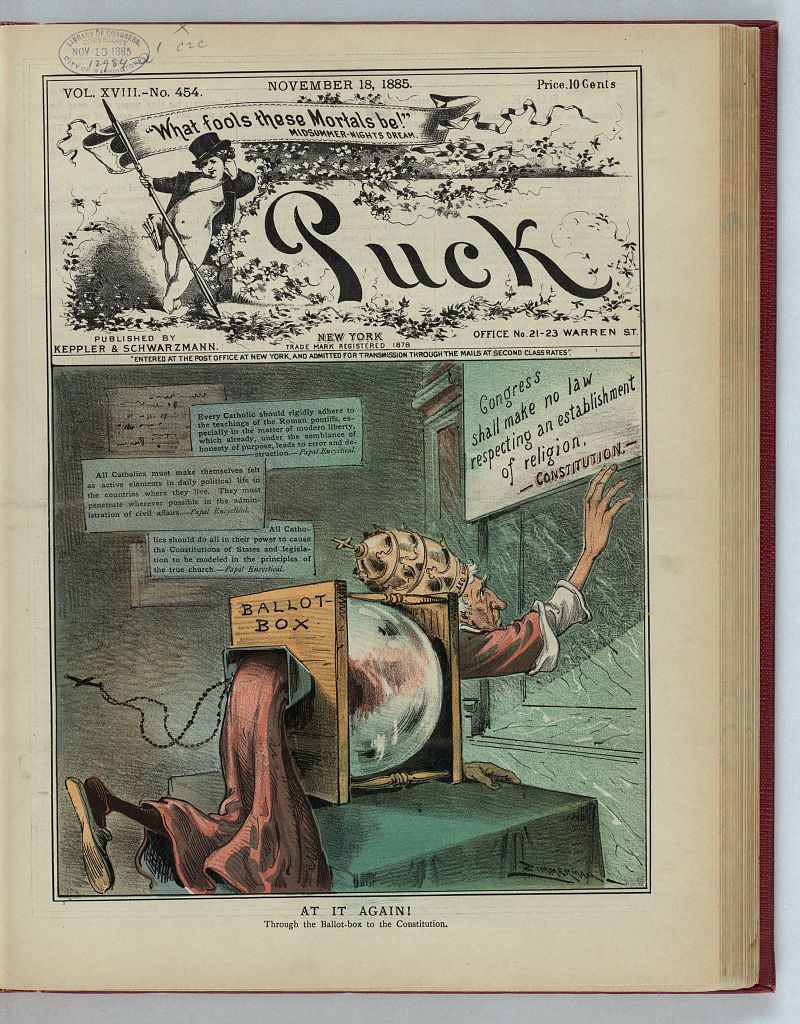
"At it again!" cover illustration by Eugene Zimmerman (1862-1935) from Puck, Vol. 18, No. 454, Nov. 18, 1885, published by Keppler & Schwarzmann (Library of Congress)
From the early days of the republic, the majority Protestant population had fretted that Catholics' allegiance to the pope — a temporal prince as well as spiritual leader — would compromise their loyalty to the United States. As the Catholic population increased, in large part through immigration, so, too, did anxieties about Catholic and papal power. Anti-Catholic and anti-papal sentiment intensified during periods of national turmoil.
Puck's "American Pope" cartoon, for example, appeared in the middle of one of the worst economic depressions in the country's history. Conspiracy theorists seized the moment, alleging that Pope Leo himself had orchestrated a run on U.S. banks, seeking to destabilize the country in preparation for a papal takeover. They insisted that Satolli, Leo's new apostolic delegate, was simply part of his advance guard.
Advertisement
Concerns about papal meddling in U.S. affairs continued to shape the story of Catholics in America well into the 20th century. (They famously hamstrung New York's Gov. Al Smith, the first Catholic nominee of a major political party, in his quest to win the U.S. presidency in 1928). U.S. Catholics embraced a hyperpatriotism that chipped away at these fears, but they didn't dissipate significantly until the onset of the Cold War, when the United States and the Catholic Church found common cause in the battle against Communism. It was actually the church's fierce anti-Communism that generated the first serious proposals that a U.S. Catholic might be elevated to the papacy. Writing in the Paulist publication The Catholic World in 1950, Rev. A.R. Pinzi suggested that cardinal-electors consider voting for one of the U.S. cardinals in the next conclave. An American pope, Pinzi argued, would be a deterrent against Communism because it would effectively foil any Communist plot to kidnap the pope.
Americans' supposed commitment to religious freedom, the theory went, would lead them to protect one of their own at all costs. Should a European pontiff fall into Communist hands, Americans might not feel obligated to intervene. If, on the other hand, "an American were in peril of that holy office or his life," it would be "Josef Stalin's worst nightmare." All U.S. citizens, "regardless of their own religious beliefs," would rise up to defend religious freedom as energetically in Rome as they did at home.
Pope Leo has said that he isn't afraid of Donald Trump, and he shouldn't be. His own pontificate will surely outlast the Trump presidency, and the institution of the papacy has survived far worse threats throughout the last two millennia. But U.S. Catholics, and indeed all Americans, should be deeply troubled by Trump's broadside against Pope Leo. In a twist that Pinzi could never have imagined, an American pope has now been threatened by a U.S. president. Will Americans, inspired by their fellow citizens, rise up to this outrageous threat against religious freedom — or will they tolerate it because it now resides in the White House?