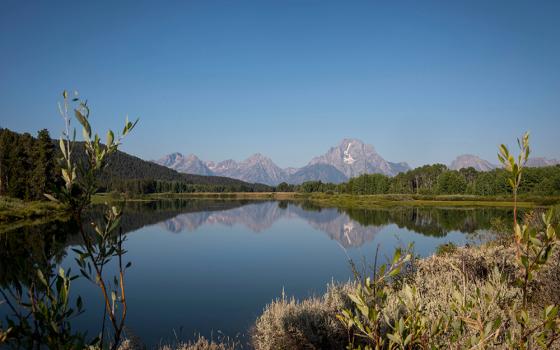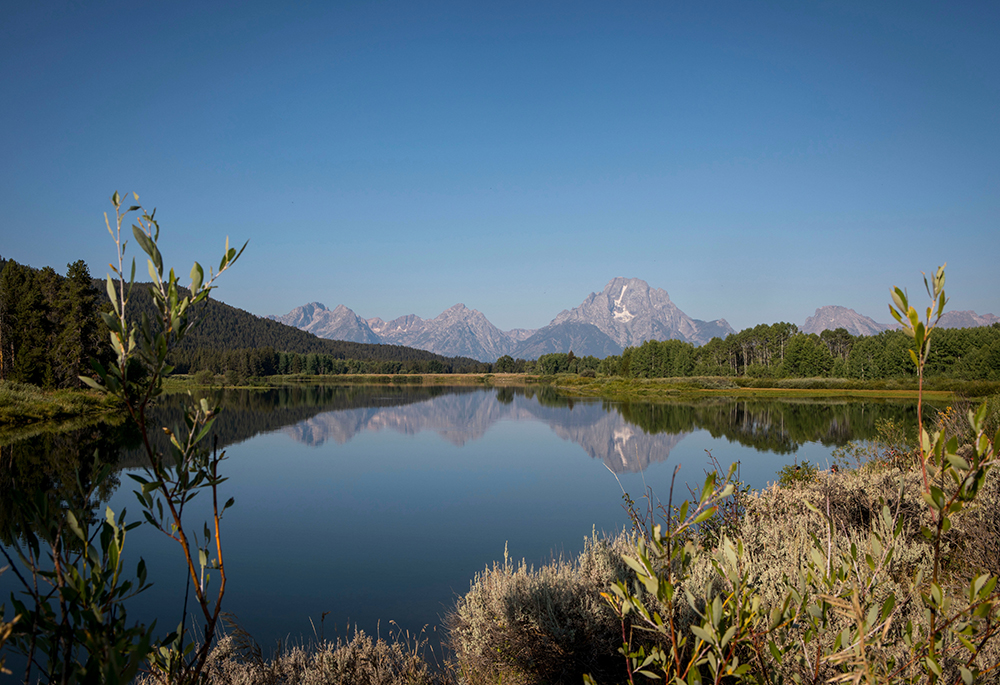
The Teton mountains reflect on Oxbow Bend in Grand Teton National Park in Moran, Wyoming, Aug. 22, 2025. (AP photo/Amber Baesler, File)

by Stephanie J. Peddicord
Join the Conversation
Send your thoughts to Letters to the Editor. Learn more
More than a decade ago, Pope Francis issued an ominous warning to the world's Catholics: "If we approach nature and the environment without this openness to awe and wonder , if we no longer speak the language of fraternity and beauty in our relationship with the world, our attitude will be that of masters, consumers, ruthless exploiters, unable to set limits on [our] immediate needs" (Laudato Si, 11).
I thought about these words a lot this summer as my family and I traveled across the American West, and again as I was putting the final touches on this article. But when I got an alert on my phone: "Trump administration considers building baseball park in Grand Teton National Park," it was as if Francis were sitting next to me, shaking his head in disapproval.
One of our family stops was in the Grand Tetons. If you've never been, they are as majestic as the name suggests: towering mountain peaks overlooking crystal clear lakes, pristine trails and abundant wildlife. I imagine them as exactly the kind of place St. Augustine had in mind when he wrote, "Look above you! Look below you! … God, whom you want to discover, never wrote that book with ink. Instead, He set before your eyes the things that He had made."
The thought of a baseball stadium being built in that sacred space — the bulldozers, the noise pollution, the destruction of the delicate ecosystem! — triggered an immediate, visceral reaction in my gut — and in my soul.
The National Park Service, or NPS, has been in the administration's crosshairs for some time. Since January 2025, the Department of Government Efficiency, or DOGE, has cut roughly one-quarter of the NPS workforce (over 4,000 positions), and the administration has slashed millions from its operating budget. These cuts have left the parks short-staffed and devastatingly under-resourced, leading to problems ranging from traffic congestion and unsanitary bathrooms to unsafe trail conditions.
Our family experienced all of this firsthand. At one point, my son and I approached a ranger for advice on where and when it would be best to spot a moose. She began sketching a route on the map in front of us, but got distracted by the exaggerated, exasperated sighing of the couple in line behind us. When I asked roughly how long the round trip would be, she grimaced and shut her eyes before responding, "Sorry, it's been a really long day." It was 8 a.m.
These concerns don't even account for the backlog of needed park repairs that the Trump administration postponed indefinitely — things like safety precautions (i.e., guardrails on dangerous roads) and experience "enhancements" (i.e., shuttle bus service). Not to mention the diversion of additional NPS funds — up to 30% of park entrance revenue — to fund administration priorities like D.C. projects and America 250 celebrations.
The situation continues to escalate. Two new proposals would allow for private road projects through both Yosemite in California and Gates of the Arctic in Alaska. Both cases would be unprecedented since the National Park Service's inception in the early 1900s, opening Pandora's box for private development and corporate interests. Potential immediate risks include irreversible ecological damage. Long-term? These places will be overrun by individuals and entities who prioritize profit over all else.
Entities, for instance, that would propose building a baseball stadium in the Grand Tetons.
"Laudato Si', on Care for Our Common Home" centered our collective Catholic imagination on what Pope Francis felt was the defining issue of a generation. And while it was technically about ecological justice, he was really calling us to be vigilant about so much more: a world that prioritizes self-interest over community, chooses profit over humanity, and treats God's creation as a commodity.
So, too, is this issue with the National Park Service. Because while the parks are in today's immediate purview, they are just the tip of a deep iceberg covering any number of ecological sins: international climate withdrawals, unregulated AI data center construction, and rollbacks in air quality and fuel efficiency standards, to name a few.
More than 11 years later, it is eerie how prophetic Pope Francis was. The actions by the "masters, consumers, and ruthless exploiters" of this administration have made and continue to make it clear that nothing is sacred so long as it can be bought, sold, packaged, commodified or profited from.
Advertisement
This is, in part, what makes this National Park Service issue for me a specifically Catholic one.
Here's the other part.
Despite my love for them, I am not naive about the national parks' complex history. Much of the land that is now "protected" was once taken — violently and with impunity — from Indigenous communities. Grand Teton National Park alone recognizes 24 tribes with spiritual and cultural ties to its landscape, all of whom were forced out through a combination of westward expansion, governmental treaties and military pressure. In fact, virtually all of the 574 federally recognized Indian tribes were displaced from lands that are now managed as parks, monuments, or preserves.
As Pope Francis often acknowledged, Catholics played a significant role in this subjugation across the Americas and other parts of the world. In fact, my family heard first-hand testimony about the negative impact of Catholic missionaries on the Blackfoot people in Northwestern Montana — a legacy that includes family separation, abuse and cultural eradication. Inspired by Pope Francis' request for forgiveness for those actions on behalf of the church I too offered land acknowledgment as we traversed historically native lands.
Rather than wallowing in a past that could not — and should not — be erased, Francis implored present-day Catholics to look to the other side of history as a blueprint for action. I would argue that this moment of reckoning with the National Park Service is a brilliant opportunity to do this — a time to offer repair and stand in solidarity where previous generations failed.
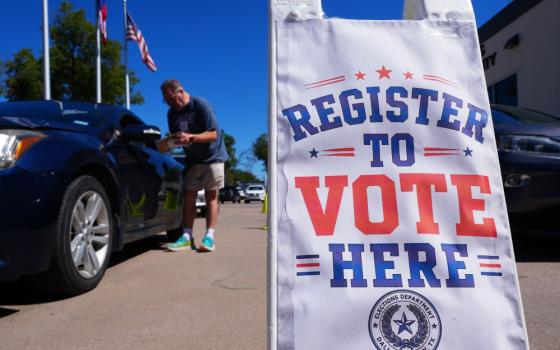
As Catholics, this is our special privilege and obligation — and what better time than the upcoming midterm elections to make our voices known? If your federal representatives are up for reelection, hold them accountable for their budget votes — not only on the National Park Service but also on other environmental issues.
Ask challenging questions about what they have/have not done to address misappropriated resources. Demand action that will safeguard vulnerable neighborhoods from data center construction and other encroachments. Get proactive commitments rather than reactive platitudes. At the state and municipal levels, learn about what is closest to you in terms of regional protected spaces. Large parks are just one part of a much larger, more robust system of forests, monuments, memorials and other intentionally designated treasures. State and county resources are just as vulnerable as national ones, and federal decisions often ripple down to our front doors. Ask if your reps have been faithful to the needs of your communities or paid lobbyists.
If not, you know what to do.
May the wisdom of Laudato Si' empower us as we head to the polls. Pope Francis, pray for us!